Physical Address
304 North Cardinal St.
Dorchester Center, MA 02124
Physical Address
304 North Cardinal St.
Dorchester Center, MA 02124


The Pentagon just placed one of its biggest missile orders of the year. On Thursday, RTX’s Raytheon unit won a contract worth up to $6.3 billion to build and maintain SM-3 Block IB interceptors, the missiles U.S. Navy ships use to shoot down incoming ballistic missiles (Naval Technology).
The timing isn’t a coincidence. The Pentagon has been racing to refill its stockpiles after months of fighting tied to the Iran conflict. The Congressional Budget Office estimated the fighting had cost the Pentagon about $38 billion through August 1, including replacing the munitions used up (Benzinga).
So here’s the obvious question for investors: with war, record orders and a soaring defense budget, why have defense stocks been falling? And are they a smart bet now? Let’s break it down.
The contract covers production and support of SM-3 Block IB interceptors over five years, with options for two more. The work will happen at Raytheon’s plants in Tucson, Arizona, and Huntsville, Alabama.
The SM-3 is a ship- and land-based interceptor built to hit short- to intermediate-range ballistic missiles while they’re still in mid-flight. Think of it as a missile designed to destroy another missile. It’s part of the Navy’s Aegis missile defense system, and Raytheon says the Block IB version was first used in combat in 2024.
This deal builds on earlier moves. In February, the Pentagon signed agreements to urgently restock missile defense supplies. In August, it set up seven-year framework deals with Boeing and RTX to ramp up production of key SM-3 parts.
Most Pentagon contracts are funded one year at a time. A multi-year contract commits to buying over several years.
That matters for two reasons. First, it gives the contractor confidence to invest in factories, hire workers and order parts in bulk, which usually lowers the price per missile. Second, it gives investors something they love: predictable revenue far into the future.
As the Pentagon’s acquisition chief put it, the contract “provides production certainty to our defence industrial base.” For a stock, certainty is worth a lot.
Defense contractors have only one major customer for their weapons: governments, mostly the U.S. government. That makes the business very different from selling phones or software.
You’d expect war and record orders to send defense stocks soaring. Recently, the opposite has happened.
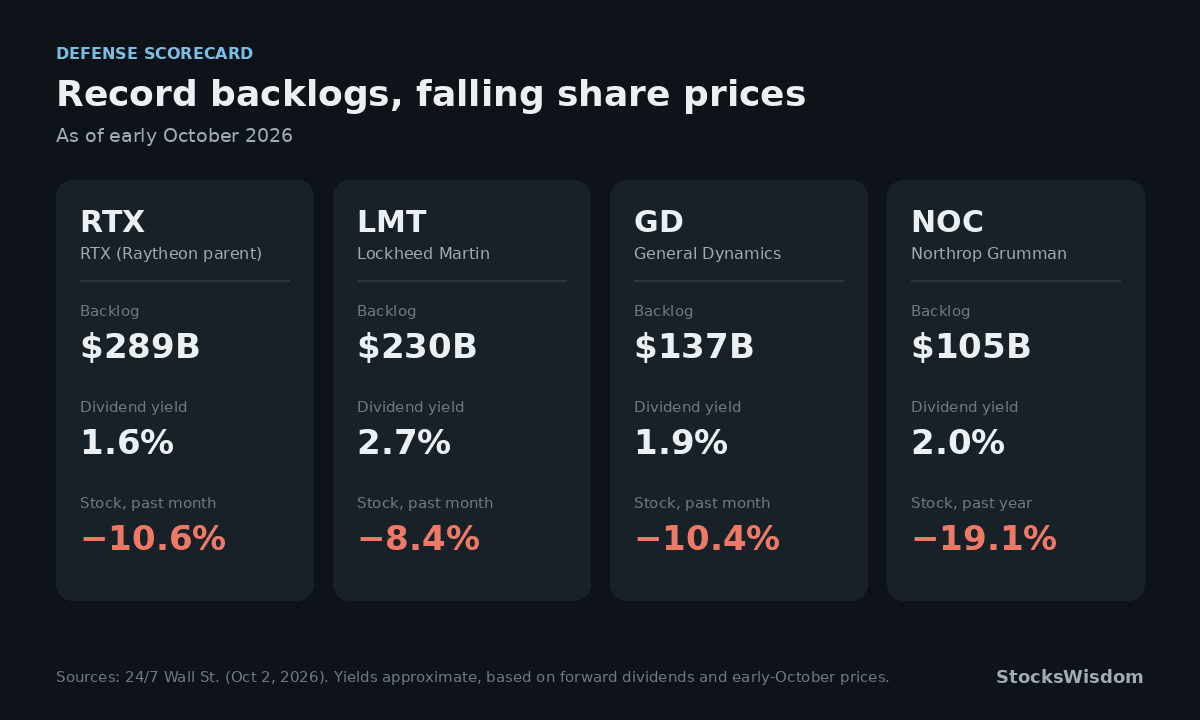
As of early October, according to 24/7 Wall St.:
At the same time, backlogs sit at or near records: about $289 billion at RTX, $230 billion at Lockheed, $137 billion at General Dynamics and $105 billion at Northrop.
The scorecard below puts the four side by side.
Why the disconnect? A few possible reasons:
Here’s a detail many investors miss. RTX isn’t only Raytheon. It also owns Pratt & Whitney, which makes jet engines, and Collins Aerospace, which makes airplane parts and systems.
A large share of RTX’s backlog comes from commercial aerospace, not missiles. That means RTX moves with airline demand and the jet engine market as much as with the Pentagon. If you’re buying RTX purely as a war trade, you’re also buying a big bet on commercial aviation.
Defense stocks are steady dividend payers, and all four have a long record of raising their payouts. Based on early-October prices, approximate yields were about 2.7% for Lockheed, 2.0% for Northrop, 1.9% for General Dynamics and 1.6% for RTX.
Those yields aren’t huge, but the dividends are backed by long-term government contracts. For income investors who want something less tied to the economic cycle, that’s part of the appeal.
The case for: governments around the world are spending more on defense, stockpiles need years of rebuilding, and multi-year contracts like this one lock in revenue. Backlogs are at records, and the recent pullback makes valuations less stretched than they were.
The case against: a ceasefire could cool the urgency, budgets are political, fixed-price contracts can blow up, and some investors avoid weapons makers for ethical reasons, which can limit demand for the stocks.
A practical approach: if you want exposure, consider a defense ETF instead of a single stock. Funds that hold a basket of aerospace and defense companies spread out the contract and execution risk. And size it as a slice of your portfolio, not a bet on how a war plays out.
To compare how RTX, Lockheed, Northrop and General Dynamics are trending, StocksWisdom shows each stock’s sentiment, technical signals and 30-day forecast in one place.
Often at the start, but not always for long. Markets tend to price in higher spending early. Once the news is widely known, stocks can fall even as orders keep coming, which is what has happened recently.
It’s a contract where the government commits to buying a product over several years instead of one year at a time. It usually lowers the cost per unit and gives the contractor more predictable revenue.
RTX is a large, diversified company with a long dividend record, which makes it less risky than smaller defense names. But it’s tied to both defense budgets and commercial aviation, so it can still swing. Beginners may prefer a broad defense ETF.
The $6.3 billion contract shows the Pentagon plans to keep buying for years. Whether the stocks follow depends on what’s already in the price. Would you add defense stocks here, or wait to see how the Iran talks play out?
Not financial advice. Do your own research.