Physical Address
304 North Cardinal St.
Dorchester Center, MA 02124
Physical Address
304 North Cardinal St.
Dorchester Center, MA 02124


Telecom stocks are supposed to be boring. On Friday they weren’t. T-Mobile fell about 13%, AT&T about 10% and Verizon about 10%, its steepest one-day drop since 2002 (Quartz).
The cause was a single announcement from SpaceX. Late Thursday, Elon Musk’s company said it agreed to buy a nationwide block of low-band wireless spectrum, a key piece it needs to turn Starlink into a real U.S. mobile carrier.
If you own any of the big three carriers, or a dividend fund that holds them, here’s what happened, why the market reacted so strongly and how worried you should actually be.
| Stock | Friday close | One-day move | Trading volume |
|---|---|---|---|
| Verizon (VZ) | $41.65 | about −9% to −10% | roughly 4x normal |
| AT&T (T) | $22.17 | about −9.8% | roughly 3x normal |
| T-Mobile (TMUS) | not reported | about −13% | heavy |
Sources: The Motley Fool on Verizon and AT&T, and Quartz. Reports differ slightly on Verizon’s exact percentage.
Volume tells you as much as price here. When several times the usual number of shares change hands, it usually means big funds are repositioning, not just individual investors reacting to headlines.
SpaceX is buying a nationwide 800 MHz spectrum portfolio from Grain Management, a private investment firm. It includes up to 14 MHz of paired licenses. The companies didn’t disclose a price, though The Wall Street Journal reported about $8 billion in cash (Forbes). The deal still needs approval from the Federal Communications Commission.
Spectrum is the set of radio frequencies wireless signals travel on. Carriers pay billions for it because you can’t run a cell network without it. Low-band spectrum, like 800 MHz, is especially valuable because the signal travels far and passes through walls well. Most phones already in people’s pockets support the band.
That matters because satellites have one big weakness: they struggle to reach phones indoors. T-Mobile’s chief technology officer has noted that more than 70% of mobile traffic happens inside buildings (Axios). Low-band spectrum is SpaceX’s attempt to close that gap.
This isn’t a one-off. The timeline below shows how the pieces have come together.
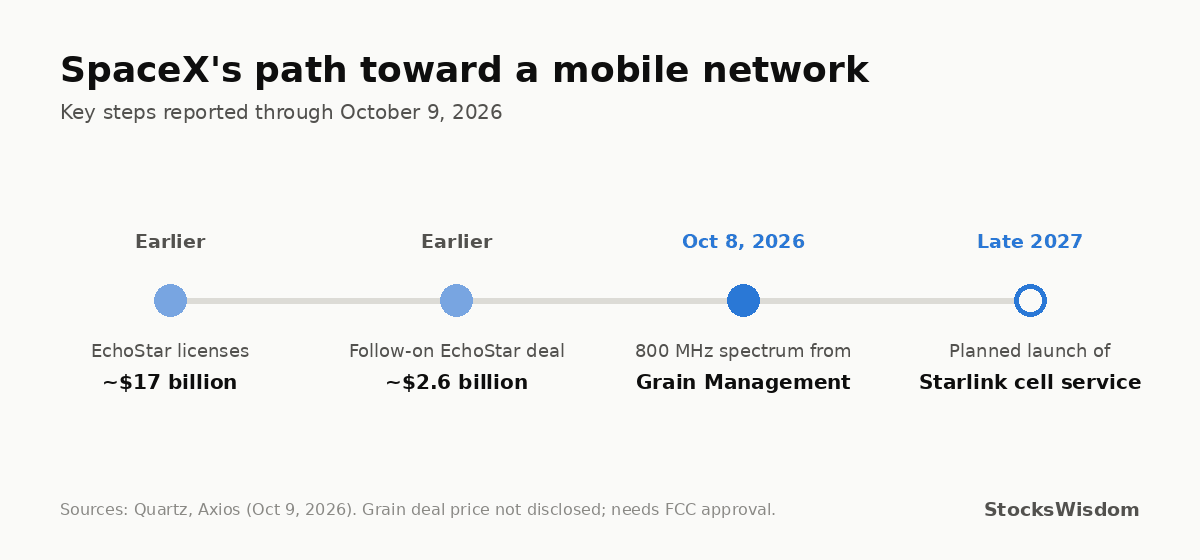
SpaceX already bought 2 GHz wireless licenses from EchoStar worth roughly $17 billion, plus a follow-on EchoStar deal worth $2.6 billion. The FCC has also approved up to 15,000 next-generation Starlink Mobile satellites, which SpaceX says will offer more than 100 times the bandwidth of its current generation. Starlink had about 12 million subscribers in 205 countries as of June 30.
SpaceX isn’t planning to copy Verizon tower for tower. According to Axios, its plan is to install small cellular base stations next to Starlink dishes on homes and businesses. Each one would act like a mini cell site, with the satellite dish providing the internet connection behind it.
In theory, that lets SpaceX cover huge areas without spending decades building towers. Satellites would handle remote areas, and the small cells plus low-band spectrum would handle homes and buildings. Service is planned for late 2027.
There’s an irony here. T-Mobile already partners with SpaceX to offer satellite texting in dead zones. The company that helped Starlink reach phones now faces it as a potential rival.
The U.S. wireless business has been a comfortable three-player market for years. Verizon, AT&T and T-Mobile compete, but none has had to worry about a well-funded newcomer that can undercut prices.
SpaceX changes that picture. It has huge resources, an existing customer base, satellite coverage nobody else has, and a CEO known for going after established industries. Investors reacted to the possibility of:
At least one analyst trimmed expectations right away. Scotiabank lowered its Verizon price target to $50 from $51.50, while keeping a positive rating on the stock.
There are strong arguments on the other side.
The FCC chair said the agency won’t pick winners and losers, and that more than $100 billion of spectrum could come to market over the next two years. More spectrum could help newcomers, but it also gives the existing carriers room to expand.
Telecom stocks are often treated like bonds with a stock ticker: buy them for the yield and stop worrying. Friday showed the risk in that approach.
A high dividend yield is partly the market’s way of pricing risk. When a business faces a credible new competitor, the stock can fall far more in one day than the dividend pays in a year. A 5% yield doesn’t help much after a 10% drop.
That doesn’t make these bad stocks to own. It means you should own them for the right reasons. Look at payout ratios, debt levels and whether free cash flow covers the dividend, and don’t let any single high-yield stock become too large a slice of your portfolio.
If you own Verizon, AT&T or T-Mobile for dividends: one day’s drop doesn’t change this quarter’s payout. Watch what each company says on its upcoming earnings call about competition, pricing and spending. Verizon reports on October 26.
If you’re thinking of buying the dip: you’re betting the market overreacted. That might be right, but competition fears can weigh on a stock for months. There’s no rush, and buying in a few pieces lowers the risk of bad timing.
If you own an index fund: this barely moves your portfolio. Telecom is a small slice of the S&P 500.
To see whether sentiment on VZ, T or TMUS keeps falling or starts to recover in the coming weeks, StocksWisdom tracks each stock’s news sentiment and 30-day forecast in one place.
Not anytime soon. Service is planned for late 2027 at the earliest, the deal needs FCC approval, and SpaceX hasn’t announced prices, phones or launch markets.
Friday’s selloff doesn’t change Verizon’s current cash flow, so nothing about the dividend changes overnight. The long-term risk is if competition forces price cuts that shrink profits. Watch the October 26 earnings call for comments on pricing and customer losses.
Reports didn’t give one clear reason. T-Mobile has grown by winning price-sensitive customers, and those are the customers a new low-cost competitor would likely target first.
Friday was a reminder that even “safe” stocks carry disruption risk. Do you think SpaceX can really take customers from the big three, or is this another overreaction?
Not financial advice. Do your own research.