Physical Address
304 North Cardinal St.
Dorchester Center, MA 02124
Physical Address
304 North Cardinal St.
Dorchester Center, MA 02124


If you own a mutual fund in a regular brokerage account, you might get a tax bill in December for gains you never sold. Fund companies are already posting their estimates. Capital Group’s 2026 year-end distribution estimates show some of its stock funds expect to pay out capital gains worth 8% to 25% of each share’s value, with record dates between December 11 and December 31.
ETF owners mostly skip that headache. In 2025, just 6% of equity ETFs paid a capital gains distribution, compared with 57% of equity mutual funds, according to Morningstar data cited by State Street.
That gap is one big reason money keeps pouring into ETFs. But it’s not the whole story, and mutual funds still make sense for plenty of people. Here’s how the two actually differ, and how to pick.
Both are baskets. You buy one share and you own a slice of dozens or thousands of stocks or bonds. Both can track an index like the S&P 500 or be run by a manager picking investments. Most of both are regulated under the same 1940 law and file the same kinds of reports with the SEC.
So the difference isn’t what’s inside. It’s the wrapper. How you buy it, what you pay, and how it gets taxed.
A mutual fund trades once a day. You place an order whenever you like, and it fills at the closing price (called the net asset value, or NAV) after the market shuts at 4 p.m. Eastern. You don’t know your exact price when you click buy.
An ETF trades on an exchange like a stock. You see a live price, you can use limit orders, and you can buy or sell at 10:15 a.m. if you want.
For long-term investors, that intraday trading barely matters. It can even hurt, because it tempts people to tinker. Mutual funds have one quiet advantage here: they’re great for automatic investing. You can set up $100 a month into a fund and it buys fractional shares like clockwork. Many brokers now offer fractional ETF shares and automatic ETF purchases too, but not all of them.
ETFs have a reputation for being cheaper, and on average they are. The Investment Company Institute reports these asset-weighted average expense ratios for 2025:
| Fund type | Average expense ratio (2025) | Yearly cost on $10,000 |
|---|---|---|
| Equity mutual funds | 0.40% | $40 |
| Bond mutual funds | 0.36% | $36 |
| Index equity ETFs | 0.14% | $14 |
| Index bond ETFs | 0.09% | $9 |
A quarter of a percentage point sounds tiny. Over time it isn’t. Put $10,000 in a fund earning 7% a year before fees and leave it for 20 years. At a 0.40% fee you’d end up with about $35,900. At 0.14% you’d have about $37,700. That’s roughly $1,800 more for doing nothing different.
There’s a catch in that table, though. The mutual fund average includes a lot of actively managed funds, which charge more. An index mutual fund from a low-cost provider can cost the same as its ETF twin. Vanguard, Fidelity and Schwab all sell S&P 500 index mutual funds with fees in the same range as the cheapest ETFs.
So compare specific funds, not categories. Look up the expense ratio on any fund before you buy. Also check for sales loads (a fee of up to several percent just to get in) and 12b-1 fees, which mostly show up in mutual funds sold through advisers.
This is the part most people never hear about until they get a 1099 in February.
When investors pull money out of a mutual fund, the manager often has to sell stocks to raise cash. If those stocks went up, the fund books a gain. By law, it has to pass those gains to everyone still holding shares, usually once a year in December. You owe tax on that distribution even if you reinvested it and never sold a single share.
ETFs mostly avoid this through something called in-kind redemptions. When big traders cash out of an ETF, the fund hands them a bundle of stocks instead of selling for cash. As Vanguard explains, those in-kind transactions aren’t taxable events, so the fund can quietly shed its lowest-cost shares without triggering a gain for the people who stay.
The graphic below shows how often each type paid out a capital gain to shareholders last year.
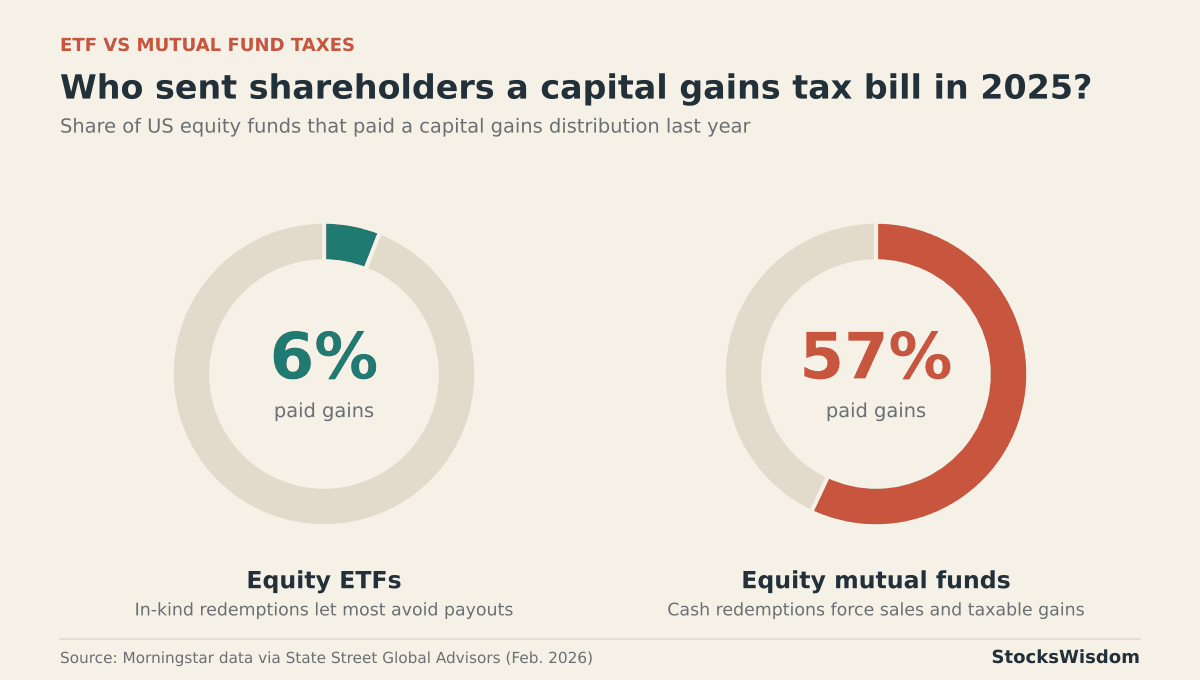
Here’s what that can cost. Say you hold $50,000 in a stock mutual fund that distributes 8% as long-term gains. That’s $4,000 of taxable income. At a 15% capital gains rate, you’d owe $600, and you didn’t choose when.
Two important exceptions. First, none of this matters inside a 401(k), IRA or Roth IRA, because those accounts don’t pay tax on distributions. Second, ETFs aren’t magic. Some still pay gains, especially niche or bond ETFs and ones that use derivatives, and you’ll owe tax on dividends from both types either way.
The line between the two is starting to blur. In November 2025, the SEC granted Dimensional Fund Advisors permission to add ETF share classes to existing mutual funds, and Seward & Kissel noted that the order cleared the way for similar applications from other firms. In March 2026, Dimensional listed the first actively managed ETF share class, the US Micro Cap ETF (DFMC).
For you, this means some familiar mutual funds may soon offer an ETF version of the same portfolio. Vanguard held a patent on this structure for about 20 years, which is why it was rare until now.
There’s no universal winner. Here’s a quick way to think about it.
Lean toward ETFs if you invest in a taxable brokerage account, want the lowest possible costs, or like seeing a live price before you trade.
Mutual funds are fine (or better) if you invest mostly through a 401(k), where they’re often the only choice, you want hands-off automatic contributions in round dollar amounts, or you already own a low-cost index fund with a fee under 0.10%.
Don’t sell a mutual fund just to switch, at least not in a taxable account. Selling could trigger a bigger tax bill today than the distributions you’d avoid later. Point new money at ETFs instead.
And look at the actual holdings, not just the label. Before buying any fund that holds big names like Apple or Nvidia, it can help to check how those stocks look right now. StocksWisdom shows a stock’s sentiment, technical signals and a 30-day forecast, which is a handy gut-check on what you’re getting exposure to.
No. Safety depends on what the fund holds, not the wrapper. An S&P 500 ETF and an S&P 500 mutual fund will rise and fall almost identically.
Yes. If the stocks inside pay dividends, the ETF passes them to you, usually every quarter. Those dividends are taxable in a regular account, just like with a mutual fund.
Sometimes, but most 401(k) plans only offer mutual funds and collective trusts. That’s fine. Taxes on distributions don’t apply inside the account, so the ETF’s biggest advantage disappears.
Do you hold mutual funds in a taxable account, and did a surprise December distribution ever catch you off guard?
Not financial advice. Do your own research.