Physical Address
304 North Cardinal St.
Dorchester Center, MA 02124
Physical Address
304 North Cardinal St.
Dorchester Center, MA 02124

Home Depot did what you’d want a big retailer to do on Tuesday. It beat Wall Street on sales and profit, posted its strongest same-store sales growth in a while, and named a new CEO. Then the stock fell anyway.
Third-quarter sales came in at $43.4 billion, up 4.9% from a year ago, against expectations of roughly $42.8 billion. Adjusted earnings per share were $3.86, a hair above the $3.84 to $3.85 consensus. Comparable sales rose 2.2%, a big step up from 0.2% in the same quarter last year. Shares still closed down 2.4% on a day when the Dow lost more than 800 points.
Why the cold shoulder? Because Home Depot raised its sales forecast and cut its profit-margin forecast at the same time. Investors heard “busier stores, thinner margins,” and in a market already selling off, that was enough.
Here’s the scorecard from the company’s Q3 earnings release, compared with the same quarter a year earlier.
| Metric | Q3 fiscal 2026 | Q3 fiscal 2025 | Change |
|---|---|---|---|
| Net sales | $43.4B | $41.4B | +4.9% |
| Comparable sales | +2.2% | +0.2% | +2.0 pts |
| Comparable transactions | -0.5% | -1.6% | Less negative |
| Average ticket | $93.09 | $90.39 | +3.0% |
| Operating margin | 12.6% | 12.9% | -0.3 pts |
| Adjusted EPS | $3.86 | $3.74 | +3.2% |
Look at the transactions line first. Fewer people actually came through the checkout (comparable transactions fell 0.5%), but each one spent more. The average ticket jumped to $93.09. Some of that is pros buying bigger orders, and some of it is plain old price inflation on lumber, tools and appliances.
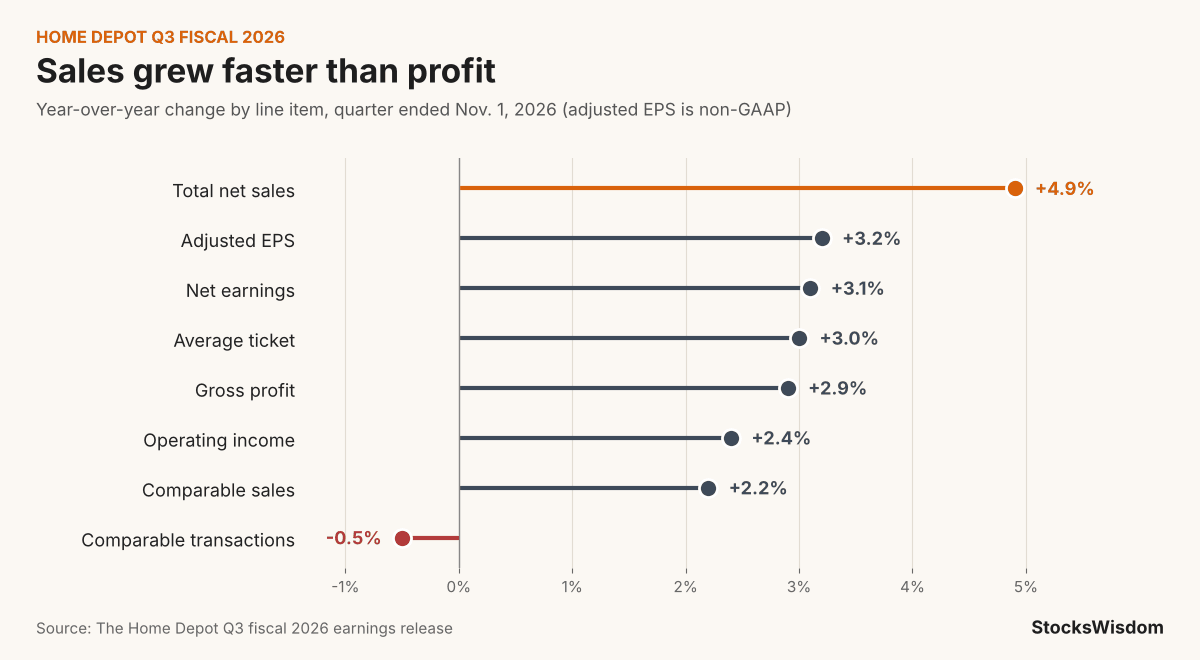
This is the part that spooked traders. Revenue rose 4.9%, but operating income rose only 2.4% and adjusted EPS 3.2%. Gross margin slipped to about 32.8% from 33.4% a year ago, so every dollar of sales kept a little less profit.
Part of the gap comes from acquisitions. Home Depot has been buying up pro-focused distributors like SRS, and those businesses run at lower margins than the orange-apron stores. Amortization tied to acquired intangibles alone was $182 million this quarter, up from $158 million.
Higher input costs matter too. Back in August, the company said tariff refunds would partly offset “unplanned fuel, energy, and other product input costs.” That pressure clearly hasn’t gone away. The chart below shows how each line of Home Depot’s third quarter grew, from top-line sales down to customer traffic.
Compare the new full-year outlook with what the company told investors in August, and the pattern jumps out. Sales went to the top of the old range. Margins went to the bottom.
| Fiscal 2026 guidance | August outlook | November outlook |
|---|---|---|
| Total sales growth | 2.5% to 4.5% | About 4.5% |
| Comparable sales growth | Flat to 2.0% | About 1.4% |
| Gross margin | About 33.1% | About 33.0% |
| Adjusted operating margin | 12.8% to 13.0% | About 12.8% |
| Adjusted EPS growth | Flat to 4.0% | About 2.0% |
A 2% bump on last year’s $14.69 works out to roughly $14.98 in adjusted EPS for the year. Analysts were looking for about $15.05. Since Home Depot has already earned $12.22 through nine months, the math points to about $2.76 for the holiday quarter, which is below what the Street had penciled in.
Seven cents doesn’t sound like much. For a stock that had rallied hard heading into the report, it was plenty.
Ted Decker is handing the top job to Richard McPhail, the company’s longtime CFO, according to CNBC. McPhail starts as CEO on November 23, Decker stays on as chairman, Ann-Marie Campbell becomes president and chief operating officer, and Jordan Broggi steps in as CFO.
“Results in the third quarter exceeded our expectations,” McPhail said in the release.
Wall Street tends to like inside promotions at steady companies. A CFO-turned-CEO knows where every dollar goes, and nobody expects a sudden strategy swerve. The bigger question for McPhail isn’t his own plan. It’s the housing market he’s inheriting.
Home Depot’s fortunes track one thing more than any other: people buying, selling and fixing up homes. And that market is stuck.
On the same morning Home Depot reported, the NAHB/Wells Fargo builder sentiment index fell four points to 25, its lowest reading since 2012. Nearly half of builders (46%) said they cut prices this month, the highest share since the pandemic.
Mortgage rates are a big reason. The 30-year fixed rate averaged 7.11% last week, per Freddie Mac. That’s down for four straight weeks, but still well above the 6.24% of a year ago. Hot inflation readings, which we broke down in our October CPI recap and October PPI recap, aren’t helping rates come down.
When people don’t move, they don’t buy new flooring, new appliances or a new kitchen. That’s why Home Depot’s comps of 2.2% look good next to last year and still modest next to the boom years.
If you own Home Depot, Tuesday’s drop says more about expectations than about the business. Sales are growing, the dividend keeps getting paid (the company has handed out nearly $7 billion in cash dividends so far this year), and management just raised its sales outlook. What changed is the profit picture for the next few months.
If you’re a homeowner, the same forces squeezing Home Depot’s margins are squeezing your project budget. A 3% rise in the average ticket means the same cart of stuff costs more than last year. Getting a few quotes and timing big purchases around holiday promotions makes more sense than usual.
If you’re house hunting, builders cutting prices is a small silver lining. With 46% of them trimming prices, there’s room to negotiate on new construction, even with rates above 7%.
And if you’re just watching from the sidelines, Home Depot is a useful read on the housing economy. Before you trade on one earnings day, it helps to check a stock’s sentiment, technical signals and 30-day forecast on StocksWisdom so you’re not reacting to a single headline.
Yes. Sales of $43.4 billion and adjusted EPS of $3.86 both topped analyst estimates. The stock fell because full-year profit guidance implied a weaker fourth quarter than Wall Street expected.
Richard McPhail, the company’s CFO, becomes CEO on November 23, 2026. Ted Decker remains chairman of the board.
Home sales drive renovation spending. With the 30-year mortgage rate above 7%, fewer people are moving, and fewer moves mean fewer big remodeling projects.
Would you buy Home Depot on this dip, or wait until the housing market thaws? Tell us in the comments.
Not financial advice. Do your own research.