Physical Address
304 North Cardinal St.
Dorchester Center, MA 02124
Physical Address
304 North Cardinal St.
Dorchester Center, MA 02124

October ended ugly. On Friday the S&P 500 fell 1.8% to 7,580 and the Nasdaq dropped 2.9%, capping the Nasdaq’s worst month since March 2025 with a loss of about 5.2%, according to Yahoo Finance. Intel had its worst day in decades, Amazon’s cash burn spooked people, and talk of a December rate hike got louder.
So if you’re sitting on a pile of cash right now (a bonus, an inheritance, a rollover from an old 401(k), money from a house sale), you’re probably asking the classic question. Do you put it all in today, or feed it in a little at a time?
That’s the dollar-cost averaging vs lump sum debate. And the research on it is clearer than most people expect.
Lump sum investing is simple. You have $50,000, you buy $50,000 of your index fund today, done.
Dollar-cost averaging (DCA) means splitting that same $50,000 into equal chunks and investing them on a schedule. Maybe $10,000 a month for five months, or $4,167 a month for a year. When prices fall, each chunk buys more shares. When prices rise, each chunk buys fewer.
One thing to clear up first. If you put part of every paycheck into a 401(k), you’re dollar-cost averaging, but not by choice. You don’t have the money yet. That kind of DCA is just how saving works, and nobody argues against it. Today’s question is only about money you already have in hand.
Vanguard has studied this twice. Its 2012 study looked at the US, the UK and Australia and found that investing a lump sum right away beat spreading it out about two-thirds of the time, as BenefitsPRO summarized it.
A 2023 follow-up, Cost averaging: Invest now or temporarily hold your cash?, used global stock data going back to 1976. Lump sum beat a three-month DCA plan 68% of the time for an all-stock portfolio. Results by country ranged from about 62% (emerging markets) to about 68% (the UK).
Here’s what that looked like for a $100,000 investment after one year, using Vanguard’s median outcomes:
| Portfolio | Lump sum | 3-month DCA | Lump sum edge |
|---|---|---|---|
| 100% stocks | $111,940 | $109,580 | about 2.2% |
| 60% stocks, 40% bonds | $109,360 | $107,453 | about 1.8% |
| 40% stocks, 60% bonds | $107,648 | $106,400 | about 1.2% |
Why does lump sum win so often? Because markets go up more often than they go down. Every month your cash waits on the sidelines is a month it’s likely missing gains. DCA isn’t magic. It’s mostly a delay.
DCA wins in one situation: when the market drops soon after you would have invested.
Vanguard’s numbers show it. In a bad year (the 5th percentile outcome), $100,000 put into stocks all at once fell to $82,947, while the three-month DCA plan ended at $85,906. That’s almost $3,000 of damage avoided.
That’s the trade. DCA gives up a little expected return in most years to soften the blow in the worst ones. It works like insurance, and insurance has a cost.
It also helps to know that DCA still beats doing nothing. Vanguard found that cost averaging beat simply holding cash 69% of the time. If spreading your money out is the only way you’ll actually invest it, it’s a far better choice than waiting for a “perfect” moment.
Charles Schwab ran a well-known study that puts this into real dollars. Five imaginary investors each got $2,000 at the start of every year from 2005 through 2024. One invested on day one. One split it into 12 monthly buys. One had perfect timing and bought at each year’s low. One had awful timing and bought at each year’s high. And one stayed in Treasury bills, waiting for a better moment that never came.
Results from Schwab’s “Does Market Timing Work?” are striking. Investing right away left Ashley with $170,555, only about $15,500 behind someone with impossible perfect timing. Monthly DCA came in at $166,591, close behind. Even the worst timer in the group, buying at the peak every single year, finished with about $151,000. Larry, the one who never bought stocks, ended up with $47,357. The chart below shows how all five investors finished.
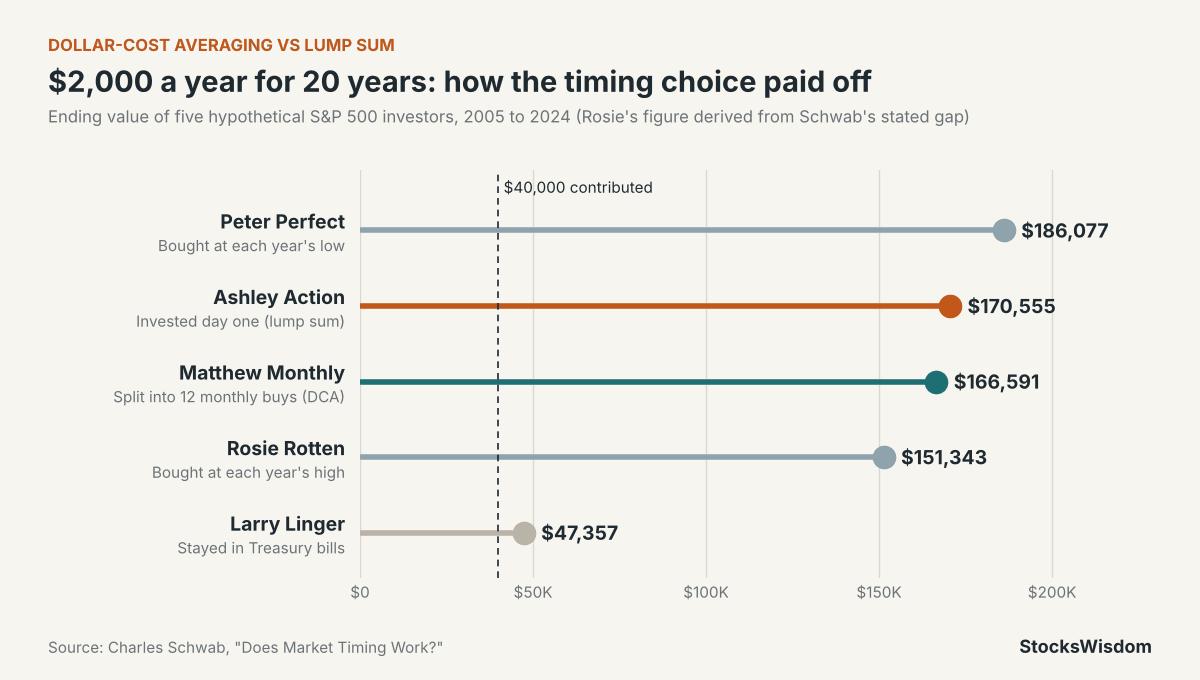
Schwab also checked 80 rolling 20-year periods going back to 1926. Investing immediately never finished last in any of them.
The lesson isn’t really lump sum vs DCA. It’s that being invested matters far more than how you get in.
Because people aren’t spreadsheets.
Picture putting $100,000 into the market on a Thursday, then watching it lose $1,800 the next day, the way Friday’s 1.8% drop would have done. Now picture three more days like that. Plenty of investors would panic and sell. Selling in a panic costs far more than the roughly 2% edge Vanguard measured.
Regret is real. If dropping a big sum all at once would keep you up at night, or if you’d keep putting off the decision until “things calm down,” a DCA plan with a fixed end date is a smart compromise. You get money working, and you get a rule that takes the guessing out of it.
Markets just had a rough month, so the urge to wait is strong. Here’s a practical way to think about it:
A low-cost index fund or ETF is usually the simplest place to put the money either way. We compared the two in our guide to ETF vs mutual fund fees and taxes.
If you’re buying individual stocks instead, it can help to see where a name stands before each purchase. StocksWisdom shows a stock’s sentiment, technical signals and 30-day forecast, which is useful context for a long-term plan. Just don’t let a one-month outlook become an excuse to never start.
And if you’re wondering whether late-year weakness tends to last, our look at whether Q4 is the best quarter for stocks covers what history says.
Usually not. Vanguard found lump sum investing beat a three-month DCA plan about 68% of the time. DCA tends to do better only when the market falls soon after you invest.
Shorter is generally better. Vanguard tested plans of three to six months, and longer plans trailed lump sum by more. Most advisers suggest finishing within a year at most.
History says no. In Schwab’s study, the investor who bought at each year’s peak still ended with more than three times what the cash holder had. Time in the market did the heavy lifting.
Are you a lump sum investor or a DCA person, and did October’s drop change your plan? Let us know in the comments.
Not financial advice. Do your own research.