Physical Address
304 North Cardinal St.
Dorchester Center, MA 02124
Physical Address
304 North Cardinal St.
Dorchester Center, MA 02124

Constellation Energy (CEG) jumped roughly 12% on Tuesday, its best day in a long while, after it signed a 20-year nuclear power deal with Google. The S&P 500 closed at a record the same day, but CEG was the story most investors were talking about.
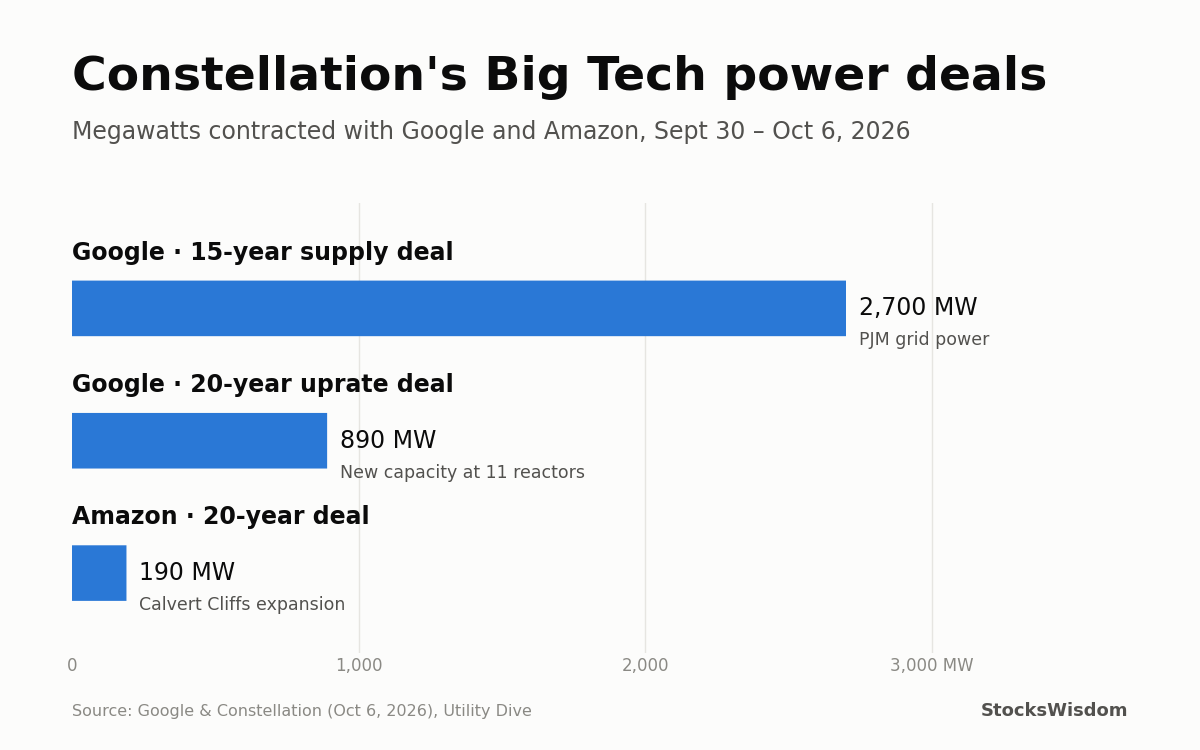
The headline numbers are big: 890 megawatts of new nuclear capacity, a $4.3 billion investment by Constellation, and a second 15-year agreement covering another 2,700 megawatts of power. Here’s what the Constellation Energy Google deal actually includes, why it moved the stock so much, and what to think about before you chase it.
According to the joint announcement, the agreement has three parts:
The first upgraded reactor is expected to come online in 2028. Constellation says the work sustains about 4,400 existing jobs and creates roughly 7,200 construction jobs.
This came one week after a similar deal with Amazon. On September 30, Constellation signed a 20-year agreement to add 190 MW at its Calvert Cliffs plant in Maryland, a $3 billion project expected online between 2030 and 2032 (Utility Dive). Two of the biggest tech companies signed long-term contracts with the same utility in the same week.
Most of the new capacity here comes from uprates, not new reactors. An uprate means upgrading equipment at a plant that already exists (turbines, generators, cooling systems) so it can produce more electricity.
That matters. Building a brand-new reactor in the U.S. has historically taken well over a decade and run far over budget. Uprates use sites that are already licensed, connected to the grid and staffed. They’re smaller. They’re also faster and much less risky.
So when you read “890 MW of new nuclear,” think of it as Constellation squeezing more output out of plants it already owns, with Google guaranteeing it a buyer for 20 years.
Data centers run around the clock, and the AI build-out needs a lot of them. Solar and wind are cheap but don’t produce power 24 hours a day without storage. Natural gas works, but it doesn’t help tech companies hit their clean-energy targets.
Nuclear is one of the few sources that is both carbon-free and always on. That’s why Google, Amazon and Microsoft have all been signing long-term nuclear contracts.
Then there’s supply. Utility Dive reports that PJM, the grid operator covering much of the Mid-Atlantic and Midwest, faces a 6.8 GW capacity shortfall as data center demand climbs. When power is scarce, the companies that own existing plants have pricing power.
A 20-year contract with a buyer like Google gives Constellation something investors pay up for: predictable revenue far into the future. Think of a landlord signing a 20-year lease with the most reliable tenant in town. That’s the main reason the stock jumped. Other power producers such as Vistra and Talen Energy rose too, as the market bet they could land similar deals.
Before you buy, though, keep a few things in mind:
None of that makes the deal bad. Far from it. It means the stock now reflects a lot of good news, and the next leg depends on Constellation delivering on time.
Most people think of the AI trade as chip stocks. Nvidia, AMD, maybe Broadcom. But every chip in a data center needs electricity, and someone has to sell it. Power, cooling and grid equipment are the “picks and shovels” of the build-out, and nuclear producers are one of the clearest examples.
If you’re interested, a few practical steps:
Big Tech is now signing 15- and 20-year power contracts, which suggests it expects AI demand to last. The question for investors is how much of that future the stock already reflects. Would you buy CEG after this jump, or wait for a pullback?
Not financial advice. Do your own research.