Physical Address
304 North Cardinal St.
Dorchester Center, MA 02124
Physical Address
304 North Cardinal St.
Dorchester Center, MA 02124


Inflation just jumped again. Consumer prices rose 3.7% over the past year in September, up from 3.4% in August and above the 3.6% economists expected. Gasoline did most of the damage, with the gas index up 9.1% in a single month (Kiplinger).
Core inflation, which strips out food and energy, came in at 2.6% versus 2.5% expected. That’s the number the Fed watches most closely, and it’s why traders are betting on more rate hikes (FXStreet).
Here’s what that means in plain terms. If your savings earn less than 3.7% a year, you’re losing buying power every month. The good news: in 2026 there are more ways to fight back than there have been in years. Here’s how to protect your portfolio from inflation, step by step.
Inflation is a slow leak. You don’t see it in your account balance, but you feel it at the gas pump and the grocery store.
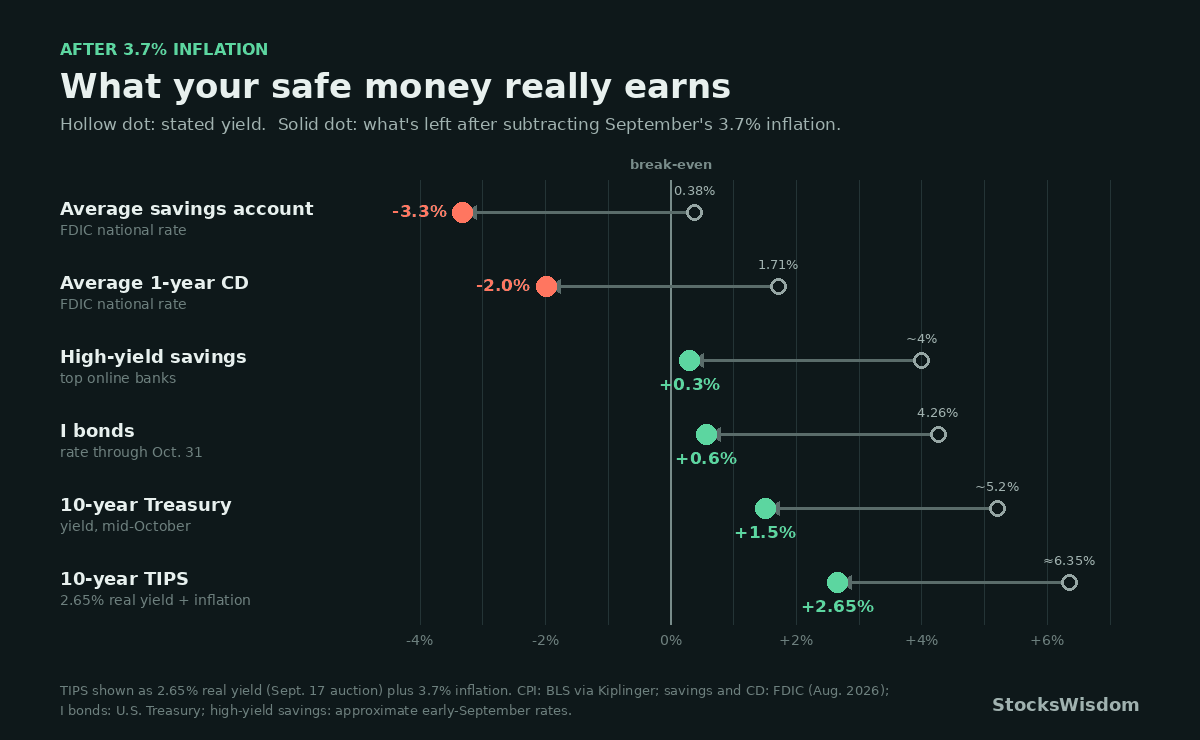
At 3.7% a year, prices double in about 19 years (divide 72 by the inflation rate, a handy shortcut called the rule of 72). A $10,000 emergency fund sitting in an average savings account, which pays just 0.38% according to FDIC data, loses roughly $330 of real buying power in a year (SavingAdvice).
That’s the goal of everything below: make sure each part of your money earns more than inflation takes away.
Start with the easy win. You need cash for emergencies, but it doesn’t have to sit at 0.38%.
High-yield savings accounts at online banks were paying around 4% in early September. Money market funds at most brokerages pay close to the Fed’s benchmark rate, which is now 3.75% to 4.00% after September’s hike. Either one roughly keeps pace with today’s inflation, and both let you get your money out quickly.
Moving $10,000 from a 0.38% account to a 4% account adds about $360 a year. No risk, ten minutes of paperwork.
The chart below shows where common options land once you subtract 3.7% inflation.
Treasury Inflation-Protected Securities, or TIPS, are U.S. government bonds whose principal rises with inflation. If CPI goes up 3.7%, the value your interest is calculated on goes up too.
What makes TIPS interesting right now is the “real yield,” the return you lock in above inflation. At the September 17 auction, the 10-year TIPS sold with a real yield of 2.653%, the highest for that term since October 2008 (Tipswatch).
Put simply, you’d earn inflation plus about 2.65% a year for a decade, backed by the U.S. government. Savers haven’t been offered that in nearly 18 years.
A few things to know:
Series I savings bonds are the simplest inflation hedge out there. Their rate has two parts: a fixed rate that stays with the bond for life, plus an inflation rate that resets every six months.
I bonds bought through October 31 earn 4.26% a year, made up of a 0.90% fixed rate plus the inflation piece (Yahoo Finance). The rate resets for new purchases on November 1.
The catches:
For a chunk of savings you won’t need for a while, I bonds are hard to beat for safety.
Bonds protect what you have. Stocks are how you grow ahead of inflation over long periods, because companies can raise prices and grow earnings along with them.
Not every company can do that equally. The ones that tend to hold up best:
Companies with pricing power. Strong brands and essential products can pass higher costs to customers without losing them.
Dividend growers. A company that raises its dividend every year gives you a rising income stream that can keep up with the cost of living.
Energy producers. When gas prices drive inflation, as they did this month, energy companies often benefit directly. U.S. crude rose about 58% this year through September, and energy was the best-performing sector in the third quarter (First Financial Trust). The flip side: energy stocks fall hard when oil does.
If you’re weighing specific names, StocksWisdom shows each stock’s sentiment, technical signals and 30-day forecast, which helps you check whether a so-called inflation winner is still in an uptrend.
Gold has a reputation as the ultimate inflation hedge. This year shows why that’s not a sure thing.
Even with inflation running well above the Fed’s 2% target, gold fell 6.9% in September and was down about 3.1% for 2026 through the end of the month. It can be a useful diversifier in small doses, but it doesn’t pay interest and it doesn’t track CPI month to month.
| Tool | What it pays now | The catch |
|---|---|---|
| High-yield savings | Around 4% | Rate can drop if the Fed cuts |
| Money market fund | Close to the 3.75% to 4.00% Fed rate | Not FDIC insured (fund, not a bank) |
| I bonds | 4.26% through Oct. 31 | $10,000 yearly limit, locked 12 months |
| 10-year TIPS | 2.65% above inflation (Sept. auction) | Price can fall if real yields rise |
| Energy stocks | Varies | Swing with oil prices |
| Gold | No yield | Down about 3% in 2026 through September |
Going all in on one hedge. Each tool covers a different risk. A mix of cash, TIPS or I bonds, and stocks holds up better than betting everything on gold or oil.
Locking up money you’ll need soon. Inflation protection doesn’t help if you’re forced to sell at a loss to cover rent.
Ignoring long-term bond risk. Regular long-term bonds lose value when rates climb. The 10-year Treasury yield rose about 85 basis points in the third quarter alone.
There’s no single best tool. For safe money, TIPS and I bonds adjust directly with inflation. For long-term growth, a diversified mix of stocks has historically outpaced inflation over long periods.
For savings you won’t touch for at least a year, yes, they’re worth a look. They pay 4.26% through October 31 with a 0.90% fixed rate that lasts the life of the bond, and they’re backed by the U.S. government.
Mostly gasoline. The gas index jumped 9.1% in the month and made up more than half of the overall increase. Shelter, airfares and used cars also rose.
Inflation at 3.7% isn’t a crisis, but it quietly punishes anyone sitting still. Which step are you taking first: upgrading your cash, buying TIPS or I bonds, or rethinking your stock mix?
Not financial advice. Do your own research.