Physical Address
304 North Cardinal St.
Dorchester Center, MA 02124
Physical Address
304 North Cardinal St.
Dorchester Center, MA 02124


You can put $7,500 into an IRA for 2026, or $8,600 if you’re 50 or older. That’s the easy part. The harder question is which kind: a Roth IRA, where you pay tax now and never again, or a traditional IRA, where you get a deduction today and pay tax when you pull the money out.
Pick wrong and you don’t lose everything. You just hand the IRS a bigger slice than you needed to, every year, for decades. On a single $10,000 slice of salary invested for 30 years, our example below shows a swing of more than $15,000 depending on when you pay the tax.
So let’s make the choice less of a guess. Here’s how each account works under the 2026 rules, who can use which, and the one question that decides most cases.
A Roth IRA takes money you’ve already paid tax on. There’s no deduction when you put it in. In exchange, the growth is tax-free, and qualified withdrawals in retirement are tax-free too.
Two rules make Roths friendlier than people expect. First, you can take out your original contributions at any time, for any reason, with no tax and no penalty. Only the earnings are locked up. Second, there are no required minimum distributions during your lifetime, so the money can keep compounding as long as you like.
To pull earnings out tax-free, you generally need to be 59½ and have had a Roth open for at least five years, according to Capital Group’s IRA comparison. Break those rules and the earnings get taxed as income, plus a 10% penalty unless an exception applies.
A traditional IRA flips the timing. You may be able to deduct your contribution this year, which lowers your tax bill now. The money grows tax-deferred, and every dollar you withdraw in retirement is taxed as ordinary income.
There’s a catch on the back end. Starting the year you turn 73, you have to take required minimum distributions whether you need the cash or not. Withdraw before 59½ and you’ll usually owe that same 10% penalty on top of the income tax.
And the deduction isn’t guaranteed. If you or your spouse has a 401(k) or similar plan at work, your deduction shrinks and then vanishes as income rises.
All figures below come from the IRS announcement of the 2026 limits, released in November 2025.
| Rule (2026) | Roth IRA | Traditional IRA |
|---|---|---|
| Contribution limit | $7,500 ($8,600 if 50+) | $7,500 ($8,600 if 50+) |
| Tax break | Tax-free withdrawals later | Possible deduction now |
| Income cap, single | Phases out $153,000 to $168,000 | None to contribute |
| Income cap, married joint | Phases out $242,000 to $252,000 | None to contribute |
| Deduction phase-out, single with work plan | Not applicable | $81,000 to $91,000 |
| Deduction phase-out, joint, contributor has work plan | Not applicable | $129,000 to $149,000 |
| Required minimum distributions | None for the owner | Start at 73 |
| Take out contributions early | Yes, tax and penalty free | Taxed, plus 10% penalty before 59½ |
One detail people miss: the $7,500 cap is shared. You can split it between a Roth and a traditional IRA, but the combined total can’t top the limit.
Will your tax rate be higher now or in retirement?
That’s most of the decision. A Roth means you pay tax at today’s rate. A traditional IRA means you pay at your future rate. If those two rates are the same, the math comes out identical, down to the dollar.
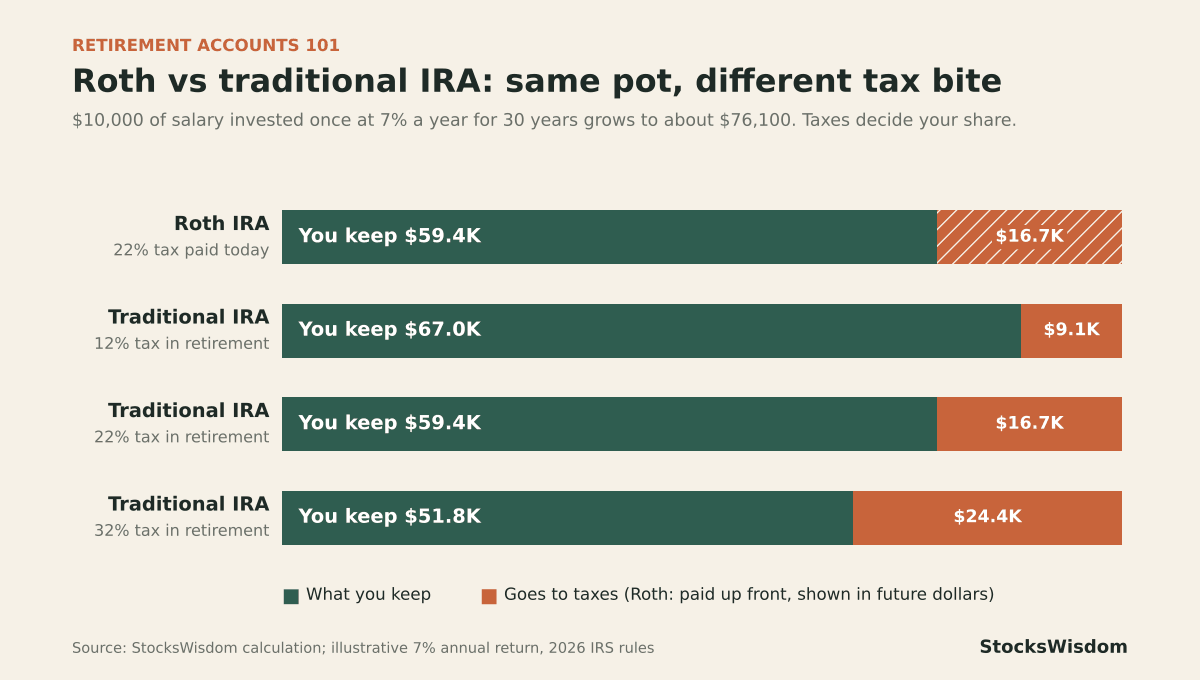
Picture $10,000 of salary set aside once, growing at 7% a year for 30 years. In the Roth, you pay 22% tax first, invest $7,800, and end up with about $59,400, all yours. In the traditional IRA, the full $10,000 goes in, grows to about $76,100, and then gets taxed on the way out. At a 22% retirement rate you keep about $59,400. Same result. At 12% you keep about $67,000. At 32% you keep only about $51,800.
The pot is the same size in every case. What changes is how big a bite taxes take and when they take it. The chart below shows how that split moves as your retirement tax rate changes.
Early-career earners are the classic Roth crowd. If you’re in the 10% or 12% bracket today and expect your income to climb, paying tax now is a bargain.
A Roth also makes sense if you suspect tax rates will rise in general, if you want flexibility to tap contributions in an emergency, or if you’d like to leave money to heirs without forcing distributions at 73. Tax diversification matters too. Having both taxable and tax-free buckets in retirement gives you room to manage your bracket year by year.
Peak earners are the traditional IRA’s best customers. If you’re in the 32% bracket in your 50s and expect to live on less later, taking the deduction now and paying 12% or 22% in retirement is a clear win.
There’s one snag. If you have a workplace plan and earn above the deduction phase-out, a traditional IRA contribution won’t be deductible. At that point most of its appeal is gone.
High earners above $168,000 single or $252,000 joint can’t contribute to a Roth directly. Many use a “backdoor Roth” instead: make a non-deductible traditional IRA contribution, then convert it to a Roth, which is legal and widely used.
Watch the pro-rata rule, though. As U.S. Bank explains, the IRS looks at all of your traditional IRA balances together when it taxes a conversion. If you already have $100,000 of pre-tax money in an old rollover IRA, most of your “backdoor” conversion will be taxable. Talk to a tax pro before you try it.
You don’t need a perfect forecast of your future tax rate. A rough read is enough. Ask whether your income today is low, middle or high compared with what you expect in your 60s and 70s, and choose accordingly. When you can’t tell, splitting contributions between both is a perfectly reasonable hedge.
Timing matters less than people think. You have until the tax filing deadline, April 15, 2027, to make 2026 contributions. If you haven’t funded an IRA this year, there’s still runway.
And picking the account is only half the job. You still need to decide what to hold inside it. If individual stocks are part of your plan, StocksWisdom shows a stock’s sentiment, technical signals and 30-day forecast in one place, which helps when you’re weighing a buy for a long-term account.
Yes. You can own both and contribute to both in the same year. The catch is the shared limit: your combined 2026 contributions can’t exceed $7,500, or $8,600 if you’re 50 or older.
Yes. A workplace plan never blocks you from contributing to an IRA. It only affects whether a traditional IRA contribution is deductible, and Roth eligibility depends on your income, not on your 401(k).
Excess contributions face a 6% tax for every year they stay in the account. If you catch the mistake, withdraw the extra (and its earnings) before your tax deadline to avoid it.
Which way are you leaning this year, Roth, traditional, or a split? Tell us in the comments.
Not financial advice. Do your own research.