Physical Address
304 North Cardinal St.
Dorchester Center, MA 02124
Physical Address
304 North Cardinal St.
Dorchester Center, MA 02124

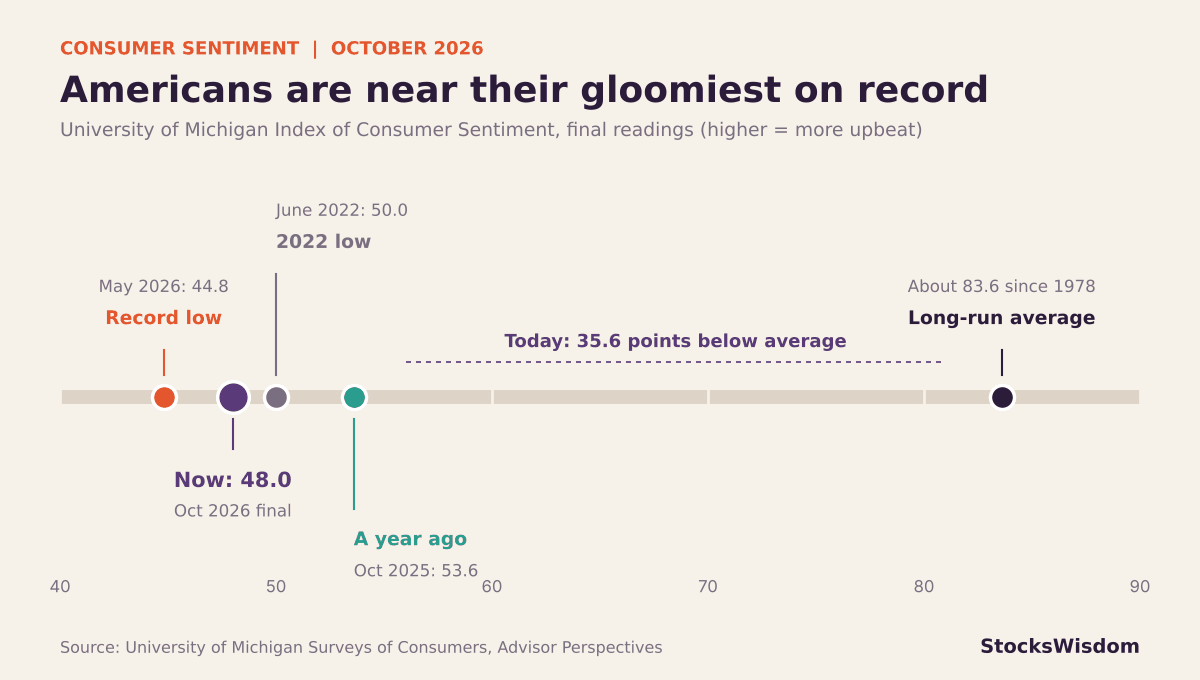
Americans are about as gloomy on the economy as they’ve ever been. The University of Michigan’s final consumer sentiment reading for October 2026 came in at 48.0 on Friday, barely changed from September’s 48.1 and down 10.4% from a year ago, according to the Surveys of Consumers. Only one final reading in the survey’s history has been lower: 44.8, set this past May.
That number landed on a rough day. Oil pushed past $103 for WTI and $116 for Brent, the highest since April, and the Dow fell about 1.2% as tech stocks sold off, per TheStreet.
So what’s going on, and should a gloomy survey change anything about your money? Let’s walk through it.
Michigan’s index has three headline pieces. Sentiment is the big one. Below it sit current conditions (how people feel right now) and expectations (how they think the next year or so will go).
| Measure | Oct 2026 | Sep 2026 | Oct 2025 | Change vs. a year ago |
|---|---|---|---|---|
| Consumer sentiment | 48.0 | 48.1 | 53.6 | down 10.4% |
| Current conditions | 46.7 | 50.9 | 58.6 | down 20.3% |
| Expectations | 48.8 | 46.3 | 50.3 | down 3.0% |
| Year-ahead inflation expectations | 4.7% | 4.6% | n/a | highest since May |
| Long-run inflation expectations | 3.5% | 3.4% | n/a | highest since May |
There’s a small bright spot. Expectations rose 5.4% from September, and the early October reading of 46.3 got revised up to 48.0 by the final count. People still feel bad. They just feel slightly less bad about what’s coming.
Current conditions went the other way and dropped 8.3% in a single month.
Survey director Joanne Hsu put it in one line: “Purchasing power continues to dominate consumer views of the economy.”
You can see why. Inflation ran at 3.7% over the 12 months through September, and gasoline prices were up 34.2% in that span, according to the Bureau of Labor Statistics. Airline fares rose 22.4%. Fuel oil jumped 74.2%.
Gas is the price everyone sees on a giant sign every morning. AAA’s national average sits around $4.29 a gallon, roughly 43% higher than when the Iran conflict began in late February, as ABC News reported.
And here’s a twist. Food at home was up just 1.8%. Used cars actually got cheaper (down 1.5%). But nobody fills a tank with cheap eggs, and the stuff that spiked is the stuff people buy constantly.
Politics shows up in the data too, though not the way you might guess. Hsu said sentiment rose among both Republicans and Democrats this month but fell among independents, enough to drag the total down. Axios reported that the share of Republicans blaming high prices for hurting their finances has climbed roughly 50 percentage points since January, a bigger jump than in either other group. It was sharpest among people with little or no money in stocks.
That last detail is worth sitting with. If you own a decent chunk of stocks, a strong market can cushion a pricey gas bill. If you don’t, there’s no cushion at all. Two households can live through the same economy and come away with completely different moods.
Hsu said this month’s drop in current conditions “was driven entirely by buying conditions for durables.” Durables are the big-ticket stuff: cars, appliances, furniture, electronics.
Buying conditions for those items fell 18%, per Axios, with people pointing to high prices and rising borrowing costs.
That second part matters. The Federal Reserve raised its benchmark rate a quarter point on September 16, to a range of 3.75% to 4%, in a unanimous 12 to 0 vote, according to the Fed’s statement. The statement said plainly that inflation is still running too high. Long-term Treasury yields have climbed too, which pushes up mortgage and credit card rates.
When a fridge costs more and the loan to buy it costs more, people wait. That waiting shows up in retail sales and company earnings a few months later.
Sentiment scores make headlines. Inflation expectations move policy.
Year-ahead expectations hit 4.7%, up from 3.4% in February before the conflict started. Long-run expectations rose to 3.5%, above the 2.8% to 3.2% range seen throughout 2024.
Why should you care? If people expect prices to keep rising, they ask for bigger raises and businesses feel freer to raise prices. That’s how a temporary oil shock can turn into sticky inflation. The Fed hates that, and it meets again October 27 and 28.
Not necessarily. Sometimes it’s the opposite.
Sentiment hit what was then a record low of 50.0 in June 2022, during the last inflation scare. The S&P 500 bottomed that October and then ran higher for years. Markets look ahead, and by the time everyone feels terrible, a lot of the bad news is usually priced in.
That said, low sentiment isn’t a buy signal by itself. Advisor Perspectives notes the index is sitting below its level at the start of all six recessions since the late 1970s, and that long stretches this low have lined up with shrinking GDP. The long-term average is about 83.6. We’re more than 35 points under it.
The chart below shows where October’s reading sits against the record low, the 2022 low, last year’s level and the long-run average.
Savers. Higher rates have one upside. High-yield savings accounts, CDs and Treasury bills pay more after a hike. If your cash earns less than 4% in a big bank savings account, it’s worth shopping around.
Borrowers. This isn’t a great moment to finance something big unless you have to. Credit card balances are the most expensive debt most people carry, and those rates rise right along with the Fed. Paying down a card balance is a guaranteed return.
Investors. Watch where the pressure lands. Companies selling big-ticket items on credit (autos, home goods, furniture) feel a durables slump first. Energy producers have the opposite problem, a nice one. Before you buy or trim anything based on a macro headline, look at how the specific stock is behaving. A tool like StocksWisdom shows a stock’s sentiment, technical signals and a 30-day forecast in one place, which helps you separate what the crowd feels from what the chart is doing.
Everyone. Gloomy surveys can become self-fulfilling if people slash spending all at once. They also tend to swing back fast when gas prices fall.
It’s a monthly survey of US households about their finances, business conditions and buying plans. A preliminary number comes out mid-month and a final one near month-end. Readings below 60 are historically very weak.
Mostly prices. Gas is up about 43% since late February, overall inflation is 3.7%, and borrowing costs rose after the Fed’s September hike. Big-ticket buying conditions fell 18% this month.
It’s a warning sign, not a guarantee. People can say they feel awful and keep spending. Watch actual spending and jobs data alongside it.
Are high prices changing how you spend or invest right now? Tell us in the comments.
Not financial advice. Do your own research.