Physical Address
304 North Cardinal St.
Dorchester Center, MA 02124
Physical Address
304 North Cardinal St.
Dorchester Center, MA 02124


The Federal Reserve meets Tuesday and Wednesday, and for once almost nobody expects fireworks. Futures traders put the odds of a hold at about 90%, and 94 of 100 economists in a Reuters survey said the same thing. The benchmark rate should stay at 3.75% to 4% when the decision lands at 2 p.m. ET on October 28.
So why care? Because the same survey had all 100 economists calling for a hike in December. Wednesday is less about what the Fed does and more about what it hints at. With Brent crude settling at $116.72 a barrel on Friday and the 10-year Treasury yield sitting right at 5%, a few words from Chair Kevin Warsh could move your mortgage quote, your savings rate and your 401(k) all at once.
Here’s what’s on the table, what the numbers say, and what it means for your money.
Most people got used to hearing about rate cuts. That changed on September 16, when the Fed raised rates by a quarter point to 3.75% to 4%, its first hike in more than three years. The vote was 12 to 0.
Warsh didn’t sugarcoat it. “Inflation is too high and has been for too long,” he said at the press conference, according to Charles Schwab’s meeting recap.
The trigger is energy. Oil supply from the Middle East has been disrupted by the Iran war, and attacks on Saudi facilities pushed Brent to a six-month high last week. That shows up fast at the pump, and the pump shows up fast in inflation data.
The job market isn’t giving the Fed a reason to back off either. Weekly jobless claims fell to 194,000 in the latest report, near a 57-year low. When layoffs are that rare, officials worry less about breaking the economy with higher rates and more about letting inflation settle in. A strong labor market is good news for paychecks. For borrowers hoping for relief, it’s the opposite.
September’s consumer price index came in hot. Per the Bureau of Labor Statistics, prices rose 0.6% in one month and 3.7% over the past year. Gasoline alone was up 34.2% from a year earlier.
Core inflation, which strips out food and energy, was calmer at 2.6% a year. That gap is the whole debate. If expensive oil stays a gasoline problem, the Fed can be patient. If it spreads into airfares, shipping and everything trucked to a store shelf, patience runs out.
| Indicator | Latest reading | Why it matters |
|---|---|---|
| Fed funds target | 3.75% to 4% | Sets the floor for short-term borrowing |
| CPI inflation (Sept.) | 3.7% a year | Nearly double the Fed’s 2% goal |
| Core CPI (Sept.) | 2.6% a year | Shows how far energy has spread |
| 10-year Treasury yield | 5.00% | Drives mortgage and long-term loan rates |
| 30-year mortgage (Freddie Mac) | 7.32% | Up from 6.19% a year ago |
| Brent crude | $116.72 | Six-month high, the main inflation driver |
CME FedWatch pricing showed a 90% chance of no change this week and a 76.2% chance of a hike in December, as reported by Seoul Economic Daily citing the Reuters poll. Not everyone agrees. Bank of America still expects a quarter-point move on Wednesday.
Timing helps explain the patience. October is one of the meetings without new economic projections, per the Fed’s 2026 calendar. December 8 to 9 brings a fresh “dot plot,” which makes it a cleaner moment for a bigger move. In September, officials penciled in a year-end rate around 4.1%, which implies one more quarter-point hike.
A hold doesn’t mean the Fed is relaxed. It means they’re waiting for one more month of data.
The fed funds rate is what banks charge each other overnight. You never pay it directly, but it ripples outward. Credit cards and home equity lines follow it almost immediately. Savings accounts and CDs follow it with a lag. Mortgages follow the 10-year Treasury yield, which reacts to what investors think the Fed will do over the next several years.
That last point trips people up. Mortgage rates can rise even when the Fed holds, if the statement sounds tougher than expected. They can fall on a hike day if markets think the Fed is finally getting ahead of inflation.
The graphic below shows how this week’s decision flows from the Fed to the rates you actually pay and earn.
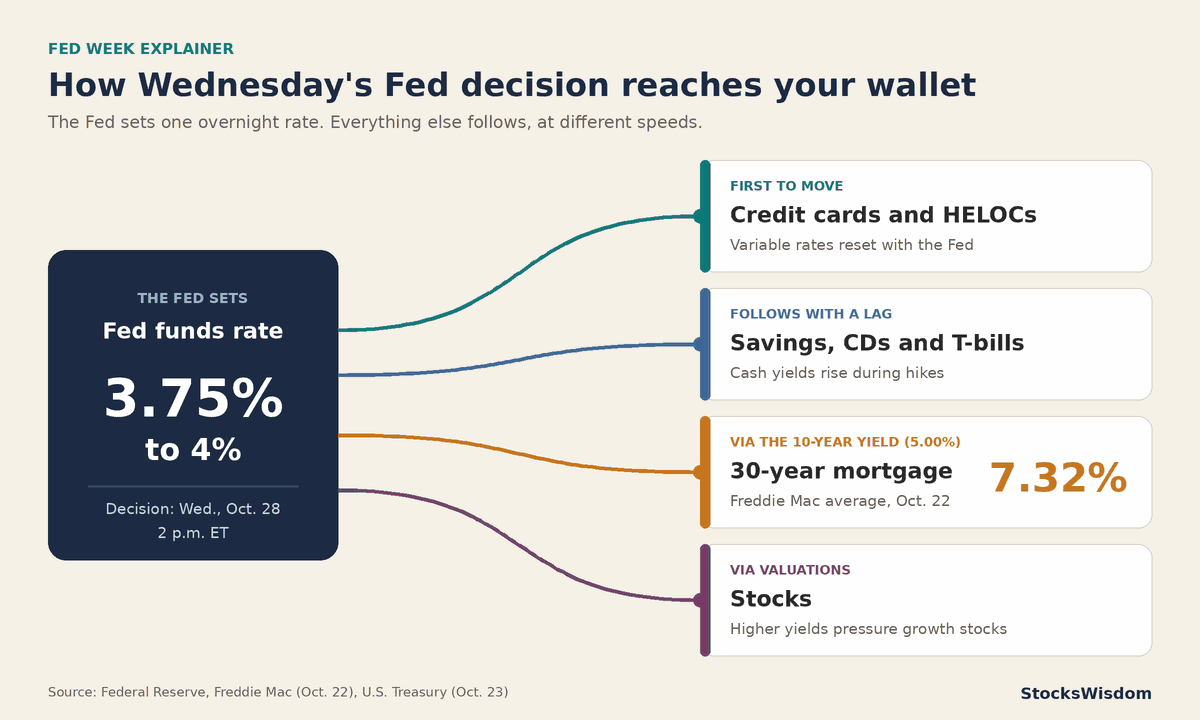
If you carry a credit card balance, the math is getting worse, not better. Variable card rates move with the Fed, and a December hike would push them up again. Paying down that balance beats almost any investment return right now.
If you’re shopping for a home, a 7.32% average 30-year rate is painful. Freddie Mac reported it was the first weekly decline since August, with the 15-year at 6.68%. Don’t count on the Fed to rescue you this year. Lock when the payment works for your budget, not when you think rates have peaked.
If you have cash saved, this is the good part. High-yield savings accounts, money market funds and short-term Treasury bills tend to pay more when the Fed is hiking. If your emergency fund sits in a big-bank account paying close to nothing, you’re leaving real money behind.
If you own stocks, watch rate-sensitive groups. Higher yields squeeze growth stocks with lofty valuations, homebuilders and small companies that borrow a lot. Energy names have the opposite tailwind while oil stays above $100.
Here’s the twist. Alphabet and Microsoft report after the close on Wednesday, just hours after the Fed statement, and Amazon follows Thursday, per Yahoo Finance’s week-ahead preview. Thursday also brings the September PCE inflation report, the Fed’s preferred gauge, expected at 3.7% for headline and 3.1% for core.
That’s a lot of volatility packed into 36 hours. A hawkish Fed plus a soft cloud number could hit the Nasdaq hard. A calm Fed plus strong AI revenue could do the reverse. If you want a quick read on how a specific stock is set up going into a week like this, StocksWisdom shows its sentiment, technical signals and a 30-day forecast in one place.
Probably not. Markets price about a 90% chance of a hold, and 94 of 100 economists in the Reuters survey agree. Bank of America is the notable holdout calling for a hike.
Not directly. Mortgage rates track the 10-year Treasury yield, which hit 5% on Friday. If Warsh signals that December’s hike is likely and inflation is under control after that, yields could ease. If he sounds worried about oil, they could climb.
Rates on savings accounts and Treasury bills usually rise during a hiking cycle, so cash is earning more than it has in a while. Keep emergency money liquid and shop around, since rates vary widely between banks.
Are you locking in savings rates now, or waiting to see what December brings? Tell us in the comments.
Not financial advice. Do your own research.