Physical Address
304 North Cardinal St.
Dorchester Center, MA 02124
Physical Address
304 North Cardinal St.
Dorchester Center, MA 02124


Anthropic made its IPO paperwork public on Monday, and the numbers are wild in both directions. The AI company behind the Claude chatbot posted $16.3 billion of revenue in the first six months of 2026, up from $1.16 billion a year earlier. Over the same six months it booked a net loss of $80.7 billion.
Both of those figures come straight from the S-1 registration statement Anthropic filed with the SEC. Shares will list on the Nasdaq under the ticker ANT. There’s no price range yet and no share count, so nobody can tell you today what a share will cost.
Wall Street liked the news anyway. On the day, the Nasdaq rose 0.82% to 26,169 and the S&P 500 gained 0.70% to 7,677, with chip stocks leading, according to Yahoo Finance. Nvidia closed up 2.39% at $216. So what did the filing say, and should a regular investor care?
An S-1 is the long document a company must file before selling shares to the public. It lays out the business, the financials, the risks and who controls the company. Anthropic filed confidentially back in June, per TheStreet, and Monday’s version is the first one the public can read.
Goldman Sachs and Morgan Stanley lead a list of more than 20 underwriting banks. Just as telling are the blanks. Price range, share count and assumed midpoint are all left empty. Companies usually fill those in with an amended filing shortly before the roadshow, and the final price gets set the night before trading starts.
For a sense of scale, Anthropic closed a $65 billion funding round at a $965 billion post-money valuation in June, according to Adweek. Public investors could end up paying more than that. Or less.
Revenue went from $386 million in 2024 to $4.6 billion in 2025. Then the first half of 2026 alone brought in $16.3 billion, more than three times the entire prior year.
Big business customers drive it. As of September 30, Anthropic had more than 11,900 customers paying at least $100,000 a year, more than 1,900 paying at least $1 million, and about 250 paying $10 million or more.
That’s real demand. It’s also concentrated. Two customers made up roughly a fifth of revenue, per Yahoo Finance’s read of the filing. If one of them cut back, you’d see it fast.
This is the number that will scare people, so it’s worth slowing down on.
Of the $80.7 billion loss, $72.4 billion came from one line: the change in fair value of convertible notes, derivative liabilities and SAFEs. In plain English, Anthropic sold investors securities that convert into stock later. As the company’s valuation shot up, those future claims got more valuable, and accounting rules make the company book that increase as a loss.
No cash left the building for that charge. Operations tell a different story. Its GAAP operating loss shrank to $693 million in the first half of 2026 from $2.1 billion a year earlier, and on the company’s adjusted measure, operating income swung to a $1.6 billion profit (a 10% adjusted margin).
| Metric (six months to June 30) | 2025 | 2026 |
|---|---|---|
| Revenue | $1.16B | $16.29B |
| Compute and infrastructure expense | $2.33B | $8.95B |
| GAAP operating income (loss) | ($2.14B) | ($0.69B) |
| Adjusted operating income (loss) | ($1.85B) | $1.62B |
| Net income (loss) | ($12.97B) | ($80.75B) |
Adjusted numbers strip out items like stock-based compensation ($2.2 billion in the half), so treat them as the company’s preferred view, not the whole truth.
Each line moves on its own scale, which is why a single chart would hide most of the story. The chart below shows how each of the four GAAP figures changed between the first half of 2025 and the first half of 2026.
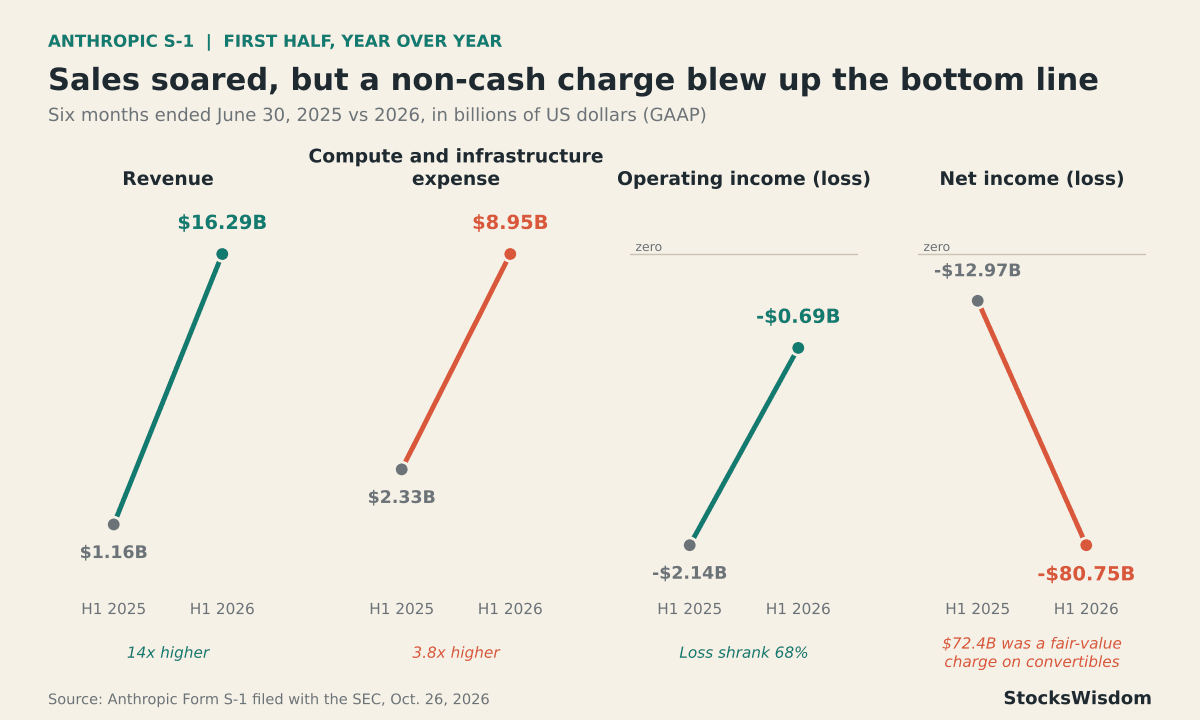
Running and training AI models eats chips and power. Compute and infrastructure expense nearly quadrupled to $8.95 billion in six months.
Anthropic also has purchase and lease commitments that stretch from the next 12 months all the way to 2045, mostly for compute. It has the cash for now: $131.7 billion in cash and short-term investments at the end of June, after raising $141.1 billion in total since its founding. What shareholders need to know is whether revenue keeps outrunning that bill once growth slows.
Here’s a detail most first-time IPO buyers skip. Public investors will buy Class A shares with one vote each. That vote won’t count for much.
A single Class F share, held by a founders’ entity, carries 50.1% of the voting power on most stockholder matters. Separately, the Long-Term Benefit Trust, a five-person body focused on AI safety and public policy, elects the Class T directors, who make up a majority of the board. Anthropic is a public benefit corporation, which means it’s allowed to weigh its mission alongside profits.
None of that is unusual for a founder-led tech company (Meta and Alphabet have dual-class shares too). It does mean you’d be buying a share of the economics, not a say in where the company goes.
You probably won’t get shares at the IPO price. Most of the allocation goes to big institutions. Some brokers run IPO access programs for retail customers, but hot deals tend to be heavily oversubscribed and allocations are small.
Day one is a different stock. Opening trades can land far above the offer price, and buyers who chase that first print take on the most risk. A few habits help:
If you already own an S&P 500 fund, don’t expect ANT inside it anytime soon. S&P’s rules require positive GAAP earnings over the trailing four quarters, and Anthropic’s GAAP numbers are deep in the red. Once it trades, you can check a stock’s sentiment, technical signals and 30-day forecast on StocksWisdom before deciding whether the hype matches the chart.
Monday’s filing lands in a busy stretch. The Fed starts a two-day meeting Tuesday, with a rate decision Wednesday afternoon. Microsoft and Alphabet both report Wednesday after the close, and investors will focus on how much they plan to spend on AI data centers.
Those reports matter for Anthropic too. Big tech capex is the other side of its compute bill.
There’s no date yet. Regulators at the SEC have to finish its review, and Anthropic still needs to set a price range and share count. Several reports point to a November listing, but the company hasn’t confirmed one.
Not on a GAAP basis. It lost $80.7 billion in the first half of 2026, mostly from a non-cash accounting charge. Its GAAP operating loss was $693 million, and its adjusted operating income was a $1.6 billion profit.
ANT, on the Nasdaq Global Select Market.
Would you try to buy ANT on its first day, or wait for a few earnings reports first? Tell us in the comments.
Not financial advice. Do your own research.