Physical Address
304 North Cardinal St.
Dorchester Center, MA 02124
Physical Address
304 North Cardinal St.
Dorchester Center, MA 02124


Intel just had one of its best quarters in years, and the stock got crushed anyway.
After the bell on Thursday, Intel reported third-quarter revenue of $16.5 billion, up 21% from a year ago, and adjusted earnings of 52 cents a share against the 40 cents Wall Street expected. Data center sales jumped 78%. Then the company told investors the fourth quarter would bring in only $15 billion to $16 billion, well short of the roughly $17 billion analysts had penciled in. Shares fell about 18% in after-hours trading, from around $92 to the mid-$70s.
So what happened? A deadly factory explosion in Israel, a memory chip shortage that’s choking PC sales, and a stock that had already more than doubled this year. Let’s walk through the numbers and what they mean if you own Intel, or own an index fund that does.
Start with the good part, because there’s a lot of it. According to Intel’s earnings release filed with the SEC, adjusted gross margin rose to 44.1% from 40.0% a year earlier. Adjusted earnings per share more than doubled from 23 cents.
| Metric | Q3 2026 actual | Wall Street estimate | Year ago |
|---|---|---|---|
| Revenue | $16.51B | about $16.4B | $13.7B |
| Adjusted EPS | $0.52 | $0.40 | $0.23 |
| Data Center and AI revenue | $7.3B | n/a | about $4.1B |
| PC chip revenue | $8.1B | $8.98B | about $8.5B |
| Adjusted gross margin | 44.1% | n/a | 40.0% |
Estimates come from LSEG via Reuters and StockStory.
One quirk: GAAP earnings were 60 cents a share, down from 90 cents a year ago. That gap comes from one-time items. Most analysts focus on the adjusted figure, which is why the headline says “beat.”
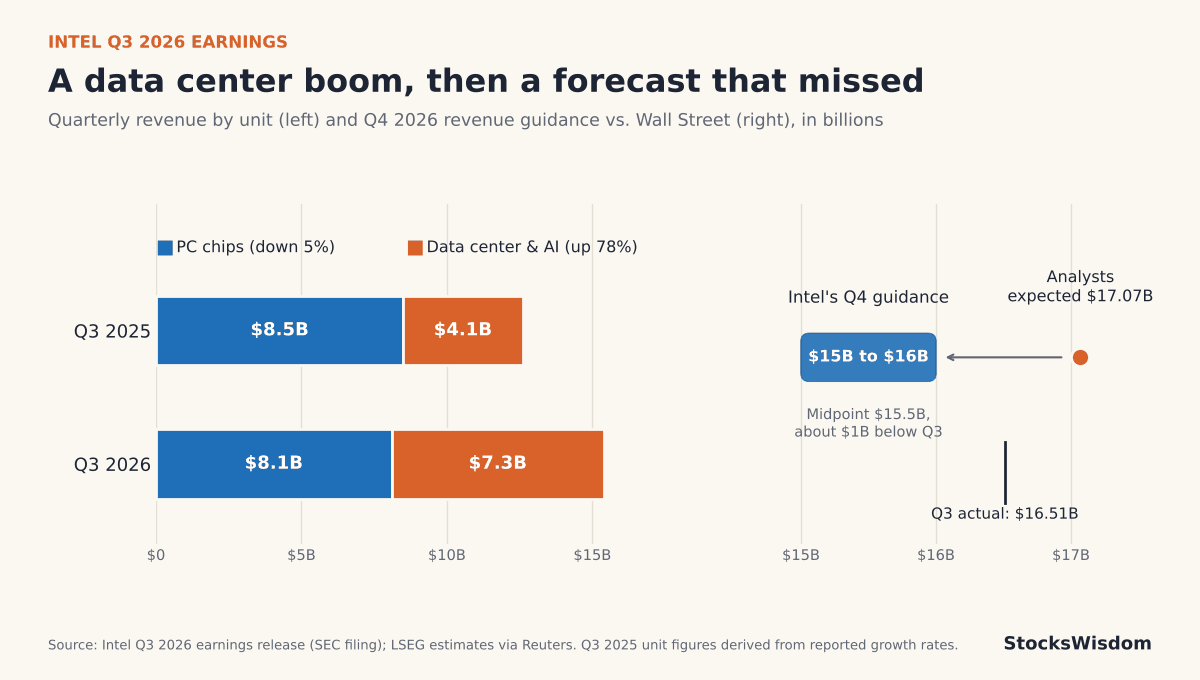
Intel’s Data Center and AI unit is now almost as big as its PC business. A year ago it was roughly half the size.
That’s the AI story investors bought into this year. Companies building AI systems need more than graphics chips. They need traditional server processors too, and Intel’s Xeon chips are in heavy demand. CEO Lip-Bu Tan said the company’s top priority is getting more Xeon supply out the door to meet that demand.
Intel Foundry, the contract manufacturing arm, grew revenue 58% to $6.7 billion, though most of that still comes from making chips for Intel itself.
The chart below shows how Intel’s revenue mix shifted in a year, and how far the Q4 forecast landed from what Wall Street wanted.
Stocks trade on the future. The fourth-quarter outlook is the problem.
Intel guided to revenue of $15 billion to $16 billion and adjusted earnings of 25 cents a share. Analysts expected about $17.07 billion and 43 cents. Adjusted gross margin is forecast to slide to 38.0%, down from 44.1% this quarter.
A midpoint of $15.5 billion means revenue is expected to shrink by about $1 billion from Q3. Wall Street was looking for growth. When a stock has doubled on a growth story, a quarter of shrinking sales hits hard.
An October explosion at Intel’s fab in Kiryat Gat, Israel, killed two people and seriously injured another, according to local media cited by Reuters. Production stopped for about two weeks.
CFO David Zinsner said Intel expects to lose about $600 million in revenue over two quarters because of it. Roughly $300 million of that hits Q4, along with about 2 percentage points of gross margin. He expects a similar revenue hit in the first quarter of 2027. Worse, that fab mainly makes data center chips, the exact business that’s growing fastest.
“We’re still assessing all of the wafers to see which ones are usable and which ones aren’t,” Zinsner told Reuters.
A bigger issue might be the one Intel can’t fix in a few weeks.
PC makers are dealing with a shortage of memory chips that has pushed prices up sharply. When memory costs more, laptops and desktops cost more, and people buy fewer of them. Intel now expects the PC market to shrink 12% this year and another 10% in 2027, The Next Web reported.
Intel expects its own PC chip revenue to fall in the mid-20% range in Q4. That’s a big drop for a unit that still brings in about half of its sales.
“Looking ahead, we see the PC slowdown continuing at least through the first half of next year,” Zinsner said in a statement.
Tan was blunter in an interview with Bloomberg: “Memory pricing went up a lot. I think my prediction is that in 2027 it is going to be a very severe issue to all of us.”
If you own Intel directly, today’s drop is a reminder of how much optimism was already baked into the price. Shares more than doubled in 2026 before this report. A stock priced for perfection doesn’t get much credit for a good quarter if the next one looks worse.
A few practical points:
Is there a silver lining? Possibly. Intel’s problems this quarter are mostly about making and shipping enough chips, plus a PC market squeezed by component costs. Those are painful, but they’re different from customers walking away. If the Israel fab ramps back up on schedule and memory prices cool off in 2027, today’s forecast could end up looking conservative. If memory stays tight, as Tan predicts, the PC slump could drag on longer than investors would like.
If you own an S&P 500 or Nasdaq index fund, Intel is a small slice. It was a rough day for tech in general, though. The Nasdaq fell 1.4% on Thursday after Alphabet dropped nearly 13%, and Amazon slid in late trading after its own results, per Yahoo Finance.
If you’re thinking about buying the dip, it helps to check more than the headline. StocksWisdom shows a stock’s sentiment, technical signals and 30-day forecast, which gives you a quick sense of whether the selling is still building or starting to fade.
Yes. Adjusted EPS of 52 cents beat the 40-cent estimate, and revenue of $16.51 billion was roughly in line with forecasts. Where it missed was the Q4 outlook.
Q4 guidance of $15 billion to $16 billion came in well below the $17 billion analysts expected, hurt by the Israel fab shutdown and a weaker PC market driven by expensive memory.
Memory makers have been benefiting from higher prices. Companies that buy a lot of memory, like PC makers and PC chip suppliers, are on the other side of that trade.
Do you see Intel’s selloff as a chance to buy a turnaround at a lower price, or a sign the stock ran too far, too fast? Let us know in the comments.
Not financial advice. Do your own research.