Physical Address
304 North Cardinal St.
Dorchester Center, MA 02124
Physical Address
304 North Cardinal St.
Dorchester Center, MA 02124

If last week hurt to look at, you’re not alone. Chip stocks crashed more than 12% on Thursday. By Friday’s close the S&P 500 was down 2.7% for the week and the Nasdaq had lost 3.4%, per TokenPost. Plenty of portfolios that looked great in October are now sitting on red numbers.
Here’s a small consolation: those red numbers can be worth real money. Tax-loss harvesting means selling an investment that’s down, locking in the loss on paper, and using it to cut your tax bill. With about seven weeks left in 2026, this is the stretch of the year when it matters most.
It isn’t complicated. There are three rules to know, one trap to avoid, and a deadline. Let’s go through them.
You sell a losing investment in a regular taxable brokerage account. The IRS lets you subtract that realized loss from any capital gains you’ve realized this year. If losses beat gains, you can also knock up to $3,000 off your ordinary income.
Then you usually buy something similar so you stay invested. Your market exposure barely changes. Your tax bill does.
One catch up front: this only works in taxable accounts. Losses inside an IRA, Roth IRA or 401(k) don’t count, because those accounts aren’t taxed year to year anyway.
Rule 1: losses offset gains first. Short-term losses net against short-term gains, and long-term against long-term. Whatever’s left over crosses to the other bucket. Kiplinger lays out that order, and it matters because short-term gains (on assets held one year or less) are taxed at your regular income rate.
Rule 2: $3,000 against your paycheck. Once your gains are wiped out, extra losses can reduce ordinary income by up to $3,000 a year, or $1,500 if you’re married filing separately. That comes straight from IRS Topic 409.
Rule 3: unused losses carry forward. Lose more than you can use? The rest rolls into next year, and the year after that, with no expiration date. A big loss this November can keep paying off for years.
Say you’re single with about $120,000 of taxable income. That puts you in the 24% federal bracket for 2026. Back in the spring you sold a stock you’d held for eight months and booked a $6,000 short-term gain.
You also bought $20,000 of a chip stock over the summer. After last week it’s worth $11,000, a $9,000 paper loss.
| Scenario | Without harvesting | With harvesting |
|---|---|---|
| Short-term gain taxed | $6,000 | $0 |
| Federal tax on that gain (24%) | $1,440 | $0 |
| Loss used against wages | $0 | $3,000 |
| Tax saved on wages (24%) | $0 | $720 |
| Total federal tax saved | $0 | $2,160 |
That’s $2,160 back in your pocket, and you can still own a similar chip investment the same afternoon. If the loss had been $15,000 instead, the extra $6,000 would carry into 2027.
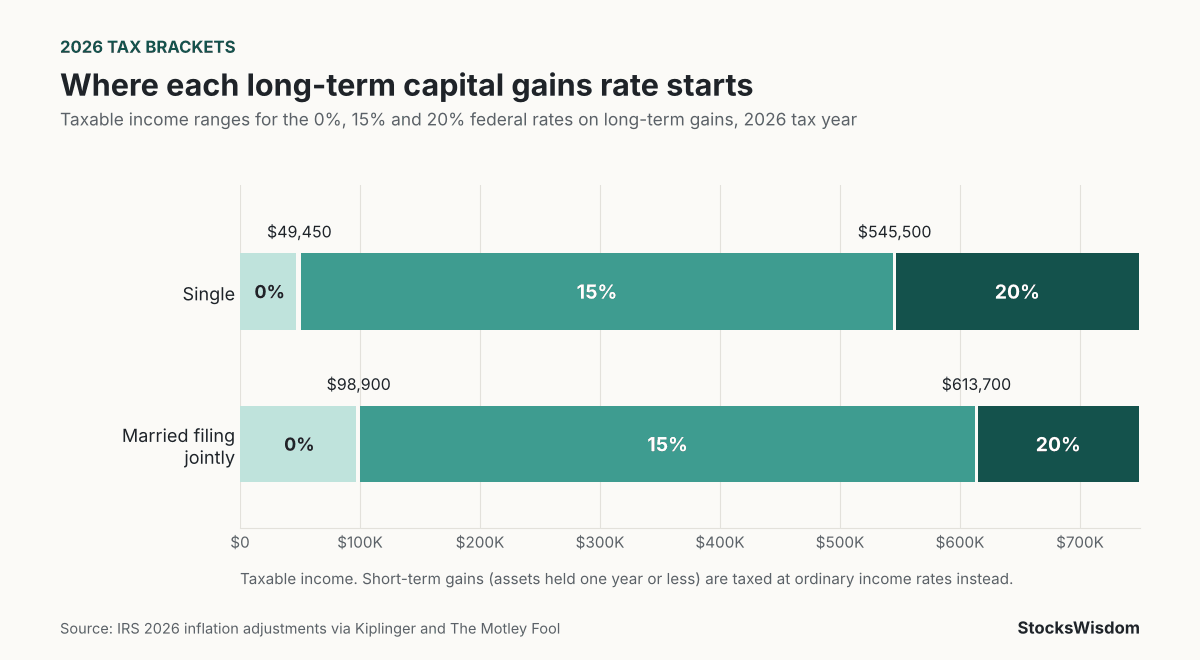
Long-term gains get friendlier rates of 0%, 15% or 20%, depending on taxable income. For 2026, a single filer pays 0% on long-term gains up to $49,450, and couples filing jointly pay 0% up to $98,900, according to both Kiplinger and The Motley Fool. Higher earners can also owe the 3.8% net investment income tax on top.
So harvesting pays the most when it cancels short-term gains or high-bracket long-term gains. If your income is low enough to sit in the 0% zone, harvesting long-term losses may save you nothing this year (though the carryforward can still help later). The chart below shows where each 2026 long-term capital gains rate kicks in for single filers and married couples.
This is the rule that trips people up. If you buy the same or a “substantially identical” security within 30 days before or after the sale, the IRS disallows the loss. Investor.gov defines it that way, and the window adds up to 61 days in total.
The loss isn’t gone forever. It gets added to the cost basis of the new shares, so you’d get the benefit later when you sell them. But it won’t help on this year’s return.
A few ways it sneaks up on people:
Start with your broker’s unrealized gain/loss page. It shows every position’s cost basis next to today’s value, split into short-term and long-term.
Pick the losers you’d be fine replacing. Then choose a replacement that keeps you in the market without being identical: a different chip ETF instead of a single chipmaker, say, or a total-market fund in place of an S&P 500 fund. Before you swap, it helps to know what you’re buying into. StocksWisdom shows a stock’s sentiment, technical signals and 30-day forecast, which makes it easier to compare a replacement against what you’re selling.
If you own several lots bought at different prices, ask your broker to sell the highest-cost shares first (often called specific identification or HIFO). Same number of shares sold, bigger loss booked.
And don’t wait until December 31. Kiplinger notes that thin holiday trading can mean wider spreads and slower fills. Most brokers want trades placed a few days before year-end anyway.
Tax-loss harvesting isn’t a reason to sell something you believe in. It’s a way to get a refund on a decline you’ve already suffered. The investment decision comes first, then the tax move.
It also rewards record-keeping. Write down what you sold, the date, and what you bought in its place, so you can check the 30-day window before buying anything back. If you want a refresher on how gains are taxed in the first place, our guide to stock market taxes covers the basics.
And keep perspective on last week. The Nasdaq is now roughly 11% under its October 6 record, which is correction territory, not a crash. Our explainer on correction vs bear market shows how often these happen.
Yes, but wait at least 31 days after the sale. Buy it back sooner and the wash sale rule disallows the loss for this year.
It can be. Even a $1,000 loss offsetting a short-term gain saves $220 for someone in the 22% bracket. Just watch trading costs and spreads on thinly traded stocks.
The sale has to happen by the last trading day of 2026, which is Thursday, December 31. Aim for mid-December to give yourself room.
Have you harvested any losses yet this year, or are you holding on and hoping for a rebound? Tell us in the comments.
Not financial advice. Do your own research.