Physical Address
304 North Cardinal St.
Dorchester Center, MA 02124
Physical Address
304 North Cardinal St.
Dorchester Center, MA 02124

CoreWeave just had its best day on the market since April 2025. Shares of the AI cloud company closed at $60.77 on Wednesday, up 24.7%, a day after it reported third-quarter revenue of $3.66 billion. That’s a 168% jump from a year ago and about $100 million more than Wall Street expected.
A month ago this stock was the poster child for AI debt fears. Shares had dropped more than 40% over the prior month, and the 52-week high of $138.25 looked very far away. So what changed in one report?
Two things. Demand kept beating supply, and management finally gave investors a clearer answer on the money question: how does a company this deep in debt pay for all those data centers?
Here’s what CoreWeave reported in its third-quarter press release, set against the same quarter last year.
| Metric | Q3 2025 | Q3 2026 |
|---|---|---|
| Revenue | $1.37 billion | $3.66 billion |
| Operating income | $52 million | $207 million |
| Adjusted EBITDA | $838 million | $2.26 billion |
| Net interest expense | $310 million | $846 million |
| Net loss | $110 million | $709 million |
| Loss per share | $0.22 | $1.27 |
| Revenue backlog | n/a | $132.5 billion |
Per-share losses still widened. But analysts had braced for a loss of $1.46 a share, according to Yahoo Finance, so $1.27 counted as a relief. Revenue also topped the $3.56 billion consensus.
CEO Michael Intrator called it “a breakout quarter for CoreWeave, with revenue increasing by more than $1 billion sequentially.” He’s right about the math. Revenue went from $2.58 billion in Q2 to $3.66 billion in Q3.
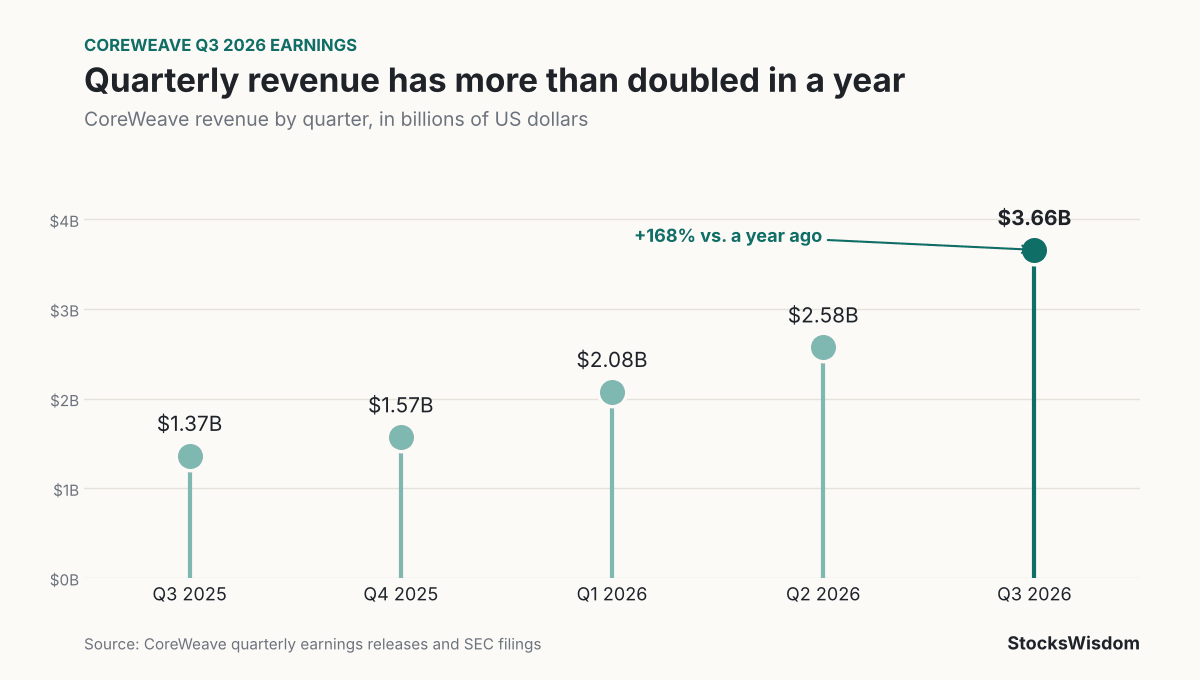
Plenty of fast growers see their growth rate fade as they get bigger. CoreWeave’s went the other way this year. Quarterly sales have climbed every quarter since last fall, from $1.37 billion in Q3 2025 to $1.57 billion in Q4 (per the company’s year-end filing with the SEC), then $2.08 billion, $2.58 billion and now $3.66 billion. The chart below shows how each quarter stacks up.
Backlog tells the same story. That’s the dollar value of signed contracts the company hasn’t turned into revenue yet. It stood at $66.8 billion at the end of 2025, about $104 billion at the end of June and roughly $132.5 billion now.
New customers this quarter include Canva, Substack and Wayve. OpenAI, Perplexity and Jane Street expanded existing deals.
CoreWeave now expects full-year revenue of $13.0 billion to $13.3 billion. Since the first nine months brought in $8.31 billion, that implies Q4 sales somewhere around $4.7 billion to $5.0 billion. Another big step up.
It also raised its adjusted operating income forecast to $1.275 billion to $1.375 billion. And it expects to exit 2026 at an annualized revenue run rate of $20 billion to $21 billion.
Capital spending guidance is still enormous: $37 billion to $39 billion for the year. In Q3 alone the company spent $9.44 billion in cash on property and equipment, while operating cash flow was $1.98 billion. You can see the gap.
This is the part that turned a decent beat into a 25% rally.
CoreWeave’s total debt is now close to $47 billion based on its latest balance sheet, up from about $21 billion at the end of 2025. Interest costs are rising fast too. Investors worried the company would keep selling expensive bonds to fund growth, a fear we covered when CoreWeave stock sank on AI debt worries last month.
On the earnings call, Intrator addressed it head on: “Looking ahead, we will not use the unsecured debt market to fund our business at current yields. Nor do we need to.”
CFO Nitin Agrawal backed that up with specifics. He said the company expects “approximately $9 billion of customer prepayments and deposits in the next 3 months alone” and plans to raise less than $5 billion in incremental parent-level capital through 2027. He also said the company expects adjusted net income to turn positive in the first half of 2028.
In plain English, customers are paying upfront to lock in computing power, and that cash helps fund the build-out instead of new high-yield bonds.
CoreWeave’s report lifted the whole “neocloud” group, the newer cloud providers that rent out AI chips. Nebius closed up 15.4% at $154.69 and Applied Digital rose 7.4%, according to The Motley Fool.
Nvidia snapped a two-day losing streak with a 2.9% gain. Memory names like Micron and Sandisk climbed more than 10%. The Nasdaq added 1.6% to 25,466 and the S&P 500 rose 1.3% to 7,619, per TheStreet.
It’s a sharp turn from early November, when chip stocks crashed and the SOX fell 12%.
One good quarter doesn’t erase the balance sheet. Through the first nine months of 2026, CoreWeave lost $2.08 billion, almost triple the $715 million it lost in the same stretch of 2025.
Interest is the big drag. Management guided Q4 interest expense to $1.05 billion to $1.15 billion, which would be another record. Even with $2.26 billion of adjusted EBITDA in Q3, most of the profit from renting out chips goes to lenders and depreciation.
Spending isn’t about to shrink either. Agrawal said that if CoreWeave builds only for its committed backlog, 2027 capex should stay in line with this year’s $37 billion to $39 billion. Revenue has to keep compounding at a fast clip for that math to work.
Power is the other constraint. Active power is a bit over 1.7 gigawatts today, while contracted power is above 4.6 gigawatts. Turning contracts into revenue depends on getting those data centers built and energized on schedule.
If you own an S&P 500 or Nasdaq index fund, you already have exposure to this trade through Nvidia, Broadcom and the hyperscalers. CoreWeave’s results suggest AI spending isn’t slowing yet. That’s good news for those holdings in the near term.
If you’re thinking about buying CoreWeave itself, be clear-eyed about what you’re getting. This is a high-risk, debt-heavy bet on AI demand. It’s still losing money, it carries a lot of debt and its share price can swing 20% or more in a day. Wednesday’s 25% gain followed a 40% drop. Both can happen again.
A few ground rules help with stocks like this:
Before you buy any volatile name, it helps to check the mood around it. StocksWisdom shows a stock’s sentiment, technical signals and 30-day forecast, which is useful context when a ticker moves this fast.
Revenue beat estimates, full-year guidance went up and management said it won’t issue new unsecured debt at current yields through 2027. Expected customer prepayments of about $9 billion eased funding worries.
Not yet. It posted a $709 million net loss in Q3, mostly because of $846 million in interest costs. Management expects adjusted net income to turn positive in the first half of 2028.
About $132.5 billion as of September 30, 2026. Backlog is signed customer contracts that haven’t been booked as revenue yet.
Do you think CoreWeave has turned the corner on its debt problem, or is this rally just a relief bounce? Tell us in the comments.
Not financial advice. Do your own research.