Physical Address
304 North Cardinal St.
Dorchester Center, MA 02124
Physical Address
304 North Cardinal St.
Dorchester Center, MA 02124

Jensen Huang is out. Nvidia’s co-founder, who has run the company since 1993, resigned as president, CEO and board member on Thursday, effective immediately. CFO Colette Kress steps in as interim CEO while keeping her finance job, and venture investor Harvey C. Jones becomes the board’s first-ever chair, according to Nvidia’s announcement.
Wall Street took the news hard, then calmed down. Nvidia shares dropped as much as 14% at the open to $148.80, the lowest level since June 2025, before clawing back to close at $166.19, down 4.3% on the day, per The Motley Fool. Volume hit 740 million shares, more than five times normal. The S&P 500 slipped 0.36% and the Nasdaq lost 0.39%.
So what does it mean if you own Nvidia, or an index fund that’s packed with it? Let’s walk through it.
The board opened an investigation on November 8 after media reports about Huang’s personal life. On Wednesday evening, reports said directors were preparing to remove him. An 8-K filing shows the board accepted his resignation on November 11, and the company announced it before Thursday’s open, per StockTitan’s market blog.
Nvidia didn’t give a reason in its release. It did say the board expects operations, customer commitments and the product roadmap to continue without interruption, and that it will look at internal and external candidates for a permanent CEO.
We covered the start of this story on Monday in Nvidia Stock Falls 4% on Jensen Huang Probe. Four days later, the worst case for the bulls actually happened.
Colette Kress has been Nvidia’s CFO since September 2013. Before that she spent close to 25 years in finance roles at tech companies including Cisco and Microsoft. Wall Street knows her well because she’s the one who walks analysts through the numbers every quarter.
That’s reassuring for the short term. She knows the customers, the supply chain and the financial guidance cold.
It’s less reassuring for the long term. Huang wasn’t only a manager. He was the product visionary who bet the company on AI chips years before anyone cared, and he was the face that sold Nvidia’s roadmap to hyperscalers, governments and developers. Replacing that isn’t a hiring exercise. It’s a culture question.
The downgrades came fast. Bernstein’s Stacy Rasgon, one of the most-followed chip analysts, cut Nvidia to Market Perform and halved his price target, writing that he’d “rather watch the circus from outside the tent at this point,” per TheStreet. Several other firms trimmed targets too, according to TradingKey.
| Firm | Rating move | Old target | New target |
|---|---|---|---|
| Bernstein | Outperform to Market Perform | $400 | $200 |
| Baird | Downgraded to Neutral | $500 | $200 |
| RBC | Not stated | $330 | $230 |
| Citi | Not stated | $315 | $225 |
Not everyone bailed. Morgan Stanley still rates the stock Overweight with a $300 target, per TheStreet. And notice something about those cuts: even the lowest new targets sit above Thursday’s close.
The chart below shows the new price targets from the four firms that cut, compared with Nvidia’s closing price on November 12.
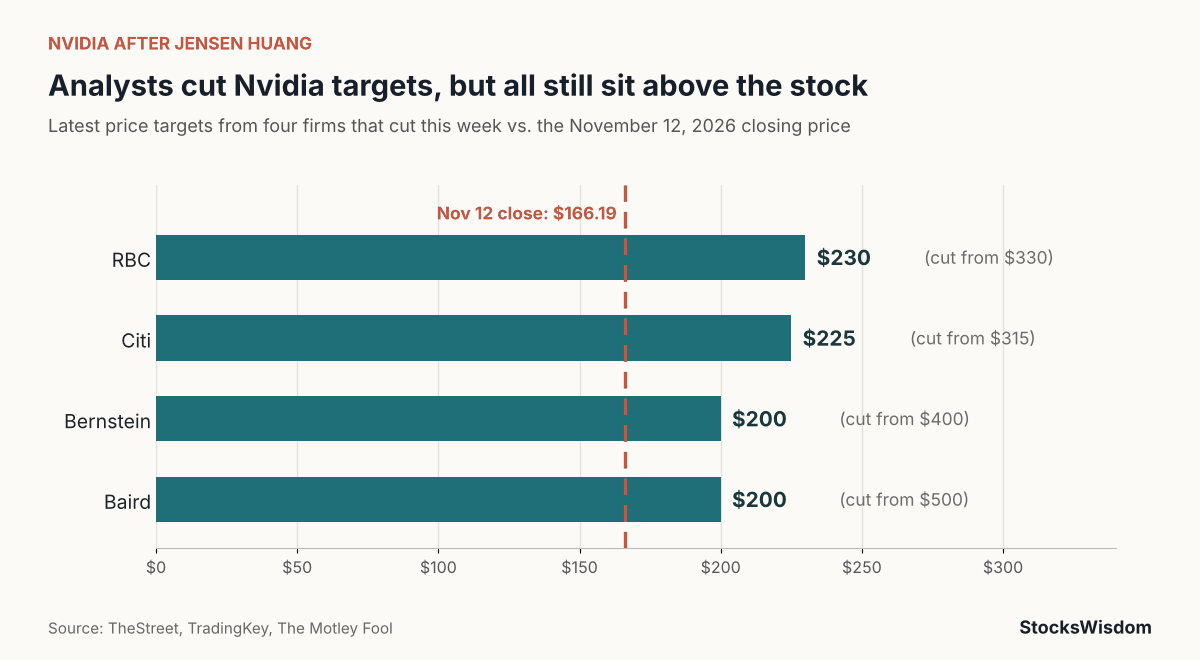
A 14% drop at the open looked like panic. A 4.3% loss at the close looked like math.
Here’s why buyers showed up. Nvidia’s business didn’t change overnight. Last quarter, revenue rose 106% from a year earlier to $96.2 billion, and data center sales jumped 117%. The company guided for about $108 billion in fiscal third-quarter revenue. We broke down those numbers in Nvidia Earnings Explained.
Chips already ordered by the big cloud companies don’t get canceled because the CEO left. At roughly 19 times earnings, per Seeking Alpha figures cited by TheStreet, the stock was already priced for some trouble.
Still, Nvidia now sits about 31% below its October 6 record close of $239.24. That’s a real drawdown for a company that was close to 6% of the S&P 500 at the end of October.
Money didn’t leave AI. It moved. AMD jumped 5.9% and Broadcom gained 5.5% on Thursday as traders bet that customers might spread orders around while Nvidia sorts out its leadership.
That bet makes sense on paper. Big buyers hate depending on one supplier, and a leadership gap gives them a reason to test alternatives. Our recent look at AMD’s Q3 earnings shows it already had momentum in data centers.
But switching AI chips isn’t like switching phone carriers. Nvidia’s CUDA software is baked into years of developer work. Market share shifts, if they come, will take quarters, not days.
Sudden CEO departures over personal conduct aren’t new. When McDonald’s ousted Steve Easterbrook in November 2019, the stock fell about 2.7% the next day, per CNBC. Intel’s Brian Krzanich resigned in 2018 after a probe into a past relationship with an employee, and the business kept running.
Huang is a different case. He’s a founder with 33 years at the top and about a 3.6% stake, per Al Jazeera. Founder exits tend to hit harder because investors priced in the person as much as the company. Apple after Steve Jobs kept growing for years, though, so a founder leaving isn’t automatically the end of the story.
If you own an S&P 500 or Nasdaq 100 index fund, you own a lot of Nvidia whether you picked it or not. A single-stock shock like Thursday’s moves your 401(k) a little. Don’t let it push you into selling a diversified fund.
If you own Nvidia shares directly, ask yourself one question: did you buy the business or the CEO? If it was the business, Tuesday’s earnings will tell you more than any headline this week. If it was Huang, this is a fair moment to rethink your position size.
And if you’re tempted to buy the dip, size it small. Leadership searches can drag on, and new CEOs often reset expectations lower in their first year. If you want a quick read on how sentiment is moving before you act, StocksWisdom shows a stock’s sentiment, technical signals and 30-day forecast in one place, which helps when the headlines are this loud.
One more thing. This is also a good test of your own risk tolerance. If a 14% morning drop made you queasy, your portfolio may be too concentrated.
Nvidia didn’t state a reason. The resignation followed a board investigation that began November 8 after media reports about Huang’s personal life.
CFO Colette Kress is interim CEO and keeps her CFO role. The board is searching for a permanent CEO and will consider inside and outside candidates.
Yes. Nvidia will report fiscal third-quarter results on Tuesday, November 17, at about 1:20 p.m. Pacific time, with the call at 2 p.m.
Would you buy Nvidia without Jensen Huang, or is this the moment you finally trim? Tell us in the comments.
Not financial advice. Do your own research.