Physical Address
304 North Cardinal St.
Dorchester Center, MA 02124
Physical Address
304 North Cardinal St.
Dorchester Center, MA 02124

Sanofi is buying Insmed for $175 a share in cash. The French drugmaker announced the deal before the opening bell on Tuesday, putting a total equity value of about $41.0 billion on the New Jersey biotech, according to Sanofi’s press release.
Insmed shareholders cheered. The stock jumped 14.13% and closed $4.85 below the offer price, per StockTitan’s market wrap, on a day when the Nasdaq fell 1.48% and healthcare was one of the few corners of the market in the green. Sanofi’s U.S.-listed shares rose 10.97%, which is unusual. Buyers usually get punished on deal day.
If you own Insmed, or you’re wondering whether to chase a stock after a buyout headline, this one is a clean example of how an all-cash takeover works. Let’s walk through it.
Here are the headline terms, straight from the Insmed announcement:
| Deal term | Detail |
|---|---|
| Price per share | $175 in cash |
| Total equity value | About $41.0 billion (about €37.6 billion) |
| Premium | About 46% to the Nov. 18 unaffected close |
| Financing | Debt plus cash on hand, committed financing secured |
| Approvals needed | Insmed shareholders, U.S. and some non-U.S. regulators |
| Expected closing | First half of 2027 |
| Impact on Sanofi | Accretive to business EPS by end of 2028, no change to 2026 guidance |
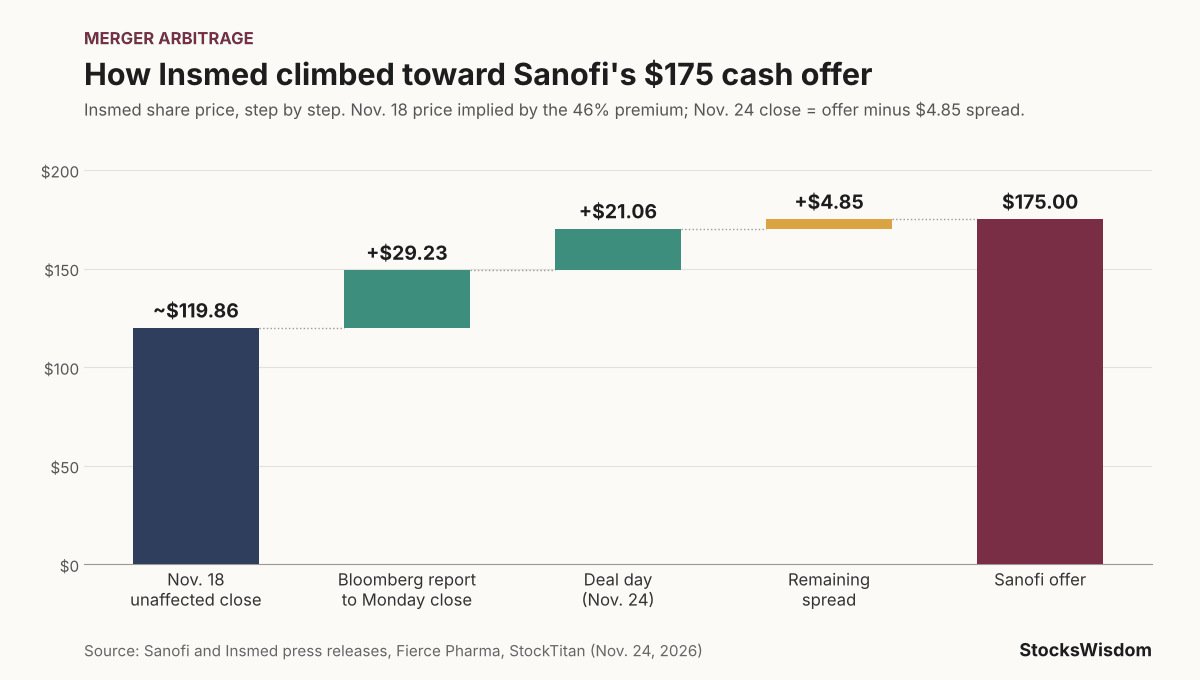
That 46% premium needs a little context. Sanofi measured it from Nov. 18, which the companies call the “unaffected” price, because the next day Bloomberg reported that Sanofi was weighing a bid. Insmed shares jumped 18% that Thursday, according to TIKR, adding roughly $5 billion of market value in a single session.
So by Monday’s close of $149.09, a lot of the premium was already baked in. Measured from that price, $175 is about 17% higher.
One word: Dupixent.
Sanofi’s blockbuster eczema and asthma drug brings in about two-fifths of the company’s revenue and faces a 2031 patent expiry, as Fierce Pharma points out. Sanofi needs new growth before that cliff, and buying it is faster than building it.
Insmed brings three assets:
Fierce cites Guggenheim analysts who think combined peak sales of the three could top $15 billion. That’s the bet Sanofi is making.
“This acquisition is a major strategic step to significantly accelerate our mid- and long-term growth trajectory,” said Sanofi CEO Belén Garijo in the release.
Big. Fierce calls it Sanofi’s largest deal since the 2004 Aventis merger, well above the $20.1 billion upfront it paid for Genzyme in 2011.
It’s also a stretch on Sanofi’s own stated limits. Back in April, CFO François Roger talked about spending up to €25 billion on a commercial asset. This deal runs about $14 billion past that ceiling, by Fierce’s math. Sanofi says it’ll keep its progressive dividend and a strong credit rating.
Here’s the part that confuses newer investors. If Sanofi is paying $175, why would anyone sell at about $170?
Because $175 is a promise, not a payment. Cash arrives only when the deal closes, which the companies expect sometime in the first half of 2027. Until then, a few things could go wrong. Regulators could object. Insmed shareholders could vote no (unlikely at this premium).
That gap between the market price and the offer is called the merger arbitrage spread. On Tuesday it was $4.85, or about 2.9% of Insmed’s closing price.
Spread traders, often hedge funds, buy the target and wait to collect that last few dollars. If the deal closes around mid-2027, 2.9% over roughly seven months works out to something like 4.5% to 5% a year. That’s in the neighborhood of what a 10-year Treasury pays right now (about 4.9%), which tells you the market sees this deal as fairly safe. Riskier deals trade at much wider spreads.
The chart below shows how Insmed’s share price climbed from its undisturbed level before the Bloomberg report to Tuesday’s close, and the small gap still left to the $175 offer.
If you own Insmed shares, you’ve got three choices.
Taxes matter here. An all-cash deal is a taxable sale. If you hold Insmed in a regular brokerage account, you’ll owe capital gains tax on the difference between your cost basis and $175 when the deal closes. Held more than a year, it’s a long-term gain at the lower rate. In an IRA or 401(k), there’s no tax hit at closing.
If you’re thinking about buying Insmed now, be clear about what you’re getting. The upside is capped at about $175. You’re no longer buying a growth biotech, you’re buying a short-term, bond-like payout with a small chance of the deal breaking. If it breaks, the stock could fall back toward where it traded before the Bloomberg report, roughly $120.
If you own Sanofi, you now hold a company betting big on lung disease to offset the Dupixent cliff.
For more on why targets usually rise and buyers often slip on deal news, see our earlier explainer on the impact of corporate mergers on stock prices.
Buyout days tempt people to go hunting for “the next Insmed.” But guessing the target is mostly luck. Most rumored deals never happen, and stocks that run up on speculation can drop hard when nothing is announced.
A more grounded approach is to own companies you’d be happy to hold even if nobody ever bids. If you want a quick read on a stock before you buy, StocksWisdom shows its sentiment, technical signals and a 30-day forecast in one place, which can help you spot when hype has run ahead of the price.
Tuesday’s split market made the same point. While AI chip stocks slid, healthcare names held up, a reminder that money rotates rather than disappearing. We covered the other side of that swing in yesterday’s piece on the stock market rebound.
Yes, if the deal closes. Your broker will remove the INSM shares from your account and deposit $175 in cash for each one. You don’t need to do anything, though you can vote at the shareholder meeting once Insmed files its proxy statement.
Both companies expect closing in the first half of 2027, subject to regulatory and shareholder approvals plus other customary conditions.
It can, though it’s not the base case. Insmed’s own SEC filing lists events that could lead to termination of the merger agreement among its risks. The narrow spread suggests the market sees a low chance of that.
Would you hold Insmed until closing for the last $4.85, or take the cash now and put it to work somewhere else?
Not financial advice. Do your own research.