Physical Address
304 North Cardinal St.
Dorchester Center, MA 02124
Physical Address
304 North Cardinal St.
Dorchester Center, MA 02124


Quick answer: Since 1928, the S&P 500 has fallen an average of 1.1% in September and finished the month higher only about 44.5% of the time, which makes it the weakest month on record. But that average hides huge swings, and trying to dodge it has usually cost investors more than it saved.
Wall Street came back from the Labor Day weekend in a bad mood. On Tuesday the Dow dropped about 1.2%, or roughly 600 points, the S&P 500 fell 0.6% and the Nasdaq slipped 0.3% (TheStreet). Brent crude closed near $98 a barrel and the 10-year Treasury yield climbed to about 4.8%.
Right on cue, the headlines are back: September is the worst month for stocks. So is the “September effect” real, and should you do anything about it?
The September effect is the pattern that U.S. stocks have historically done worse in September than in any other month.
The numbers are real. According to data cited by The Motley Fool, the S&P 500 has dropped an average of 1.1% in September since 1928. It has finished the month in positive territory only about 44.5% of the time. Every other month has done better on average.
That sounds like a strong signal. It isn’t as strong as it looks.
Nobody has a definitive explanation, but there are a few popular theories:
That last point matters most. A pattern that everyone knows about tends to get traded away. If investors were sure September would be bad, they’d sell in August, and the weakness would show up a month earlier instead.
This year there are real reasons for nerves, and none of them have anything to do with the calendar.
Oil is flirting with $100 because of the conflict with Iran and attacks on Saudi energy facilities. Last Friday’s jobs report showed 162,000 new jobs in August, far above the 12-month average of about 31,000, which raised the odds that the Federal Reserve hikes rates at its meeting next week. The latest inflation numbers come out Thursday and Friday.
So if stocks fall this month, it will probably be because of oil, inflation and the Fed. Not because the calendar says September.
Here’s the strongest argument against acting on the September effect.
Fidelity looked at what happened to $10,000 invested in the S&P 500 at the start of 1988 and left alone. By the end of 2025 it grew to roughly $616,000. If you missed just the five best trading days in that entire stretch, you ended with about $380,000 (as cited by The Motley Fool).
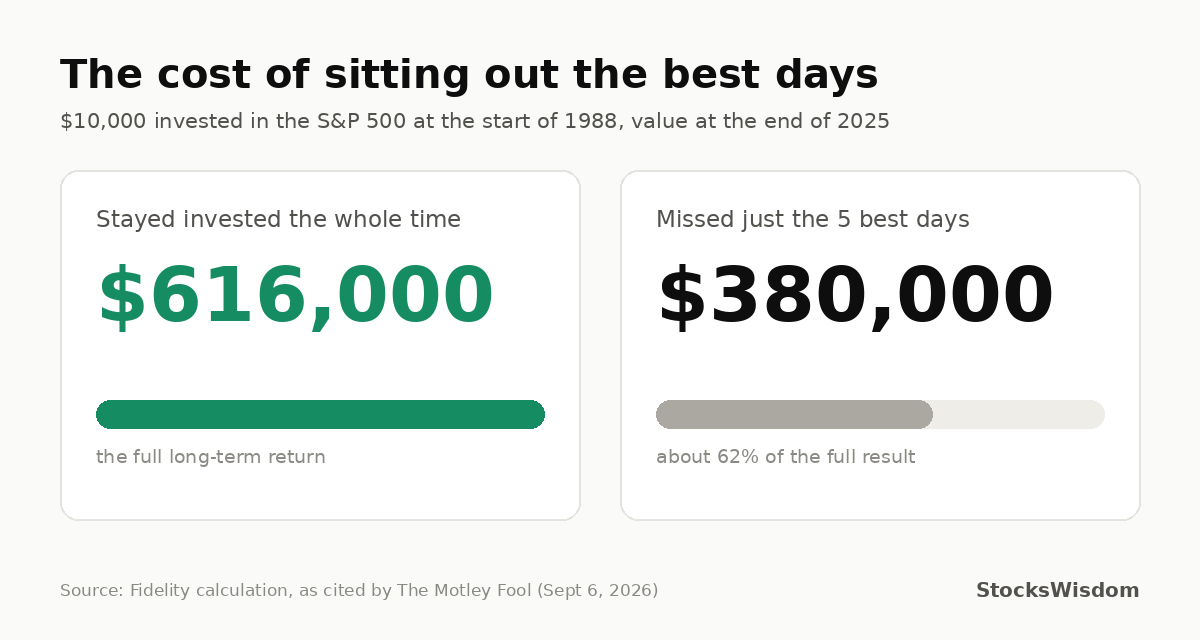
The best days often show up right after the worst ones, usually in the middle of a scary stretch. Investors who sell to “skip” a bad month tend to be sitting in cash when the big rebound day arrives.
You don’t need a September strategy. You need a strategy that works in any month.
If you want a second opinion before buying into a dip, StocksWisdom shows each stock’s technical indicators and news sentiment, which helps you tell a temporary drop from a stock that’s breaking down.
The September effect is real in the history books. Its average is small, it varies wildly from year to year, and it’s far less important than inflation, interest rates and earnings. This year, those forces are front and center anyway.
Stay invested, stick to your plan, and let the calendar be a curiosity rather than a trading signal. Do you change anything in your portfolio when September rolls around?
Not financial advice. Do your own research.