Physical Address
304 North Cardinal St.
Dorchester Center, MA 02124
Physical Address
304 North Cardinal St.
Dorchester Center, MA 02124


Going into last Wednesday, Nvidia had a strange streak. The stock had fallen the day after each of its previous four earnings reports, even when the numbers beat expectations (The Motley Fool).
This time it broke the pattern. Nvidia reported $96.2 billion in quarterly revenue, guided even higher, and the stock jumped roughly 6% to 9% on Thursday, its biggest one-day gain since April 2025 (Kiplinger). That added more than $400 billion to its market value in a single session.
Nvidia earnings are now one of the most important events on the market calendar. The company is a huge slice of the S&P 500, so its results move most people’s retirement accounts whether they own NVDA directly or not. Here’s how to read the report in plain English.
From the company’s official release for the quarter ended in July (Nvidia calls it Q2 of fiscal 2027):
Nvidia used to be known for gaming graphics cards. Today, data center chips are almost the whole business. Of the $96.2 billion in revenue, $89.0 billion, about 93%, came from data centers. Everything else, which Nvidia now reports as edge computing, brought in $7.2 billion.
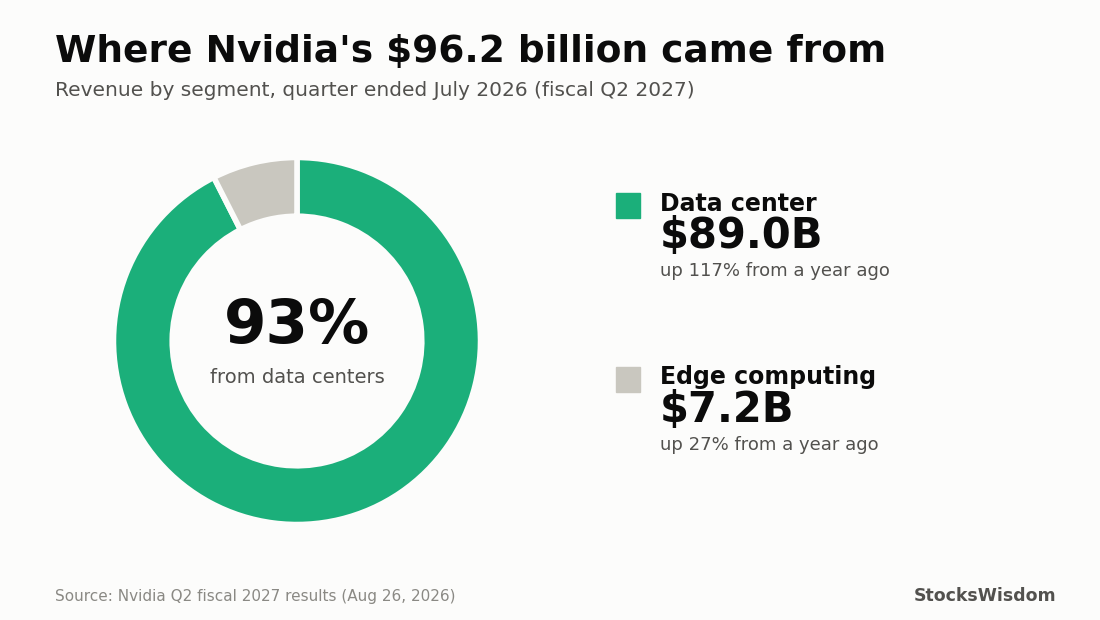
That means Nvidia’s results are really a measure of how much the biggest tech companies are spending on AI. And they’re spending a lot. On the call, Nvidia pointed to hyperscaler capital spending of roughly $800 billion in 2026 and $1.3 trillion in 2027, plus an order backlog above $2 trillion.
Here’s the part most beginners miss. Wall Street already expected a huge quarter. Beating estimates is the minimum.
What investors really trade on is the outlook. Nvidia guided to $108 billion next quarter, and CEO Jensen Huang said he expects revenue to grow about 70% in fiscal 2028, calling the business “supply-constrained.” In other words, Nvidia says it could sell even more if it could make more chips.
That forward view is what pushed the stock higher. “AI has reached its inflection point,” Huang said in the release. “Now, compute is revenue.”
The Motley Fool’s review of the last 13 quarters makes the same point. There’s no consistent link between how big Nvidia’s earnings beat is and how the stock reacts the next day. Guidance matters more than the past quarter.
Nobody can answer that for you, but here’s how to think about it.
The bull case. Revenue doubled from a year ago, margins are near record highs and customers are telling Nvidia they’ll spend even more next year. Demand still exceeds supply. For a company this size, that’s extraordinary.
The bear case. Nvidia’s growth depends on a small group of very large customers. If Microsoft, Amazon, Alphabet or Meta slow their spending, Nvidia feels it fast. In July, investors already punished Big Tech companies whose AI spending wasn’t showing up clearly in revenue. Competition from custom chips and from rivals is also growing, and a stock this large has a lot of good news built into its price.
The middle ground. Many long-term investors already own plenty of Nvidia through index funds, since it’s one of the largest companies in the S&P 500. Before buying more, check how much of your portfolio already depends on one company and one trend.
You don’t need to be an analyst to follow along. Next time, look for four things:
If you want to see how sentiment shifts around reports like this one, StocksWisdom tracks NVDA’s news sentiment, technical signals and 30-day forecast in one place, so you can see whether a post-earnings move is holding.
Nvidia just showed that the AI spending boom hasn’t slowed down. The question for the next few quarters is whether it can keep growing this fast as the numbers get bigger. Are you adding to Nvidia after this report, or waiting for a better price?
Not financial advice. Do your own research.