Physical Address
304 North Cardinal St.
Dorchester Center, MA 02124
Physical Address
304 North Cardinal St.
Dorchester Center, MA 02124


People are flying more than ever. Delta just proved it doesn’t matter as much as you’d think.
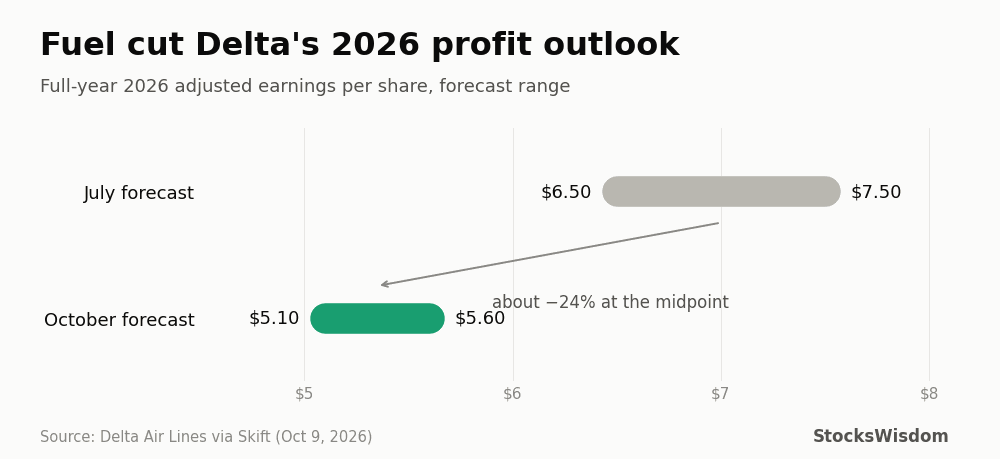
Delta Air Lines kicked off earnings season on Thursday with record-looking demand: third-quarter revenue jumped 16% to $17.59 billion, and premium ticket sales rose 18% (Skift). Then it cut its full-year profit forecast by about a quarter. The reason was one line on the income statement: fuel.
Delta’s fuel bill was 62% higher than a year ago, and the company now expects about $6 billion in extra fuel costs this year (24/7 Wall St.). Here’s what Delta’s earnings tell you about airline stocks when oil sits near $100 a barrel, and how to read an airline report yourself.
The stock fell about 3% in early trading, and United and American slipped about 1%.
It’s easy to see “profit warning” and assume travel is slowing. The opposite is true.
CEO Ed Bastian said demand “remains strong, supported by consumers’ growing preference for experiences and travel.” Unit revenue, a key measure of how much an airline earns per seat it flies, rose in every region: 16% domestically, 11% across the Atlantic, 13% across the Pacific and 22% in Latin America. And Delta did all of that without adding flights. Capacity was flat.
That’s the strongest pricing environment the airline industry has seen in a long time. If fuel were at last year’s prices, this would have been a blowout quarter.
Jet fuel is one of an airline’s two biggest costs, alongside labor. Delta said jet fuel averaged about $4.50 a gallon as of Thursday evening, and it expects about $4.25 in the fourth quarter. Crude oil and the “crack spread,” the margin refiners earn turning crude into jet fuel, are both running above where they were in July.
The math is brutal. Airlines burn billions of gallons a year, so every extra dime per gallon adds up to hundreds of millions of dollars. And unlike a manufacturer, an airline can’t easily pause production. Planes already scheduled still have to fly.
Airlines can raise fares to make up for it, and they have been. But fares follow fuel with a lag. Tickets for October flights were often sold in July and August, before the latest jump in oil prices. That gap is where profits get squeezed.
Airline reports are full of jargon. Four numbers tell you most of the story:
Delta’s quarter scored well on the first and fourth, and badly on the third. That combination tells you the business is healthy but exposed to commodity prices.
The bull case: demand is strong, premium travel keeps growing, and Delta’s loyalty program and credit card partnership provide steady income that doesn’t depend on fuel. If oil eases, earnings could rebound quickly. Delta’s CFO also noted that most new industry capacity heading into early 2027 is in markets where Delta isn’t a major player.
The bear case: the company just cut its forecast by about a quarter, and fuel is still expensive. Oil has been swinging on news about Iran and a Gulf hurricane. Airline stocks also tend to fall hard in recessions.
The realistic version: buying airline stocks right now is mostly a bet on oil prices. If you think tensions in the Middle East will ease and crude will fall, airlines are among the biggest winners. If you think $100 oil is here to stay, there are safer places to put your money.
To see how sentiment on DAL and other airline stocks shifts as oil moves, StocksWisdom shows each stock’s news sentiment, technical indicators and 30-day forecast side by side.
If you’re booking holiday flights, expect fares to stay firm. Delta is still growing revenue about 20% in the fourth quarter, and airlines have every reason to keep passing higher fuel costs on to passengers. Booking earlier usually helps when demand is strong and costs are rising.
Delta’s report is a clear example of a great business having a tough quarter for reasons outside its control. Would you buy airline stocks here, or wait for oil to cool off first?
Not financial advice. Do your own research.