Physical Address
304 North Cardinal St.
Dorchester Center, MA 02124
Physical Address
304 North Cardinal St.
Dorchester Center, MA 02124


CoreWeave stock fell about 11% on Friday, and it took a big chunk of the AI trade down with it. The Nasdaq Composite dropped 2.14% to 26,140, the S&P 500 lost 1.09% to about 7,659, and the Dow slipped just 0.34%. Tech stocks in the S&P 500 fell roughly 3% in a single session.
For the week, the Nasdaq lost about 4.5%. That’s its worst week since late June, according to Investing.com. Meanwhile, the Dow actually finished the week up 0.7%.
So what spooked everyone? Not a bad earnings report. Not the Fed. It was debt. Specifically, the roughly $50 billion that CoreWeave, one of the biggest renters of Nvidia chips, has borrowed to build AI data centers. Investors started asking a simple question: what happens if the money coming in can’t keep up with the bills?
CoreWeave is a “neocloud.” It buys huge numbers of Nvidia GPUs, puts them in data centers, and rents that computing power to AI companies. Business is booming. Its second-quarter revenue hit $2.58 billion, up about 112% from a year earlier, and it reported a revenue backlog of roughly $104 billion, per the company’s Q2 2026 results release.
The problem is how it pays for all that hardware.
Earlier this week, a chart of CoreWeave’s spiking bond yields went viral, and the cost to insure its debt against default hit a record. The stock dropped 7% on Thursday before bouncing. Then Nvidia CEO Jensen Huang spoke at a Bloomberg event in Stockholm. “CoreWeave’s strength is improving every day,” he said, adding, “I’m optimistic. Their cost of capital is actually decreasing,” as reported by Yahoo Finance.
Shares rose 5.9% Thursday on those comments. By Friday afternoon they’d given all of it back and more, trading near $62.
Here’s the number that matters most. CoreWeave has a bond paying a 9.75% coupon that matures in 2031. According to Forbes, that bond now trades at a price that gives buyers a yield to maturity of about 15.7%.
Why does that matter to a stock investor?
Bond prices and yields move in opposite directions. When bondholders get nervous, they sell, the price drops, and the yield climbs. A 15.7% yield means lenders are demanding stock-like returns just to hold a loan. That’s the bond market saying it sees real risk of not getting paid back in full. And bondholders get paid before shareholders do. If lenders are worried, shareholders should be paying attention.
| CoreWeave snapshot | Figure |
|---|---|
| Total debt | About $52 billion |
| Market value of the stock | About $35 billion |
| Q2 2026 revenue | $2.58 billion |
| Q2 2026 net interest expense | $640 million |
| Q2 2026 net loss | $626 million |
| Yield on 9.75% bond due 2031 | About 15.7% |
Look at the interest line. CoreWeave spent $640 million on interest in one quarter, about a quarter of its revenue. When a company owes more than its entire stock market value, small changes in borrowing costs hit shareholders hard.
CoreWeave isn’t a huge company by Nasdaq standards. Its slide mattered because it raised a bigger fear. If the companies buying AI chips with borrowed money get squeezed, they buy fewer chips.
Other worries piled on. A Gartner report predicted that by 2030, 80% of neocloud providers will no longer operate independently. Memory stocks got hit after reports of progress at China’s ChangXin Memory Technologies. And reports said investors were pushing back on Anthropic’s hoped-for IPO valuation, talking about roughly $1.5 trillion instead of $2 trillion.
The chart below shows how the damage spread this week, from the blue-chip Dow, which actually rose, to the memory chip makers that got crushed.
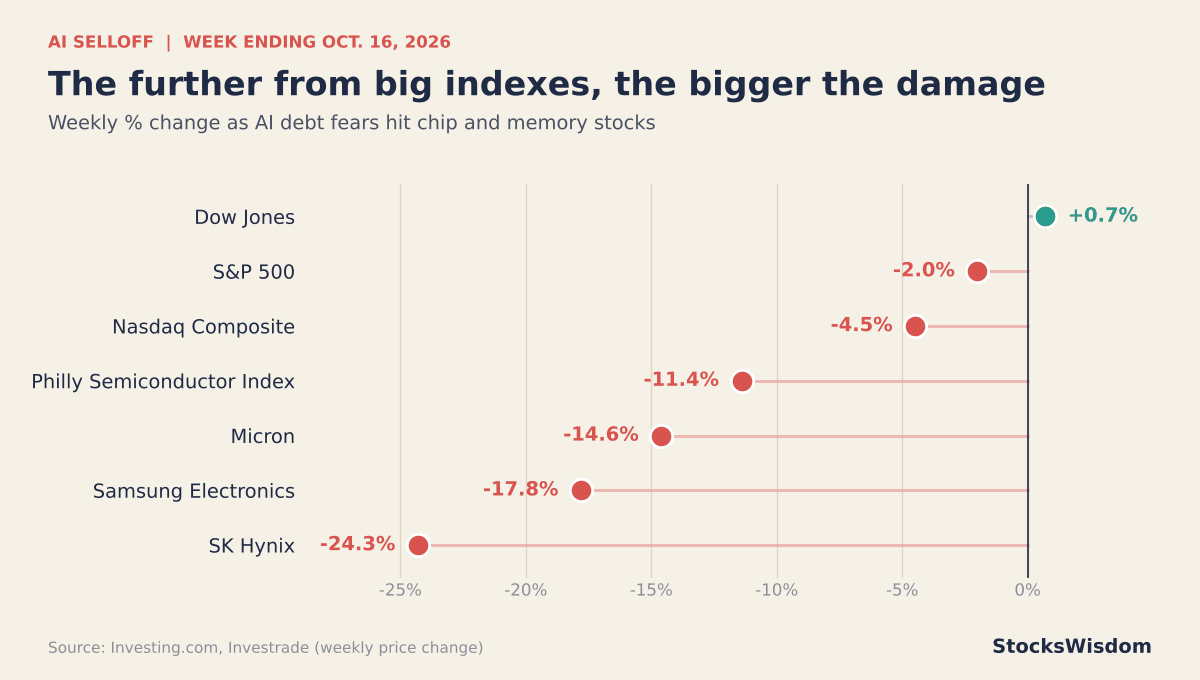
The Philadelphia Semiconductor Index fell 11.4% for the week, its worst week since early April 2025. It also posted its eighth straight daily decline. Micron lost 14.6% on the week, Samsung Electronics dropped 17.8%, and SK Hynix fell 24.3%.
Zoom out and this looks less like panic and more like money moving around.
Energy stocks rose about 2.5% Friday as Brent crude settled near $110 a barrel. Bank earnings were solid. The equal-weight S&P 500, where every company counts the same, had its best week relative to tech since 2009, per Investrade’s market review.
Michael O’Rourke of Jones Trading said the market is worried that “2026 will mark the peak for earnings growth” and that investors are “repositioning defensively.”
One streak did end, though. Friday’s drop snapped a run of 55 trading days without a 1% decline in the S&P 500, the longest in more than six years. Calm markets make 1% days feel bigger than they are.
If you own an S&P 500 or Nasdaq index fund, you own a lot of AI. The biggest companies in those indexes are chipmakers and cloud giants, so a week like this one shows up in your 401(k) even if you’ve never heard of CoreWeave.
A few practical points:
If you want a quick read on any single stock before deciding anything, StocksWisdom shows a stock’s sentiment, technical signals and 30-day forecast in one place, which is handy on weeks when headlines move faster than fundamentals.
For borrowers and savers, there’s a small bright spot. The 10-year Treasury yield settled near 5.10%, down about 0.15 percentage point for the week. Traders also cut the odds of a Fed rate hike at the late-October meeting to about 17%, from nearly 28% a day earlier, based on CME FedWatch data.
There’s no sign of that right now. It has a $104 billion backlog and fast-growing revenue. But its debt is large compared with its stock value, and bond investors are pricing in real risk. That’s worth respecting.
It’s a newer cloud company, like CoreWeave or Nebius, that focuses on renting GPU computing power for AI. Unlike Amazon or Microsoft, neoclouds don’t have giant profitable businesses to fund their buildout, so they borrow more.
That depends on your timeline and how much of your money is in tech. If a 4% weekly drop keeps you up at night, you may be too concentrated. Rebalancing on a schedule usually beats selling in a panic.
Are you trimming your AI stocks after this week, or buying the dip? Tell us in the comments.
Not financial advice. Do your own research.