Physical Address
304 North Cardinal St.
Dorchester Center, MA 02124
Physical Address
304 North Cardinal St.
Dorchester Center, MA 02124

One day. That’s how long Wall Street’s post-election party lasted.
On Wednesday the Dow jumped 1,569 points, its best day after a midterm in 44 years. On Thursday, November 5, chip stocks crashed and took everything else with them. The Philadelphia Semiconductor Index (SOX) lost 12.25% to close at 9,011.14. The Nasdaq fell 5.52%, the S&P 500 dropped 4.36% and the Dow shed 1,833 points, per Yahoo Finance.
That’s the S&P 500’s worst session since April 2025. For chipmakers, you have to go back to March 2020 to find a day this ugly. So what happened, and should you do anything about it?
Selling started at the open and never let up. By late morning the Nasdaq sat more than 10% below its October 6 record, which officially put it in correction territory. It closed at 24,315, about 11.9% under that record close of 27,599.89 reported by GV Wire, and below its 200-day moving average for the first time since April.
No sector escaped. Even defensive groups like utilities and consumer staples, which held up in the morning, rolled over by the close.
| Index | Close | Daily change |
|---|---|---|
| Dow Jones Industrial Average | 51,523.06 | -3.44% |
| S&P 500 | 7,353.73 | -4.36% |
| Nasdaq Composite | 24,315.00 | -5.52% |
| Russell 2000 | 2,729.89 | -4.45% |
| PHLX Semiconductor (SOX) | 9,011.14 | -12.25% |
Wall Street’s fear gauge, the VIX, jumped about 70% to roughly 28, its highest reading since March. Small caps didn’t offer shelter either. The Russell 2000 slid into its own correction.
Three things hit at once.
First, politics. Democrats swept Congress on Tuesday, and investors spent Thursday rethinking what that means for the AI buildout. Data centers have become a political fight because they eat electricity and push up power bills. Fortune counted 41 ballot measures aimed at slowing data center construction, and most passed. In Texas, where Wells Fargo estimates 27% of planned data center gigawatts sit, Democrat Gina Hinojosa beat Gov. Greg Abbott. UBS strategists now think about 30% of expected 2028 data center additions are at risk.
Second, earnings. Qualcomm’s outlook disappointed, and the company warned that the chip industry is facing “a broad-based increase in input costs.” Microsoft also took a tougher stance on so-called neocloud projects, which hammered names like CoreWeave.
Third, positioning. These stocks were 2026’s biggest winners, and big winners attract crowded trades. Nomura’s Charlie McElligott described hedge funds rushing to lock in gains before year-end. His summary of the AI selloff: “They’re shooting the generals.”
Nvidia, the generals’ general, fell 9.26% to $181.60. That leaves it below where it ended 2025, which means the year’s gain is gone. Nvidia actually held up better than most of its peers.
Memory and custom chip makers took the worst of it. Here’s the regular-session damage for eight big chip names, based on closing data compiled by StockTitan. The chart below shows how far each one fell on Thursday.
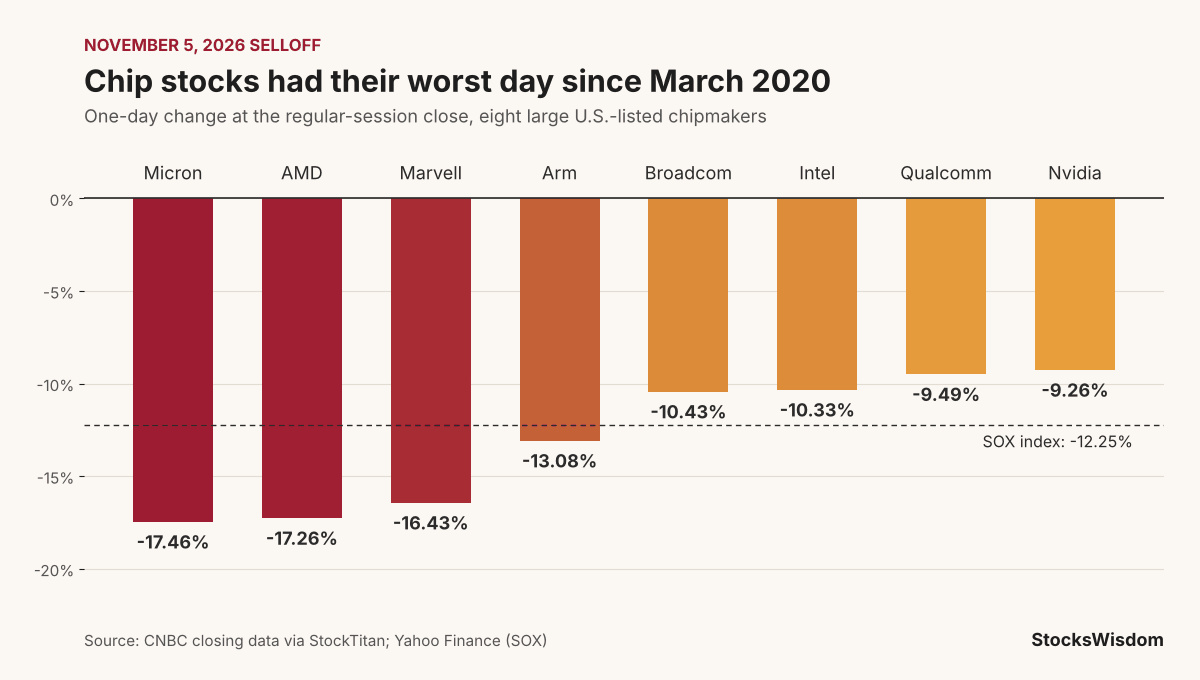
Micron dropped 17.46%. AMD lost 17.26%, just two days after an upbeat revenue forecast sent the stock higher (we covered that in our AMD Q3 2026 earnings breakdown). AMD CEO Lisa Su pushed back, saying the market “can sometimes be a little bit short-sighted” and that she sees no slowdown in AI chip demand.
It wasn’t only chips. Tesla and SpaceX each fell more than 9% on regulatory worries, and Palantir and CrowdStrike were down more than 10% at their lows.
Depends who you ask.
Jed Ellerbroek of Argent Capital Management told Reuters it “feels like the capitulation phase for the data center capex beneficiary stocks,” then added that “the magnitude of the moves is outsized.” eToro analyst Jakub Rochlitz, quoted by Fox Business, put it more bluntly: the market thinks “the AI infrastructure buildout will become slower and more expensive.”
Both can be true. Policy risk is real. Ballot measures and permit pauses don’t vanish because a stock got cheaper. But a 12% one-day drop in a whole sector usually says more about crowded trades than about a sudden collapse in demand. Chip orders didn’t change between Wednesday and Thursday. Expectations did.
That distinction matters for anyone holding these stocks. A stock price is a bet on years of future profits. If investors decide data centers will get built two years later than planned, or cost 20% more in power and permits, those future profits shrink on paper right away. Nothing in the companies’ order books has to change for the price to fall.
If you own an S&P 500 index fund, you lost a bit more than 4% in a day. If you own a Nasdaq-100 fund like QQQ, which fell 6.49%, it hurt more. Most people’s 401(k)s are much heavier in tech than they realize, because chipmakers and AI giants make up a huge slice of the big indexes.
Here’s what history says. According to The Motley Fool, citing Schaeffer’s Research data since 1971, the Nasdaq has averaged a 13.6% gain in the six months after first closing 10% below a high, and was higher 73% of the time. The catch? Roughly 37% of Nasdaq corrections since 1971 turned into bear markets. We explained how those two differ in Correction vs Bear Market.
Retail investors did the opposite of patient on Thursday. Vanda Research said individuals sold a net $358 million of stocks by mid-afternoon, their heaviest selling since March 2020. Vanda’s Viraj Patel called it “a total capitulation by retail investors.” Selling at the bottom of a scary day is how a paper loss becomes a real one.
A few practical moves:
Savers and borrowers got a small break. The 10-year Treasury yield slipped to about 4.84% as money ran to safety, which can nudge mortgage rates lower. Rate hikes are still on the table, though. Traders now see a 70.1% chance the Fed raises rates in December, down from 82.7% on Wednesday, per CME FedWatch.
Investors worried that the Democratic midterm sweep and dozens of local ballot measures will slow data center construction, the biggest source of AI chip demand. Weak guidance from Qualcomm and heavy profit-taking by hedge funds made the drop worse.
Yes. It closed about 11.9% below its October 6 record, past the 10% line that defines a correction. A bear market starts at a 20% decline.
Selling after a 12% sector drop locks in the loss. A better first step is checking whether your portfolio is too concentrated in one area and whether you’ll need the money within a few years.
Did you buy, sell or sit tight on Thursday? Tell us in the comments.
Not financial advice. Do your own research.