Physical Address
304 North Cardinal St.
Dorchester Center, MA 02124
Physical Address
304 North Cardinal St.
Dorchester Center, MA 02124

Wall Street threw a party on Monday, and Nvidia wasn’t invited. The Dow jumped 1,104 points, the S&P 500 rose 2.35% and the Nasdaq gained 2.74% as oil slid and chip stocks bounced hard. Nvidia, the company most people think of as the engine of the AI trade, closed down 4.27% at $178.67.
The reason had nothing to do with chips. Over the weekend, Nvidia’s board said it had opened an investigation into whether CEO Jensen Huang was the target of a foreign intelligence effort, after reports from Bloomberg and Axios about his relationship with a woman U.S. officials suspected of working for a Chinese spy agency. Huang admitted to an extramarital affair in a note to staff.
So what does a personal scandal at the top of a $4 trillion company mean for your portfolio? More than you might think if you own an index fund, and less than the headlines suggest if you’re a long-term holder. Let’s walk through it.
The facts so far are thin, and that matters. According to Fox Business, the review will be run by a committee of independent directors with outside independent counsel. The board said it “has no reason to believe that either national security or NVIDIA secrets were compromised,” that the inquiry “will examine all available information,” and that Huang “fully supports the review.”
Directors also said they have confidence in Huang and his leadership team.
Huang apologized to employees, writing, “There is no excuse for what I did,” and said he’s committed to protecting Nvidia and supporting U.S. national security. China’s foreign ministry called the spy allegation “unsubstantiated.” President Trump called Huang “an honorable guy.”
Nobody has accused Huang of leaking anything. The market isn’t pricing a crime. It’s pricing uncertainty.
Nvidia had already been bruised. Shares fell 9.26% last Thursday during the AI chip rout we covered in why the SOX fell 12%, and the stock was more than 20% below its peak from a month earlier, per CNN via Yahoo Finance. Then came Monday.
| Monday, Nov. 9 close | Level | Change |
|---|---|---|
| Nvidia (NVDA) | $178.67 | -4.27% |
| S&P 500 | 7,549.94 | +2.35% |
| Nasdaq Composite | 25,253.14 | +2.74% |
| Dow Jones | 52,389.75 | +2.15% |
| 10-year Treasury yield | 4.86% | roughly flat |
Closing figures are from Yahoo Finance’s market blog. At one point in the morning Nvidia was down more than 8%, so buyers did step in. Using about 24.3 billion shares outstanding, the 4.27% close-to-close drop works out to roughly $190 billion in lost market value.
What makes this unusual is the gap. AMD rose about 12% on an Oppenheimer upgrade and Broadcom gained around 8%, according to TheStreet. Nvidia lagging its own sector by double digits on a day like that tells you the selling was about Nvidia’s leadership, not about AI demand.
Key-person risk is the chance that a company loses value because it depends heavily on one individual. Founder-CEOs are the classic case. Investors often pay a premium for a visionary leader, and that premium can shrink fast when the leader’s future looks shaky.
Huang co-founded Nvidia in 1993 and has run it ever since. He owns about 3.6% of the company, Reuters reported. Analysts see him as the strategist behind its bet on AI computing. “Jensen is the core DNA of Nvidia and its AI success and ambitions are heavily tied to him staying on as CEO,” Dan Ives of Yorkville Ives & Co. said.
That’s the worry in one sentence. The products, the customers and the supply contracts didn’t change over the weekend. What changed is the probability, however small, that the person steering all of it might not be there next year.
Citi framed the two questions investors are asking: does the probe turn up something serious enough to threaten Huang’s job, and could regulators respond in ways that limit sales? Nigel Green of deVere Group called it, “for now at least, a personal scandal.”
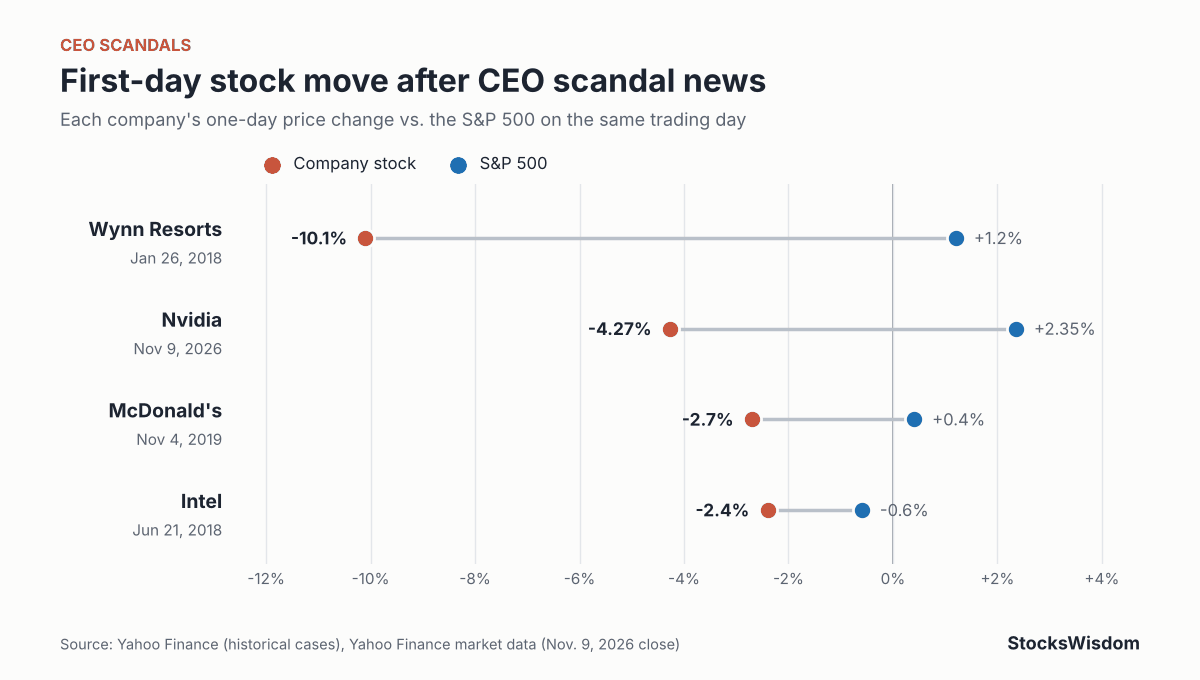
There’s a decent track record to look at. A Yahoo Finance analysis pulled three cases where a CEO left after personal-conduct problems: Intel in June 2018 (Brian Krzanich resigned over a past relationship with an employee), McDonald’s in November 2019 (Steve Easterbrook was fired over a relationship with an employee) and Wynn Resorts in January 2018 (misconduct allegations against Steve Wynn). The first-day drops averaged 5.1%.
Wynn was the outlier because the company was so closely tied to its founder’s name. Intel and McDonald’s fell less than 3% on day one. Six months later, McDonald’s had actually beaten the S&P 500.
The chart below shows how each stock moved on the first trading day after the news, compared with the S&P 500 on the same day.
Here’s the part most people miss. If you own an S&P 500 index fund, you own Nvidia. It makes up roughly 7% of the index, per CNN.
On a $10,000 S&P 500 position, about $700 sits in Nvidia. Monday’s drop cost that slice around $30. The other $9,300 had a great day, and the fund as a whole gained roughly $235. Diversification did exactly what it’s supposed to do.
That 7% weight cuts both ways, though. When one stock is that large, its bad weeks show up in your retirement account even if you’ve never bought a single share directly. If you want to see how concentrated your fund really is, check its top-10 holdings page.
For people who own Nvidia directly, the calculus is different. A few things to think about:
If you’d like a quick read on where the stock stands, StocksWisdom shows Nvidia’s current sentiment, technical signals and a 30-day forecast in one place, which helps separate a scary headline from what the chart is actually doing.
Nvidia reports third-quarter results on November 17, eight days from now. Normally investors hang on Huang’s comments about demand from cloud giants. This time, every analyst on the call will want to ask about the probe, and the company will probably say little while the review is open.
Strong numbers could calm things quickly. Our breakdown of Nvidia’s last quarter shows how much cash the business throws off, and a company doesn’t lose that because of a board inquiry. But a soft outlook combined with a leadership cloud would be a rough mix.
No. As of Monday, the board says it has confidence in him, and he’s cooperating with the review. Analysts like Dan Ives expect him to stay in the role with no near-term interruption.
That’s your call, but keep the math in mind. Nvidia is about 7% of the index, so a 4% drop in Nvidia alone moves the whole fund by roughly 0.3%. On Monday, the S&P 500 still rose 2.35%.
It depends on whether the CEO stays and whether the business gets hurt. In the three cases above, Wynn was still down 17.3% after six months, Intel was down 14.8%, and McDonald’s slipped 5.8% while the S&P 500 fell further.
Would you hold a stock through a CEO scandal if the business itself still looked strong, or is leadership risk a deal-breaker for you? Tell us in the comments.
Not financial advice. Do your own research.