Physical Address
304 North Cardinal St.
Dorchester Center, MA 02124
Physical Address
304 North Cardinal St.
Dorchester Center, MA 02124

Inflation is running hot again, and the Treasury just handed cautious savers one of the better deals around. Series I savings bonds bought from November 1, 2026, through April 30, 2027, pay a 5.51% annualized rate, up from 4.26% for bonds bought over the prior six months. That’s the highest new-issue I bond rate since late 2022, according to TheStreet.
But the headline number isn’t the real news. The fixed rate, the slice you keep for the entire life of the bond, jumped to 1.40%. You’d have to go back to November 2006 to find one this high.
That small number is what separates this round from the 9.62% frenzy of 2022, when buyers lined up for a fixed rate of exactly zero. So should you buy before the year ends? Here’s how the I bond rate works, what 5.51% actually gets you, and where it falls short.
An I bond’s rate has two parts. A fixed rate, which Treasury sets every May and November and which never changes once you buy. And an inflation rate, which resets every six months for every I bond outstanding, based on the change in CPI-U, the consumer price index that the Bureau of Labor Statistics publishes each month.
For this window, CPI-U rose 2.04% between March and September 2026. Double it and you get a 4.08% annualized inflation component. Treasury then combines the pieces with one formula:
Composite rate = fixed rate + (2 × semiannual inflation) + (fixed rate × semiannual inflation)
Plug in the numbers. 1.40% plus 4.08% plus a tiny 0.03% cross term gets you 5.51%. Tipswatch, the site run by I bond tracker David Enna, posted the same breakdown the day Treasury announced it.
Your 5.51% lasts six months. Period. In May 2027, the inflation part resets based on what prices did from September through March. If inflation cools, your rate falls. If it heats up, your rate rises.
The fixed rate doesn’t move. It’s locked for up to 30 years, and it’s your guaranteed return above inflation.
That’s why someone who bought in May 2022 at 9.62% now earns just 4.08%. Their fixed rate is 0%, so they earn inflation and not a penny more. A buyer this month earns inflation plus 1.40% for as long as they hold.
Try a quick scenario. Say inflation cools to 2% a year by 2028. A bond bought today would pay about 3.41% at that point. A May 2022 bond would pay 2%. Same economy, very different paycheck.
Here’s every six-month window since late 2021, per the rate history kept by Savings Bond Check.
| Purchase window | Composite rate | Fixed rate | Semiannual inflation |
|---|---|---|---|
| Nov 2021 to Apr 2022 | 7.12% | 0.00% | 3.56% |
| May 2022 to Oct 2022 | 9.62% | 0.00% | 4.81% |
| Nov 2022 to Apr 2023 | 6.89% | 0.40% | 3.24% |
| May 2023 to Oct 2023 | 4.30% | 0.90% | 1.69% |
| Nov 2023 to Apr 2024 | 5.27% | 1.30% | 1.97% |
| May 2024 to Oct 2024 | 4.28% | 1.30% | 1.48% |
| Nov 2024 to Apr 2025 | 3.11% | 1.20% | 0.95% |
| May 2025 to Oct 2025 | 3.98% | 1.10% | 1.43% |
| Nov 2025 to Apr 2026 | 4.03% | 0.90% | 1.56% |
| May 2026 to Oct 2026 | 4.26% | 0.90% | 1.67% |
| Nov 2026 to Apr 2027 | 5.51% | 1.40% | 2.04% |
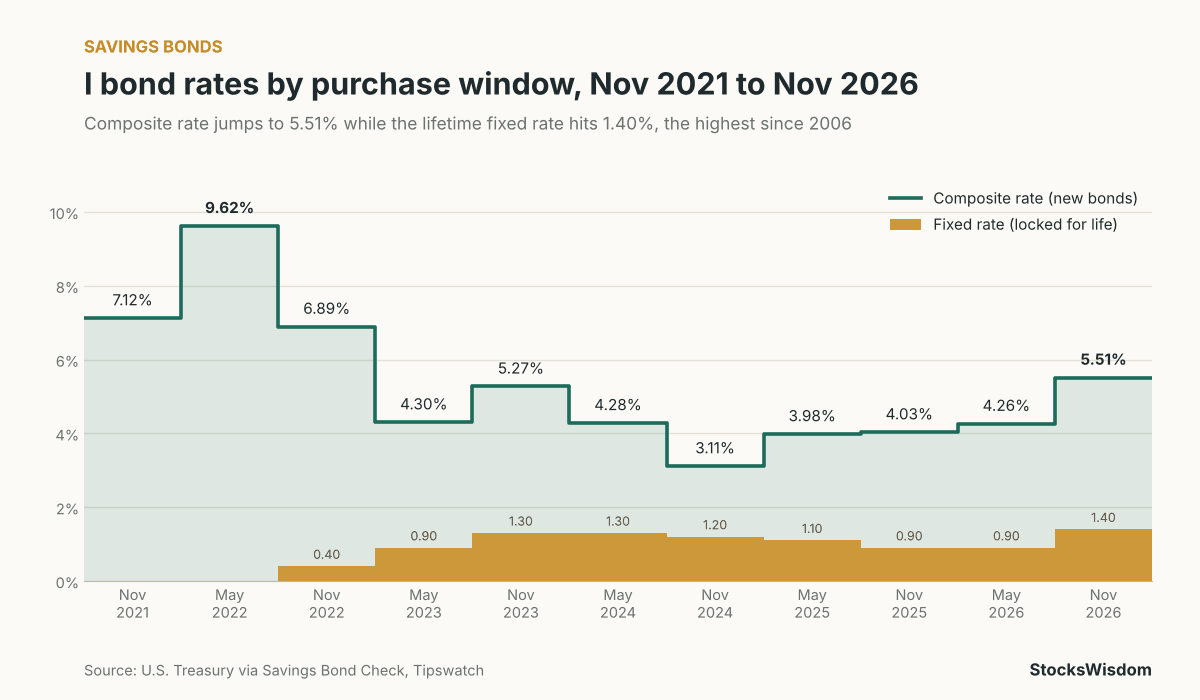
Look at how wild the composite rate has been: 9.62% at the peak, 3.11% at the low, now back above 5%. Meanwhile the fixed rate crept from zero to 1.40% as real Treasury yields climbed. The chart below shows the composite rate for every window since November 2021, with the fixed rate shaded underneath.
Here’s what else your cash could earn right now.
| Option | Current yield | Taxes | Access to your money |
|---|---|---|---|
| New I bond | 5.51% for 6 months, then inflation plus 1.40% | Federal tax deferred, no state tax | Locked 1 year, penalty before 5 years |
| Top high-yield savings | 4.40% APY | Fully taxable | Anytime |
| Average savings account | 0.38% | Fully taxable | Anytime |
| 1-year Treasury bill | 4.42% | Federal tax, no state tax | Sell anytime at market price |
| 5-year TIPS | About 2.31% plus inflation | Federal tax each year, no state tax | Sell anytime at market price |
Savings figures come from TheStreet (citing The College Investor and the FDIC), and the Treasury yields come from Tipswatch around the October 30 announcement.
For pure real return, TIPS win. A 5-year TIPS pays roughly 2.31% above inflation versus 1.40% for the I bond. That’s nearly a full point.
I bonds win on peace of mind. Their value never drops, you don’t pay tax until you cash out, and there’s no price to watch. A TIPS sold early can lose money if yields rise. If you want a refresher on why bond prices fall when yields rise, our Treasury yields explainer walks through it.
Know these before you click buy at TreasuryDirect.gov.
Those rules are spelled out in Wallet Hacks’ I bond guide. Enna’s view on the lockup is simple: “In my opinion, I Bond investors should be looking to hold for 5 years and then cash out when they need the money.”
One timing trick helps. Treasury credits interest for the whole month you buy in, so a purchase late in the month earns a full month for a few days of holding. Enna flagged November 25 as a good target. And because the 1.40% fixed rate runs through April, you could buy $10,000 now under your 2026 limit and another $10,000 in early 2027 at the same fixed rate.
Prices aren’t behaving. October consumer prices rose 0.4% in a month, as we covered in our October CPI breakdown, and wholesale inflation is at a four-year high. An asset that resets with CPI and adds 1.40% on top is a direct hedge against exactly that problem.
I bonds fit best for money you won’t touch for a year and would like to keep safe for five: a down payment fund a few years out, the second layer of an emergency fund, or cash a retiree wants protected from rising prices.
They’re a poor fit for money you might need next month. They also can’t absorb big sums, thanks to the $10,000 cap. And they won’t match stocks over 20 years.
Think of them as ballast, not an engine. If most of your savings sits in stocks and you’re trimming a position to fund a bond purchase, StocksWisdom shows each stock’s sentiment, technical signals and 30-day forecast, which can help you decide what to sell first.
No. You get 5.51% for your first six months of ownership. After that, the inflation part resets with each May and November announcement, while the 1.40% fixed part stays with you.
Your principal can’t fall, and the rate has a floor of zero. The only real cost is the three-month interest penalty if you redeem before the five-year mark.
It can make sense once the old bonds are past five years, since there’s no penalty. You’d trade a 0% fixed rate for 1.40%. Just know the new purchase counts against your $10,000 yearly limit, and you’ll owe federal tax on the interest you cash out.
Are you buying I bonds at 5.51%, or sticking with savings accounts and T-bills? Tell us in the comments.
Not financial advice. Do your own research.