Physical Address
304 North Cardinal St.
Dorchester Center, MA 02124
Physical Address
304 North Cardinal St.
Dorchester Center, MA 02124

Inflation didn’t cooperate. The October CPI report, released Tuesday morning, showed consumer prices rising 0.4% in a single month, a tenth of a point hotter than the 0.3% economists expected. Core prices, which strip out food and energy, climbed 0.3% against a 0.2% forecast.
That core number is the one that stung. It’s the third straight 0.3% gain, and it lands right on the line one Fed governor drew last week for considering a half-point rate hike. Stocks slid, the 10-year Treasury yield pushed back toward 5%, and traders now see a December hike as close to a sure thing.
So what does a hot October CPI 2026 print mean for your portfolio, your mortgage and your grocery bill?
Here are the headline numbers from the Bureau of Labor Statistics release:
| Measure | October 2026 | September 2026 | Forecast for October |
|---|---|---|---|
| All items (monthly) | +0.4% | +0.6% | +0.3% |
| Core CPI (monthly) | +0.3% | +0.3% | +0.2% |
| Food | +0.5% | 0.0% | n/a |
| Energy | +0.7% | +5.2% | n/a |
| Shelter | +0.3% | +0.4% | n/a |
| Used cars and trucks | -1.2% | +0.7% | n/a |
On paper, 0.4% is cooler than September’s 0.6%. That’s the good news, and it’s thin. September was inflated by a 9.1% jump in gasoline. October’s energy index rose just 0.7%, so most of the heat this time came from everyday stuff that doesn’t swing with oil.
Food rose 0.5%. Groceries were up 0.4% after a small dip in September, and restaurant meals gained 0.5%. Electricity jumped 0.9%. Car insurance rose 0.7%. Hospital services climbed 0.8%.
Shelter, the biggest single piece of the index, rose 0.3% and accounted for more than 30% of the monthly increase.
If you went looking for the familiar “inflation is X% over the past year” number, you didn’t find it.
During the government shutdown in October 2025, the BLS couldn’t collect prices. No October 2025 index means no clean 12-month comparison for October 2026 on most items. The agency only printed yearly changes for a handful of series, and one of them is eye-opening: gasoline is up 37.4% from a year ago (not seasonally adjusted).
The last official annual reading was September’s 3.7%, up from 3.4% in each of the two months before, according to HNGN. For core, the September annual rate was 2.6%.
Here’s a quick way to fill the gap yourself. Three straight months of 0.3% core inflation works out to roughly a 3.7% annualized pace. That’s well above the Fed’s 2% goal and a lot faster than the 2.6% yearly figure suggests.
One hot print can be noise. Three in a row starts to look like a pattern, and that’s what worries the Fed.
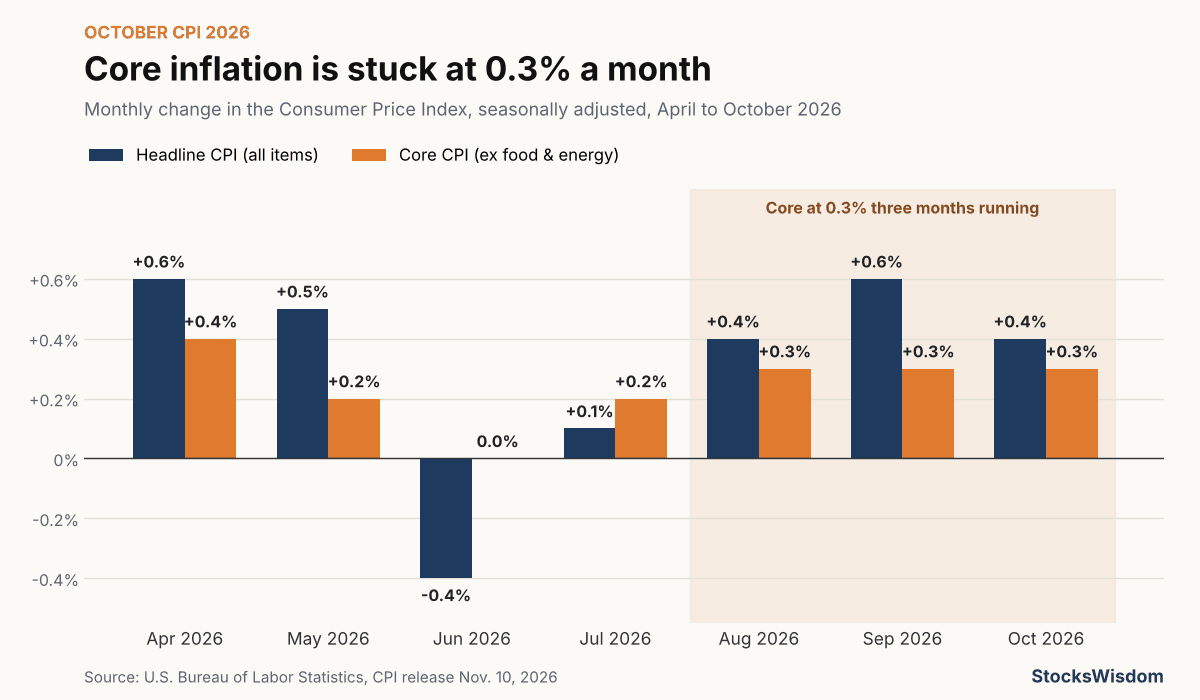
Core CPI ran at 0.0% in June and 0.2% in July. Then it stepped up to 0.3% in August, September and October.
The chart below shows headline and core CPI month by month from April through October 2026, using seasonally adjusted BLS data.
Brian Jacobsen of Annex Wealth Management told TradingKey that the oil shock has now worked its way into core prices. Businesses that ate higher fuel costs earlier in the year may keep passing them along. Andrew Davis of Bryn Mawr Trust put it more plainly: “Today’s CPI report suggests underlying inflation remains more persistent than the Fed would like.”
The market didn’t panic, but it didn’t shrug either. Per TheStreet, here’s how Tuesday closed:
Tech took the bigger hit. Nvidia, already under pressure from the Jensen Huang investigation, fell about 5.5%.
Bonds told the louder story. The 10-year Treasury yield climbed to roughly 5%, a level it had backed away from in recent weeks. When safe bonds pay 5%, pricey growth stocks look less attractive. That’s why the Nasdaq lagged.
One bright spot: oil kept falling. Brent crude dropped to about $91 a barrel, more than 20% below its late October peak above $117.
The Fed’s target range sits at 3.75% to 4%. It raised rates a quarter point on September 16, then held on October 28 in a 10-2 vote. Lisa Cook and Beth Hammack dissented because they wanted another hike. (We covered that decision in our October Fed meeting preview.)
Now the December 8 to 9 meeting looks like a hike meeting. Fed Governor Christopher Waller said he is “leaning toward supporting an increase in our policy rate of 25 basis points” in December, per StockTitan. He also said a half-point move should be considered if core CPI came in around 0.3% or higher. It did.
Dallas Fed President Lorie Logan has said she sees a need for two more quarter-point increases.
Traders moved fast. CME FedWatch data showed an 84.7% chance of a quarter-point hike in December and a 15.3% chance of a half point, up from just 1.1% before the report. Add last week’s strong October jobs report, which showed 165,000 new jobs, and the case for holding steady got a lot weaker.
If you have a mortgage or plan to buy a home. Mortgage rates follow the 10-year yield more than the Fed. Freddie Mac’s 30-year average fell to 7.18% last week, its third straight drop, per the AP. A climb back to 5% on the 10-year could stall that relief. If you’re close to locking a rate, waiting for a big drop may not pay off right now.
If you carry credit card debt. Card rates track the Fed closely, so a December hike would show up on statements within a cycle or two. Paying down variable-rate balances is one of the few guaranteed returns out there.
If you have cash in savings. Good news for once. High-yield savings, money market funds and short-term Treasuries should keep paying solid rates, maybe a bit more after a hike.
If you invest in stocks. Rate-sensitive corners (small caps, unprofitable tech, real estate) tend to struggle when yields rise. This is a good moment to check how much of your portfolio depends on rates coming down soon. Our guide on how to protect your portfolio from inflation goes through the options.
If you want to see how a specific stock is holding up in this kind of tape, StocksWisdom shows a stock’s sentiment, technical signals and 30-day forecast in one place, so you can tell a stock that’s breaking down from one just drifting with the market.
There’s a timing quirk worth knowing about. The November CPI report comes out on December 10. The Fed announces its decision on December 9.
So policymakers will vote without seeing another inflation reading. That raises the stakes on October’s numbers, and it’s a big reason markets reacted the way they did.
Consumer prices rose 0.4% in October 2026 on a seasonally adjusted basis, above the 0.3% forecast. Core CPI rose 0.3%, versus 0.2% expected.
The October 2025 government shutdown stopped price collection that month. Without an October 2025 index, the BLS can’t calculate most 12-month changes for October 2026.
Markets think so. CME FedWatch showed about an 85% chance of a quarter-point hike and roughly a 15% chance of a half-point hike after the report. The decision comes December 9.
Are you changing anything in your portfolio ahead of a likely December hike, or sitting tight? Tell us in the comments.
Not financial advice. Do your own research.