Physical Address
304 North Cardinal St.
Dorchester Center, MA 02124
Physical Address
304 North Cardinal St.
Dorchester Center, MA 02124


In May, Bank of America told clients to stay away from Salesforce. Analyst Tal Liani rated the stock Underperform with a $160 price target, worried that AI would eat into the company’s core business.
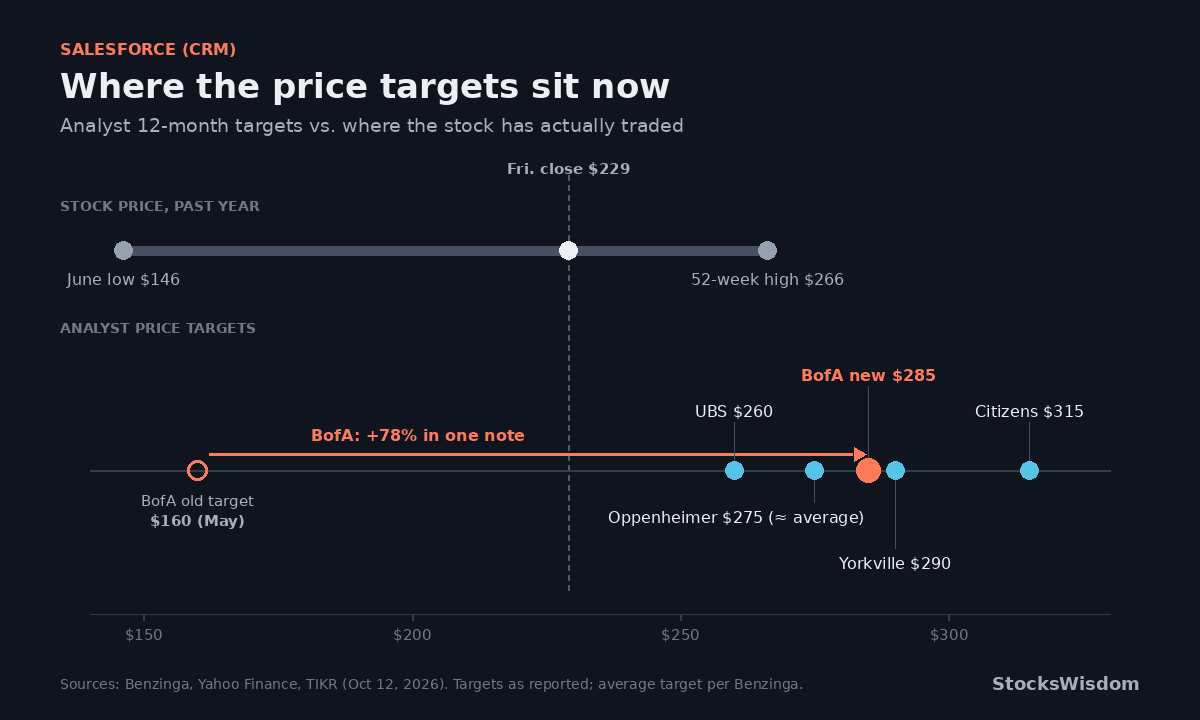
On Monday he flipped all the way to Buy. His new target is $285, which is 78% higher than the old one and about 24% above Friday’s close of $229.13 (Benzinga).
Salesforce (CRM) shares jumped as much as 5% Monday morning and were holding a gain of around 2% to 3% later in the session (Yahoo Finance). Analysts change their minds all the time. Going from “sell” straight to “buy” on a company this big is a lot rarer, and the reasons behind it say a lot about where software stocks stand right now.
Most Wall Street banks rate stocks on a three-step ladder. At Bank of America the steps are Buy, Neutral and Underperform. Underperform is the polite way of saying “we think this stock will do worse than the market.”
A normal upgrade moves a stock one step, from Underperform to Neutral or from Neutral to Buy. A double upgrade skips the middle step entirely. It’s the analyst admitting the old call was wrong, not just a little too cautious.
The price target matters too. It’s the analyst’s estimate of where the stock could trade in about 12 months. Liani’s jump from $160 to $285 is a big swing for a company worth more than $200 billion.
To understand the flip, you need to know what scared investors in the first place. Wall Street gave it a dramatic nickname: the “SaaSpocalypse.”
SaaS stands for software as a service. Companies like Salesforce sell subscriptions, usually priced per user, or “seat.” A sales team of 500 people pays for 500 seats of Sales Cloud.
The worry went like this. If AI agents can do the work of many employees, companies will need fewer seats. And if workers start asking an AI assistant for information instead of opening Salesforce, the app itself could become a background database that’s easy to replace.
That fear hit hard. When BofA put its Underperform rating on the stock in May, Salesforce was down roughly 33% for the year, and Liani argued AI agents could “replace seats” instead of adding them (Yahoo Finance). The stock bottomed at $146.32 in June.
Liani says his view changed after talking with chief information officers at large companies. Their message: replacing the platforms that hold a company’s data, workflows and compliance rules is very unlikely.
“If anything, AI should deepen dependence on these platforms,” he wrote.
He describes the AI shift in stages: “If AI 1.0 was the model, AI 2.0 was the agent, then AI 3.0 is the interface.” His point is that Salesforce doesn’t need to own the screen where people type their questions. It needs to stay the system that decides what an AI agent can see and what it’s allowed to do.
BofA lays out four layers where Salesforce plays:
Liani still thinks smaller businesses may try cheaper AI-native apps. Big enterprises, with years of rules and data built into Salesforce, are a different story.
The upgrade isn’t only a story about CIO conversations. Salesforce’s last quarter gave the bulls some real numbers to point to (Salesforce Q2 results via Pulse 2.0).
| Metric (quarter ended July 31) | Result | Change vs. a year ago |
|---|---|---|
| Revenue | $11.35 billion | up 11% |
| Subscription and support revenue | $10.82 billion | up 12% |
| Current remaining performance obligations | $33.5 billion | up 14% |
| Agentforce annual recurring revenue | over $1.5 billion | up more than 240% |
| Agentforce + Data 360 recurring revenue | nearly $3.9 billion | up more than 210% |
| Free cash flow | $1.1 billion | up 81% |
Current remaining performance obligations, or cRPO, is signed business that Salesforce expects to turn into revenue over the next year. It’s one of the best early signals for software companies, and 14% growth is solid for a business this size.
Liani also pointed out that about half of Agentforce bookings last quarter came from customers buying more usage credits. That suggests companies are coming back for more, not just testing it once.
Then there’s valuation. BofA’s old $160 target valued Salesforce at 9 times its expected 2027 free cash flow. The new $285 target uses 16 times. Same company, very different level of trust in its future.
BofA’s move puts it in line with most of the Street. The average analyst target sits around $275, and several firms have targets near or above BofA’s new number (TIKR). The chart below shows how the targets stack up against where the stock has traded this year.
A Buy rating isn’t a guarantee. Liani flagged a few things that could go wrong:
It’s also worth remembering that the stock had already climbed about 56% from its June low to Friday’s close before this upgrade. Some of the good news is in the price.
Analyst upgrades move stocks for a day or two. They shouldn’t be the main reason you buy one. A few practical takeaways:
Read the reasoning, not the rating. The useful part of Monday’s note is the argument: big companies won’t rip out their core systems because of AI. If you believe that, it applies to other enterprise software names too.
Watch what changed. Liani didn’t upgrade because the stock got cheap. It’s up a lot since June. He upgraded because the business data improved. That’s a more meaningful kind of call.
Don’t chase the pop. If you like the story, there’s no rush to buy on an analyst-driven spike. Splitting a purchase into a few pieces over several weeks lowers the risk of buying at a short-term high.
If you want to see whether the upgrade changed the bigger picture for CRM, StocksWisdom shows its sentiment, technical signals and 30-day forecast in one place, which helps separate a one-day bounce from a real trend change.
BofA now believes AI will make big companies more dependent on Salesforce, not less. It cited conversations with CIOs, fast Agentforce growth and strong bookings.
$285, up from $160. That was about 24% above Friday’s closing price of $229.13.
That depends on your goals and time frame. Most analysts now rate it a Buy, but the stock is volatile and its AI revenue is still small compared with the whole business.
Monday’s double upgrade was really a bet that the SaaSpocalypse was overdone. Do you think AI makes software like Salesforce more valuable, or easier to replace?
Not financial advice. Do your own research.