Physical Address
304 North Cardinal St.
Dorchester Center, MA 02124
Physical Address
304 North Cardinal St.
Dorchester Center, MA 02124


Boeing lost less money this quarter than it did a year ago. A lot less. And the stock still had its worst day since April 2025.
On Tuesday, Boeing reported third-quarter 2026 revenue of $24.19 billion, up 4%, and a core loss of 34 cents a share. A year earlier it lost $7.47 a share on the same measure, thanks to a giant 777X charge. So why did the shares drop roughly 10% to around $170, touching a fresh 52-week low on more than four times normal volume, on a day the Nasdaq rose 1.2%? Because the market had expected a loss closer to 21 cents, and because Boeing admitted it won’t hit its goal of delivering 500 737s this year.
That second part matters more than the earnings miss. Here’s what happened, what the numbers mean, and how a regular investor can think about a stock that’s improving and disappointing at the same time.
The headline figures come straight from the company’s SEC filing. Net loss shrank to $116 million, or 26 cents a share, from $5.34 billion a year ago. Operating cash flow climbed 33% to $1.5 billion. Free cash flow, the cash left after spending on factories and equipment, came in at $464 million.
| Metric | Q3 2026 | Q3 2025 |
|---|---|---|
| Revenue | $24.19B | $23.27B |
| Core EPS | ($0.34) | ($7.47) |
| GAAP EPS | ($0.26) | ($7.14) |
| Free cash flow | $464M | $238M |
| Commercial deliveries | 161 | 160 |
| Total backlog | $745.4B | n/a |
The backlog is a record. Boeing has more than 6,300 commercial jets on order, worth about $612 billion. Demand isn’t the problem. Building the planes is.
Stocks trade on expectations, not on how things compare with last year’s disaster.
Analysts polled by Bloomberg were looking for a core loss of about 21 cents, according to Yahoo Finance. Boeing’s commercial jet unit lost about $700 million, roughly twice what the Street had penciled in. JPMorgan analyst Seth Seifman wrote that the unit’s sales “were in line, but margin came in [about] 280 bps light due to cost growth.” In plain English: Boeing sold what people expected, but it cost more to build each plane.
Then came the guidance. CFO Jim Albay said 737 output will “come in shy of the 500 delivery target,” per the earnings call transcript. He didn’t give a new number.
You can do the math yourself. Boeing delivered 367 737s through September. Hitting 500 would mean 133 in the fourth quarter, and it managed 124 in Q3. That’s a stretch.
Boeing currently builds 737s at a target pace of 47 a month. It wanted that rate stable this year, then a step up to 52. CEO Kelly Ortberg told analysts, “It is taking us longer than we had expected to demonstrate performance at Rate 47,” and said he expects “it’ll take us into next year to get fully stable at this rate.” The financial plan now targets Rate 52 in the back half of 2027. Every month of delay pushes revenue and cash further out, which is why investors care about production rates more than any single quarter’s earnings.
The 787 isn’t immune either. Boeing still guides to 90 to 100 Dreamliner deliveries in 2026, but Albay said the count should land “closer to the lower end.”
Here’s the part of the report that got lost in the selloff. Two of Boeing’s three businesses are doing fine.
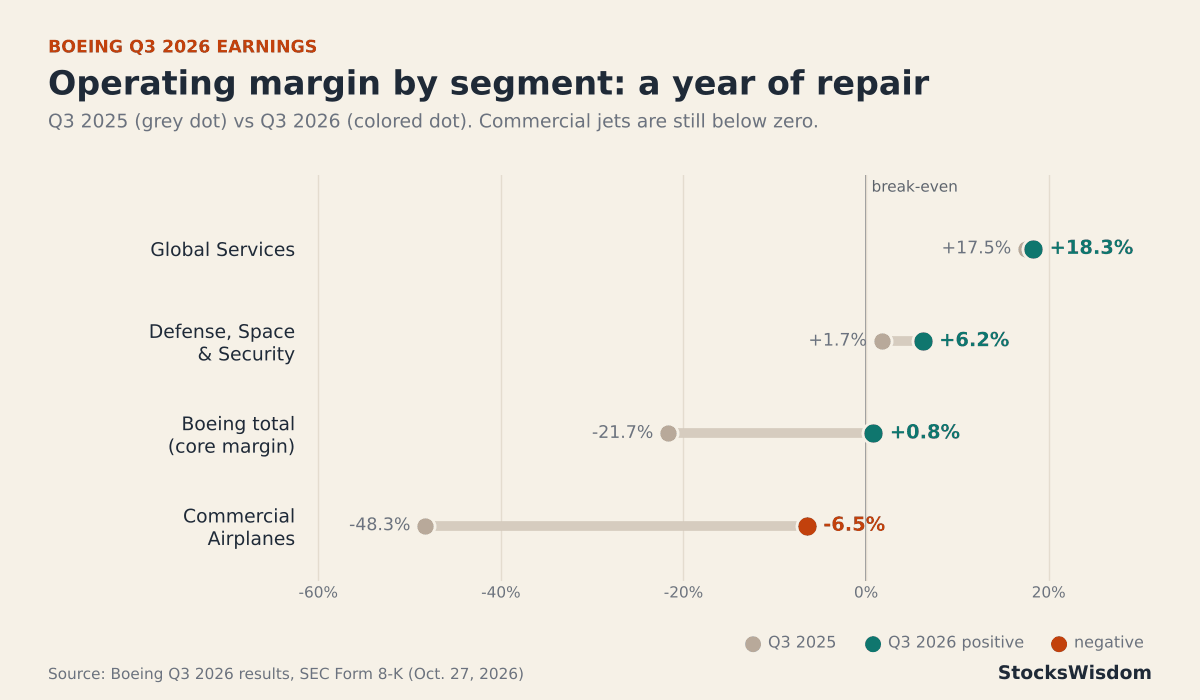
Defense, Space & Security grew revenue 15% to $7.94 billion, and its operating margin jumped to 6.2% from 1.7%. Global Services, the parts and maintenance arm, earned just over $1 billion at an 18.3% margin. That’s a steady, high-margin business that keeps humming because airlines have to service the planes they already fly.
Commercial Airplanes is the drag. Its margin improved from negative 48.3% to negative 6.5%, which sounds like progress (and it is), but it’s still losing money on every dollar of jets it sells.
So the picture is a company slowly climbing out of a hole, with the climb taking longer than promised. The chart below shows how each segment’s operating margin moved from Q3 2025 to Q3 2026, and how far Commercial still has to go to reach zero.
Boeing narrowed its 2026 free cash flow outlook to about $2 billion, from a prior range of $1 billion to $3 billion. Through nine months it’s at negative $359 million. That implies roughly $2.4 billion of free cash flow in the fourth quarter alone, which only works if deliveries pick up.
The balance sheet is stable but heavy. Boeing holds $20.7 billion in cash and securities against $45.9 billion of debt, plus a $10 billion undrawn credit line. Management kept its long-term goal of $10 billion in annual free cash flow by 2029.
If Q4 deliveries come in light, that $2 billion target is the next thing at risk. Watch it.
If you own Boeing directly, Tuesday’s drop is a reminder that turnaround stocks get punished for missed timelines, even when the trend is improving. The stock is down about a fifth this year. Your thesis probably hinges on one question: do you believe the 737 line gets to 52 a month in 2027? If yes, the backlog gives Boeing years of locked-in demand. If you’re not sure, that’s a sign the position may be bigger than your conviction.
If you own an S&P 500 index fund, Boeing is a small slice of it, so a 10% drop barely moves your balance. But it does ripple out. Boeing’s suppliers, airlines waiting on jets, and aerospace ETFs all react to delivery news. A delayed 737 means airlines keep older, thirstier planes flying longer, which can show up in ticket prices.
And if you’re tempted to “buy the dip,” slow down. A stock hitting a 52-week low on heavy volume tells you sellers are in control right now. Before acting, it helps to check how sentiment and momentum look, not just the price. StocksWisdom shows a stock’s sentiment, technical signals and 30-day forecast in one place, which is a quick way to see whether BA’s selling pressure is easing or still building.
No. Boeing posted a net loss of $116 million, or 26 cents a share. Its core loss was 34 cents a share. Both are far smaller than the $5.34 billion loss it reported a year earlier.
Two reasons. The core loss was wider than the roughly 21 cents analysts expected, and Boeing said it will deliver fewer than its 500-jet target for the 737 this year because production stability at 47 a month is taking longer.
Boeing says the 777-9 remains on track for first delivery in 2027, with certification flight testing still under way.
Boeing is getting better, just slower than it promised. Is that a reason to wait, or the kind of frustration that creates a buying chance? Tell us how you’re playing it.
Not financial advice. Do your own research.