Physical Address
304 North Cardinal St.
Dorchester Center, MA 02124
Physical Address
304 North Cardinal St.
Dorchester Center, MA 02124

If you own Sandisk, your share count is about to jump eightfold. On October 29 the flash memory maker announced an 8-for-1 stock split alongside a blowout quarter, and split-adjusted trading is set to start on November 20. Meta has its own odd version coming in January, and KLA, Amphenol and Netflix have all split within the past year.
So what is a stock split, and should you care? Short answer: it changes how your shares are counted, not what they’re worth. A $1,000 share becomes eight $125 shares, and nobody gets richer in the process.
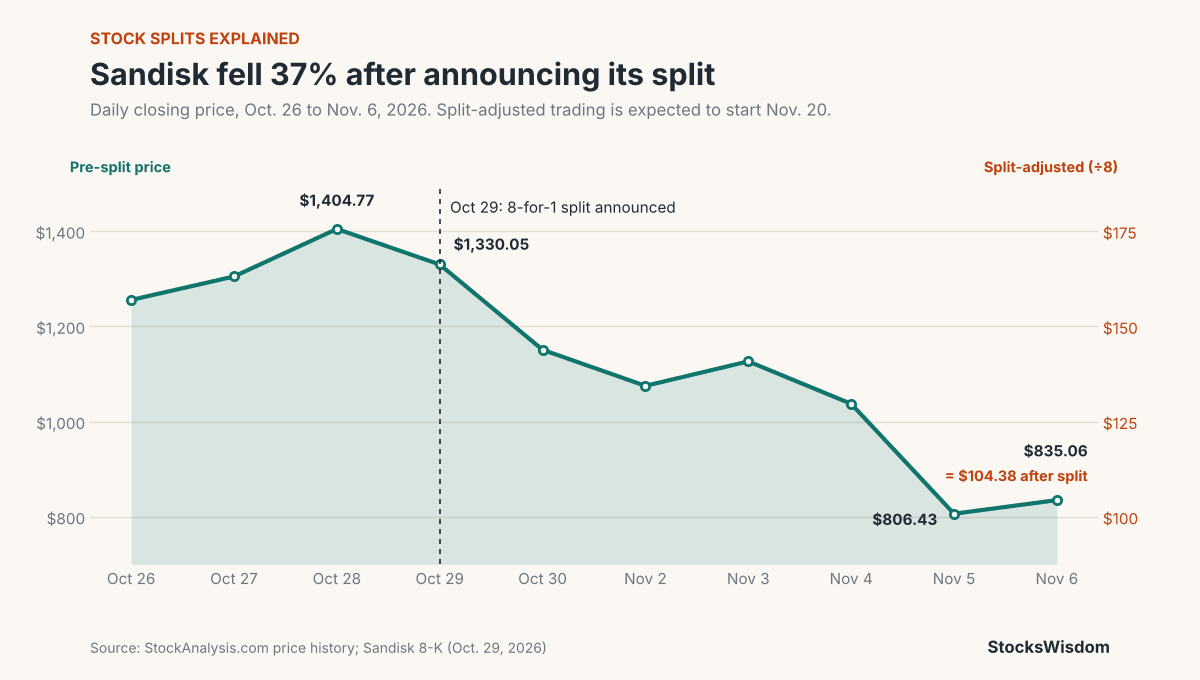
Sandisk is proof. Since the announcement the stock has dropped about 37%, from a $1,330.05 close on October 29 to $835.06 on November 6. The split didn’t cause that slide, and it didn’t stop it either. Let’s walk through how splits work, why companies bother, and what they mean for a regular investor.
A stock split is when a company cuts each existing share into several smaller ones. Your slice of the company stays exactly the same size. You just hold more pieces.
Think of a pizza. Cut it into 8 slices or 16, you still have one pizza. A 2-for-1 split doubles your shares and halves the price. A 10-for-1 split gives you ten shares for every one you held, each priced at a tenth of the old level.
Market value doesn’t move because of the split itself. If a company is worth $100 billion on Friday, it’s worth $100 billion on Monday after a split, give or take whatever the market does that day.
Say you held 10 Sandisk shares at Friday’s close of $835.06. That’s a position worth $8,350.60.
After the 8-for-1 split, you’d hold 80 shares. Divide the price by eight and each share is worth about $104.38. Multiply it back out and you’re at $8,350.60 again. Same money, more line items in your brokerage app.
Sandisk’s 8-K filing lays out the timeline. Holders of record at the close on November 9 get seven extra shares for each share they own. Those shares land after the market closes on November 19, and the stock is expected to open on a split-adjusted basis on Friday, November 20. You don’t have to do anything. Your broker handles it.
Splits come in waves, usually after a big run in a stock’s price. Here’s what the past year looks like:
| Company | Ratio | Split-adjusted trading or effective date |
|---|---|---|
| Netflix (NFLX) | 10-for-1 | Nov. 17, 2025 |
| Vanguard Information Technology ETF (VGT) | 8-for-1 | Apr. 21, 2026 |
| KLA (KLAC) | 10-for-1 | Jun. 12, 2026 |
| Amphenol (APH) | 2-for-1 | Shares distributed Sep. 2, 2026 |
| Sandisk (SNDK) | 8-for-1 | Nov. 20, 2026 (expected) |
| Meta Platforms (META) | 1 Class C share per Class A share | Effective Jan. 19, 2027 |
Meta’s is the weird one. It’s creating a new class of non-voting Class C stock and handing one to every Class A holder, which the Motley Fool calls an unconventional 2-for-1 split. Your economic stake doubles in share count, but the new shares carry no vote.
Funds do this too. Vanguard split five of its equity ETFs in April, including VGT at 8-for-1. If you hold funds rather than single stocks, our ETF vs mutual fund guide explains why share price matters more for ETFs.
If nothing changes, why go to the trouble? Mostly it’s about access.
KLA’s CFO Bren Higgins said the company’s split was “intended to improve the accessibility and liquidity of KLA shares,” according to KLA’s press release. Netflix said its 10-for-1 split would bring the price into a range more accessible to employees in its stock option program. Sandisk gave a similar reason, pointing to staff who buy through its employee stock purchase plan.
There’s also a softer reason. A company only splits when its stock has climbed a lot, so the announcement is a quiet signal of confidence. Management rarely splits a stock it expects to fall.
And options traders care. One options contract usually covers 100 shares, so a $1,000 stock means $100,000 of exposure per contract. Cut the price to $125 and that contract gets much easier to trade.
Sometimes, but not because of the split. Bank of America research, cited by the Motley Fool, found that stocks returned about 25% in the 12 months after a split announcement, compared with roughly 12% for the S&P 500.
That sounds like free money. It isn’t. Companies that split tend to have strong momentum and growing earnings already, so the split is more symptom than cause. Valuation still rules. A stock at 40 times earnings is just as pricey at $50 a share as it is at $500, and our P/E ratio explainer shows how to check that.
Sandisk is a live example of a split doing nothing to protect a stock. Shares jumped to $1,404.77 the day before earnings, fell 13% the day after the announcement, then lost another 22% on November 5 as memory stocks sold off with the rest of the chip sector. The chart below shows Sandisk’s daily closes since late October, with what each price works out to after the 8-for-1 split.
There’s a mirror image. In a reverse split, a company merges shares together, say 1-for-10, so you end up with fewer, higher-priced shares.
Struggling companies usually do this to keep their price above an exchange’s minimum listing level, often $1. It’s still just math, and your stake’s value doesn’t change on the day. But a reverse split is often a warning sign, while a forward split tends to follow good news.
For most people, a split changes almost nothing. A few practical details are worth knowing, though.
Taxes. A split generally isn’t a taxable event, since you haven’t sold anything. Your cost basis per share does change. The IRS says you must adjust your basis per share, spreading the old basis across your new share count. Your broker typically does this for you, but check it if you’ve moved accounts.
Dividends. Payouts shrink per share but stay the same in total. KLA paid $2.30 per share before its split and expected to declare $0.23 per share after, which is the same money across ten times the shares.
Fractional shares. Many brokers now let you buy a slice of a share, so a high price matters less than it did. That’s one reason splits are more about employees, options and optics these days.
Orders. Open limit or stop orders may get adjusted or canceled around the split date. If you have any on Sandisk, look at them before November 20.
Before reacting to a split headline, check how the stock itself is behaving. StocksWisdom shows a stock’s sentiment, technical signals and 30-day forecast, which tells you a lot more than the share count does.
Only if you’d want to own it anyway. A split doesn’t add value. Any pre-split rally comes from buyers chasing the headline, and that can reverse fast, as Sandisk showed.
No. Your total position value stays the same at the moment of the split. Leftover fractions are usually paid out in cash or kept as fractional shares, depending on your broker.
Not always, but it’s often a sign the stock has fallen hard. It’s worth reading why the company is doing it before you hold on or buy more.
Have you ever bought a stock because it was about to split? Tell us how it worked out in the comments.
Not financial advice. Do your own research.