Physical Address
304 North Cardinal St.
Dorchester Center, MA 02124
Physical Address
304 North Cardinal St.
Dorchester Center, MA 02124

For the first time in nearly three years, JPMorgan Chase missed Wall Street’s profit estimate. The biggest bank in America earned $5.57 a share in the third quarter, short of the roughly $5.90 analysts expected (Fortune).
On the same morning, Goldman Sachs blew past expectations with $17.01 a share against about $13.02 forecast, powered by a 72% jump in stock-trading revenue (TheStreet). Citigroup and Wells Fargo both beat as well.
Bank earnings are one of the best health checks on the U.S. economy. Banks see how much people borrow, spend, save and fail to repay before almost anyone else. So what did JPMorgan’s rare miss and Goldman’s blowout actually tell us? Here’s the plain-English version.
| Bank | Q3 profit | vs. expectations | Stock on Tuesday |
|---|---|---|---|
| JPMorgan Chase | $15.3B ($5.57/share) | Missed | up about 1% |
| Goldman Sachs | $5.29B ($17.01/share) | Big beat | up about 2% to 4% |
| Citigroup | up 40% from a year ago | Beat | down about 0.7% |
| Wells Fargo | $5.95B ($1.87/share) | Beat | down about 1.5% |
Notice something odd? The bank that missed went up, and two that beat went down. That’s a reminder that stock moves depend on the details and on what was already expected, not just on the headline “beat” or “miss.”
JPMorgan’s profit still grew. Net income rose 6% to $15.3 billion, and revenue climbed 8% to $50.2 billion (JPMorgan 8-K via StockTitan). A few things dragged the result below estimates:
The core business looked healthy. Average loans grew about 10%, deposits rose 9% to about $2.78 trillion, and net interest income, the money the bank earns from lending, grew nearly 13%. JPMorgan also earned a 20% return on tangible equity, a level most banks would love to hit in their best year.
So the “miss” says more about a slow quarter in bond trading and a one-off charge than about trouble in the bank.
Goldman’s quarter was close to the mirror image of JPMorgan’s. Its business leans much more on Wall Street activity, and that activity was booming. Net revenue rose 23% from a year ago to $18.7 billion, and profit climbed 29% (Goldman Sachs earnings release).
Bond trading was the soft spot here too. Goldman’s fixed-income revenue was roughly flat from a year ago, which suggests the slowdown JPMorgan flagged was an industry thing rather than a JPMorgan problem. CEO David Solomon put it this way: “Against the backdrop of a complicated operating environment, our clients continued to turn to Goldman Sachs.”
To understand bank earnings, it helps to know the three main engines. The graphic below shows them using JPMorgan’s numbers.
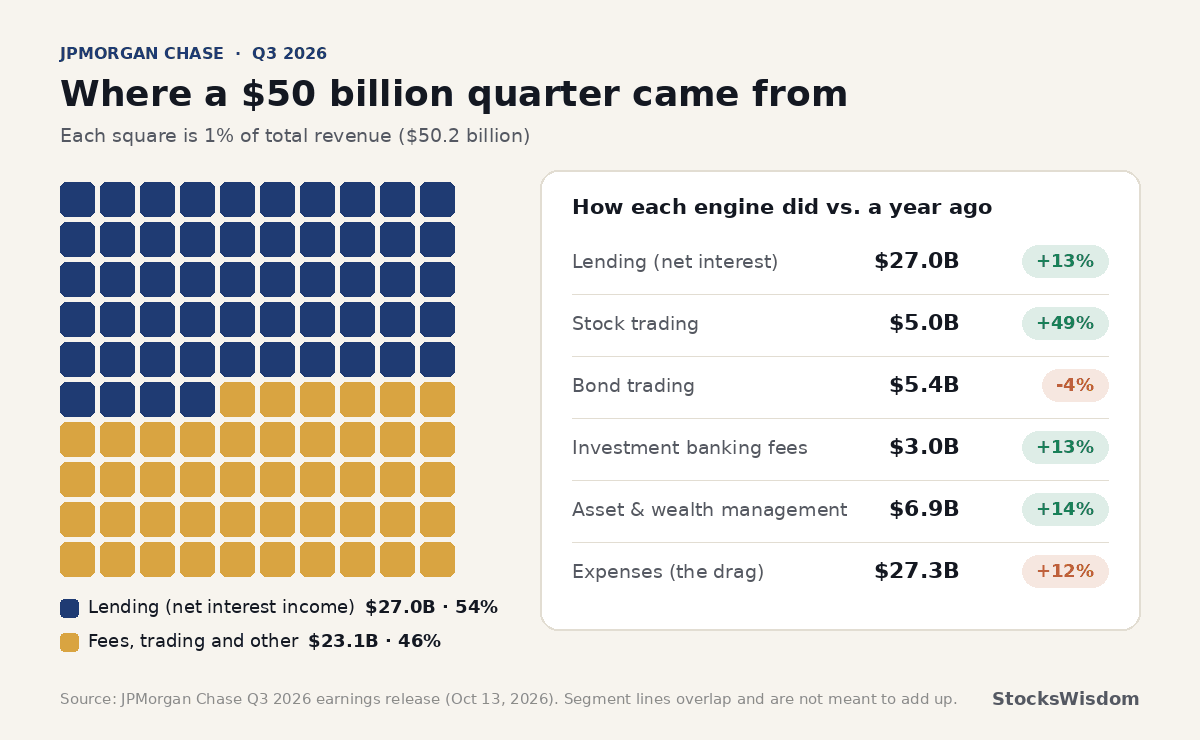
1. Lending (net interest income). Banks pay you interest on deposits and charge more on loans. The difference is net interest income, and it’s usually the biggest piece. Higher interest rates often help here, because loan rates rise faster than what banks pay on savings.
2. Wall Street businesses. Trading stocks and bonds for clients, and advising companies on mergers and stock sales (investment banking). This is where Goldman shines, and why its stock-trading revenue jumping 72% made such a big difference.
3. Fees and wealth management. Managing money for wealthy clients and charging fees on cards, accounts and services. JPMorgan’s asset and wealth management arm brought in $6.9 billion this quarter, up 14%.
When one engine sputters, the others can carry the quarter. That’s exactly what happened at JPMorgan.
This is the part that matters most for everyone else.
The consumer looks healthy. JPMorgan’s CFO said “the consumer is currently very healthy,” mainly because people still have jobs. Card spending at JPMorgan rose 10% from a year ago (Yahoo Finance).
But the banks are getting more careful. Jamie Dimon said, “We are tightening up a little bit on credit,” pointing to looser lending standards he’s seeing in parts of the market. Wells Fargo set aside more money for bad loans, $1.03 billion versus $681 million a year ago.
Inflation is the worry. Dimon described the economy as “fueled by strong business investment and ongoing consumer spending,” but flagged “sticky inflation” and rising interest rates as risks. The Fed raised rates in September, and long-term Treasury yields are near multi-year highs.
Put together, the picture is a strong economy that’s starting to feel the weight of high rates. Not a crisis, but a reason for caution.
Savers: high rates are still working in your favor. Banks are earning more on lending, and competition for deposits keeps high-yield savings accounts and CDs attractive. If your cash is sitting in a checking account earning almost nothing, it’s worth moving.
Borrowers: expect lenders to get pickier. When banks “tighten credit,” it often means higher minimum credit scores, larger down payments or lower credit limits. If you’re planning a big loan, cleaning up your credit now helps.
Credit card users: JPMorgan expects its card charge-off rate, the share of card balances it writes off as unpaid, to hold around 3.2%. That’s not alarming, but card interest rates remain very high. Paying down card balances is one of the best “returns” available.
Bank stocks have lagged lately. The KBW Nasdaq Bank Index was down about 8.4% over the past three months, while the S&P 500 gained more than 3%.
The case for buying: big banks are earning strong returns, lending is growing and trading desks are busy. JPMorgan raised its quarterly dividend to $1.65 a share this year, and Dimon said the bank has about $30 billion of excess capital.
The case for waiting: if high rates start to hurt borrowers, loan losses could rise. Banks are also very sensitive to the economy, so a slowdown would hit them quickly.
A sensible approach: look at the big, diversified banks first. They have multiple revenue engines, which helps them get through a weak quarter in any one business. If you’re comparing JPM, GS, C and WFC, StocksWisdom shows each stock’s sentiment, technical signals and 30-day forecast side by side, which helps you see whether earnings week changed the trend.
The miss was mostly due to weaker bond trading and a one-time securities loss. The core lending business grew strongly, and investors focused on that.
It’s the difference between the interest a bank earns on loans and the interest it pays on deposits. For most banks, it’s the largest source of revenue.
This quarter, mostly yes. Consumers are spending and paying their bills. The warning signs are the banks tightening lending and worrying about inflation and high rates.
JPMorgan’s rare miss grabbed the headlines, but the bigger story is a banking system that’s still strong and growing a little more careful. Which do you think matters more for your portfolio right now: strong consumers or sticky inflation?
Not financial advice. Do your own research.