Physical Address
304 North Cardinal St.
Dorchester Center, MA 02124
Physical Address
304 North Cardinal St.
Dorchester Center, MA 02124


SpaceX just posted its first quarterly profit as a public company, and it wasn’t close. Revenue for the third quarter hit $14.6 billion, up 161% from $5.6 billion a year ago, according to the company’s Q3 2026 results release. Wall Street was looking for roughly $12.7 billion to $12.9 billion.
Net income came in at $4.4 billion, or 35 cents a share. A year earlier SpaceX lost about $1.05 billion. Analysts had penciled in around 15 cents.
So why did the stock only tick up about 2% after hours? Because the most interesting number in the report isn’t the profit. It’s the $19.6 billion SpaceX spent on equipment in a single quarter, and the fact that it plans to spend about twice that in the next one.
Here’s what the company reported for the quarter ended September 30.
| Metric | Q3 2025 | Q2 2026 | Q3 2026 |
|---|---|---|---|
| Total revenue | $5.58B | $7.81B | $14.58B |
| Super Intelligence (AI) revenue | $0.81B | $2.56B | $7.56B |
| Connectivity (Starlink) revenue | $3.10B | $4.29B | $5.25B |
| Space (launch) revenue | $1.67B | $0.96B | $1.77B |
| Operating income | -$0.27B | -$0.14B | $2.79B |
| Adjusted EBITDA | $2.17B | $3.54B | $8.81B |
| Capital spending | $6.88B | $18.37B | $19.59B |
Adjusted EBITDA (earnings before interest, taxes, depreciation and amortization, with some one-offs stripped out) reached $8.8 billion. The Street expected about $6.6 billion, per Investing.com.
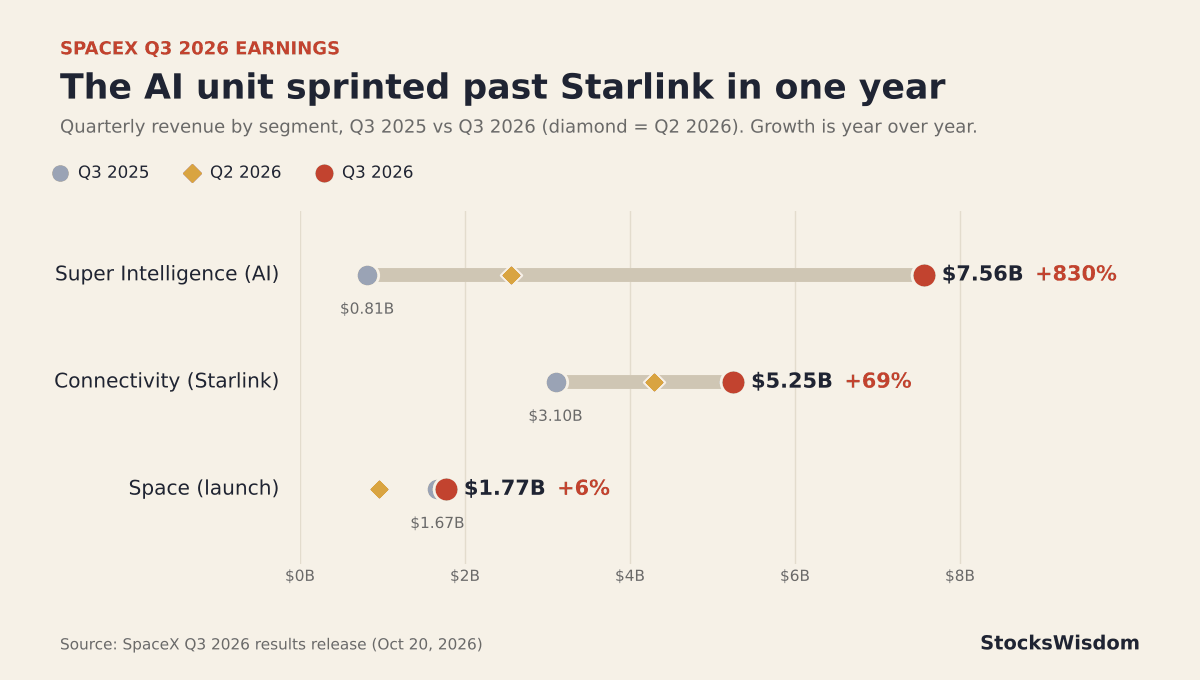
This is the headline most people missed. SpaceX’s Super Intelligence segment, which rents out computing power to AI companies and runs its own AI products, brought in $7.56 billion. That’s nine times what it made a year ago and almost triple the prior quarter.
Starlink, the satellite internet service most people associate with SpaceX, made $5.25 billion. Still a great quarter, up 69%. But it’s now the second-biggest business inside a rocket company.
Fortune reported that the AI unit’s customers include Anthropic, Google, Grok and X. The segment also flipped from a $1.26 billion operating loss in Q2 to a $431 million operating profit.
One caveat on that AI profit. CFO Bret Johnsen said on the call that the segment’s results included about $1.2 billion of stock compensation tied to Cursor, according to the Benzinga call transcript. Strip that out and the AI business earned roughly $1.6 billion from operations.
The chart below shows how each SpaceX segment’s quarterly revenue moved from Q3 2025 to Q3 2026, with Q2 2026 marked in between.
Starlink ended the quarter with 13.6 million consumer subscribers, up from 7.2 million a year earlier. Its operating income nearly doubled to $2.37 billion.
Not everything was rosy, though. SpaceX added 1.6 million consumer subscribers in the quarter, while analysts expected about 2.29 million, per Fortune. Average revenue per user was $69 a month. That’s up from $66 in Q2 but down from $83 a year ago, which suggests more of the growth is coming from cheaper plans or lower-priced markets.
Musk didn’t sound worried. “We do see a clear path to several hundred billion dollars a year in connectivity revenue,” he said on the call.
That’s a big claim. Keep it in the “CEO optimism” column until the numbers show it.
SpaceX spent $19.6 billion on capital projects in Q3. About $16.4 billion of that went into AI data centers and chips. Its compute capacity reached 1.7 gigawatts, up from 0.6 gigawatts a year ago.
And it’s speeding up. Johnsen said he expects fourth-quarter capital spending of $35 billion to $40 billion. Musk added, “I would be surprised if we brought on less than 13 gigawatts of compute by the end of next year.”
Compare that with the cash coming in. Adjusted EBITDA was $8.8 billion. Capital spending was more than double that. SpaceX isn’t funding this buildout out of profits. It’s funding it from the roughly $90 billion in cash and marketable securities it had on September 30 and, soon, from borrowing.
Johnsen confirmed “there are a number of available pools of debt capital that we are talking to at the moment.” Morgan Stanley’s Adam Jonas flagged this before the report, writing that the “need for additional financing remains a key overhang for sentiment, especially given the recent neocloud debt saga,” as quoted by Yahoo Finance. Neoclouds are AI cloud renters like CoreWeave, whose debt worries we covered last week.
SpaceX told investors it expects total revenue of $33 billion to $37 billion in the first quarter of 2027. That would be more than double this quarter. Johnsen also said the company remains on track for its goal of $100 billion in annualized revenue by the end of 2026.
Musk went further, saying annualized revenue by the end of 2027 could land “somewhere between 100 billion and a trillion.” A range that wide isn’t a forecast. It’s a mood.
If you own SpaceX shares, this quarter answered one big question: yes, the company can make real money. Starlink is a cash machine, and the AI business is now profitable on an operating basis.
The open question is return on all that spending. Johnsen said new compute deployments are paying back in under a year at current prices. If AI rental prices fall, that math gets worse fast, and SpaceX will be carrying a lot more debt by then.
A few practical points:
Before buying or adding, it helps to see what the market’s mood and chart look like. StocksWisdom shows a stock’s sentiment, technical signals and a 30-day forecast, which is a quick gut check before you hit buy on something this jumpy.
Other space names barely moved. Rocket Lab, Firefly and AST SpaceMobile all rose about 1% or less after hours, per Benzinga.
Yes. Revenue of $14.6 billion topped estimates of about $12.7 billion to $12.9 billion, and earnings of 35 cents a share beat the roughly 15 cents expected. Starlink subscriber additions were the main miss.
SpaceX rents out large amounts of AI computing power to companies like Anthropic and Google. Demand for that compute has exploded, so the segment’s revenue went from $813 million a year ago to $7.56 billion this quarter.
That depends on your goals and risk tolerance. The business is growing fast and is now profitable, but it plans to spend $35 billion to $40 billion next quarter and will likely take on debt. Treat it as a high-risk position.
Would you buy SpaceX after this report, or wait to see how it pays for the next $40 billion? Tell us in the comments.
Not financial advice. Do your own research.