Physical Address
304 North Cardinal St.
Dorchester Center, MA 02124
Physical Address
304 North Cardinal St.
Dorchester Center, MA 02124


Meta just did something it has never done in 14 years as a public company. Alongside its third-quarter results on Wednesday, the Facebook and Instagram parent announced what works out to a two-for-one stock split, delivered through a brand-new class of non-voting Class C shares.
The quarter itself was messy in an interesting way. Revenue jumped 26% to $64.6 billion, ahead of the roughly $63.3 billion Wall Street expected. Profit took a $9.89 billion hit from a legal settlement, though, and operating margin fell to 20% from 40% a year ago. Shares, which changed hands around $708 during the regular session, still climbed in after-hours trading.
So what is happening with the split, why is Meta doing it with non-voting stock, and does any of it change what your shares are worth? Let’s walk through it.
Here are the headline figures from Meta’s earnings release filed with the SEC, next to the same quarter last year.
| Metric | Q3 2025 | Q3 2026 | Change |
|---|---|---|---|
| Revenue | $51.24B | $64.60B | +26% |
| Costs and expenses | $30.71B | $51.61B | +68% |
| Operating income | $20.54B | $12.99B | -37% |
| Operating margin | 40% | 20% | -20 pts |
| Net income | $2.71B | $9.86B | +264% |
| Diluted EPS | $1.05 | $3.83 | +265% |
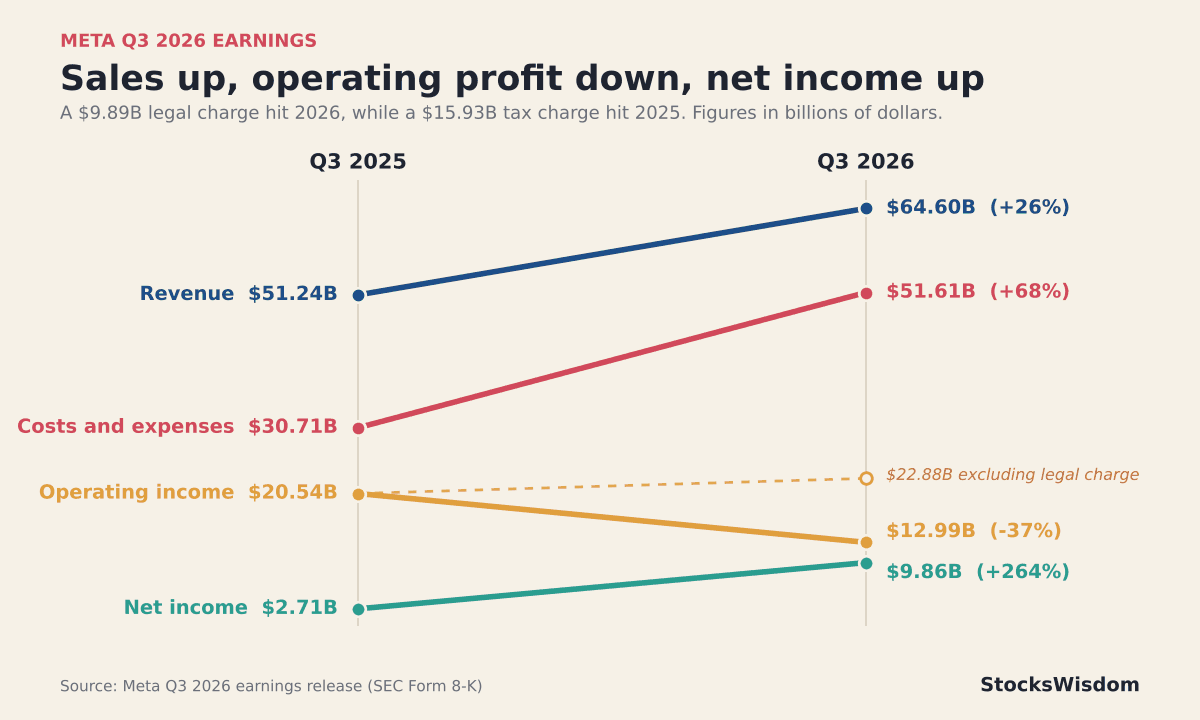
Yes, net income nearly quadrupled while operating income fell by more than a third. That looks backwards until you know two things. Last year’s third quarter carried a one-time, non-cash tax charge of $15.93 billion tied to the One Big Beautiful Bill Act, which squashed reported profit to $2.71 billion (TheWrap). This year, the legal charge lands higher up the income statement instead.
Strip it out and Meta says operating income would have been $22.88 billion, with EPS of $7.40. Even with the charge, $3.83 a share beat the roughly $3.56 consensus Bloomberg compiled before the report (Yahoo Finance).
Ads are still the engine. Ad impressions rose 10% from a year earlier and the average price per ad rose 14%. That second number matters more than it sounds. Advertisers don’t pay more for each slot unless the targeting is earning its keep, and Meta’s targeting now runs heavily on AI.
Family daily active people reached 3.64 billion in September, up 3%. Meta’s new Muse AI app passed 10.9 million downloads within 40 days of launch, according to Stocktwits.
Mark Zuckerberg sounded pleased. “Our investments are paying off, the core business is strong, and we’re seeing velocity across the board,” he said in the release.
One more number: headcount was 66,775 at the end of September, down 15% from a year earlier. Meta is spending like crazy on chips and data centers while running leaner on people.
That charge comes from a settlement with 52 state attorneys general over teen mental health litigation, as Investing.com reported. Meta raised its full-year 2026 expense outlook to $175 billion to $179 billion, up from $165 billion to $169 billion, to absorb it.
Investors usually look past one-time charges, and that’s mostly fair here. Legal risk around young users isn’t finished, though. More U.S. trials on the issue are still ahead.
Meta will create a new, publicly listed Class C common stock with no voting rights. Every holder of Class A shares (the stock that trades today as META) and Class B shares (the super-voting stock held mostly by Zuckerberg) will get one Class C share for each share they own.
Meta’s amended charter takes effect January 19, 2027. Class C shares are expected to start trading in late January, per investingLive. The board hasn’t set the record or payment dates yet.
A quick example. Say you own 10 shares of META at $708, worth $7,080. After the dividend you’d hold 10 Class A shares and 10 Class C shares. If each trades near $354, you still have $7,080. Same pizza, more slices.
Your votes don’t change either. Meta says the dividend “will not change the voting power of any shareholder.” Class C shares simply arrive with zero votes attached.
Meta says it may use Class C stock for raising capital, paying employees and funding acquisitions. It also signed a Founder Alignment Agreement with Zuckerberg covering his sales of Class C stock, his continued service and future stock dividends.
Read between the lines and the logic is simple. If Meta pays staff and buys companies with stock that carries no votes, Zuckerberg’s control doesn’t get diluted over time. He can also sell Class C shares without giving up a single vote.
Google ran this exact play in 2014. Institutional investors sued, and the settlement promised Class C holders compensation if their shares traded more than 1% below the voting shares during the first year. That discount averaged between 1% and 2%, so holders got small payments (The Motley Fool). Today Alphabet’s two share classes trade at nearly the same price.
It helps to see why the quarter looked so odd on paper before getting to your portfolio. The chart below shows how Meta’s revenue, costs, operating income and net income moved between Q3 2025 and Q3 2026.
Your holdings don’t change in value. A split is accounting. A lower price per share (somewhere in the mid $300s if nothing else moves) makes whole shares easier to buy, but fractional shares already solved that problem for most people.
You’ll own two tickers. For most retail holders, votes don’t swing anything because Zuckerberg controls the outcome either way. What you should watch is whether Class C trades at a small discount, like Google’s did at first.
Taxes should be a non-event for most people. Stock dividends like this one usually aren’t taxed when you receive them. Your brokerage will split your cost basis between the two classes, so check that it looks right once the shares show up.
The bigger story is cash. Meta spent $34.91 billion on capital expenditures in the quarter and posted negative free cash flow of $2.12 billion. It bought back zero shares in the first nine months of 2026, versus $3.33 billion in buybacks in Q3 2025 alone. Full-year capex guidance is now $135 billion to $145 billion. That’s the number that decides whether this stock works from here, far more than the split.
Meta shares were up only about 6% this year before the report, against roughly 17% for the Nasdaq-100 tracking QQQ fund. If you want a quick read on how the market is treating META heading into January, StocksWisdom shows a stock’s sentiment, technical signals and 30-day forecast in one place.
Meta’s amended charter takes effect January 19, 2027, and Class C shares are expected to start trading in late January. Record and payment dates are still to be announced.
No. If you hold META at the record date, the Class C shares should appear in your brokerage account automatically.
Generally no. A stock dividend of this kind usually isn’t a taxable event, and your cost basis gets divided between the two share classes. Ask a tax pro if your situation is unusual.
Would you rather hold the voting Class A shares or the new Class C shares once both trade? Tell us which and why in the comments.
Not financial advice. Do your own research.