Physical Address
304 North Cardinal St.
Dorchester Center, MA 02124
Physical Address
304 North Cardinal St.
Dorchester Center, MA 02124


Alphabet just reported a quarter where Google Cloud revenue doubled. The stock still fell hard after the bell.
That sounds backwards, so let’s untangle it. Alphabet’s Q3 2026 earnings showed revenue of $127.6 billion, up 25% from $102.3 billion a year ago, and Google Cloud sales jumped 103% to $30.7 billion. But earnings per share came in at $2.12, well short of the roughly $3.00 Wall Street expected, and the company spent a record $51.4 billion on capital projects in three months. Shares slid as much as 9% in extended trading, according to CNBC.
It also happened on a busy afternoon. Hours earlier, the Federal Reserve held its benchmark rate at 3.75% to 4%. So investors got a pause from the Fed and a spending shock from Google on the same day.
Start with what went right. Revenue landed almost exactly on forecasts (consensus sat around $127.8 billion to $128.2 billion). Operating income rose about 30% to $40.6 billion. Sundar Pichai told investors, “We had a strong quarter and are now on a half-trillion dollar revenue run rate,” per 9to5Google.
Now the miss. GAAP earnings per share fell to $2.12 from $2.87 a year earlier, and net income dropped to $26.2 billion from $34.9 billion. That snapped a run of 12 straight quarters of beating EPS estimates, as 24/7 Wall St. noted.
Here’s how the main pieces stacked up against last year:
| Line item | Q3 2025 | Q3 2026 | Change |
|---|---|---|---|
| Total revenue | $102.3B | $127.6B | +25% |
| Google Search & other | $56.6B | $63.4B | +12% |
| YouTube ads | $10.3B | $11.2B | +9% |
| Subscriptions, platforms & devices | $12.9B | $14.3B | +11% |
| Google Cloud | $15.2B | $30.7B | +103% |
| Capital expenditures | $24.0B | $51.4B | +114% |
| Diluted EPS | $2.87 | $2.12 | down 26% |
Most of the gap isn’t about the business. Alphabet booked an $8.7 billion paper loss on its equity investments, the stakes it holds in other companies. That hit alone cut EPS by 55 cents, Fortune reported.
Add it back and you get about $2.67 a share. Still below the $3.00 target, though, so you can’t blame the whole miss on accounting.
A quick lesson here if you’re newer to reading earnings: companies have to mark many investments to market each quarter. When those holdings rise, profits get a free boost. When they fall, profits take a hit even though no cash left the building. Last year’s Q3 profit was inflated by gains. This year’s was dragged down by losses. Comparing the two straight up exaggerates the decline.
Cloud is the bright spot, and it’s very bright. Revenue grew from $15.16 billion to $30.71 billion. Pichai said growth was “powered by huge demand for our AI infrastructure and AI solutions.”
The acceleration matters as much as the size. Back in Q2, Cloud grew 82% to $24.8 billion. In Q3 it hit 103%. Companies renting AI computing power are lining up, and Google has the chips and data centers they want. The Gemini app also crossed one billion users.
The graphic below shows the four growth rates that set the tone of this report, side by side.
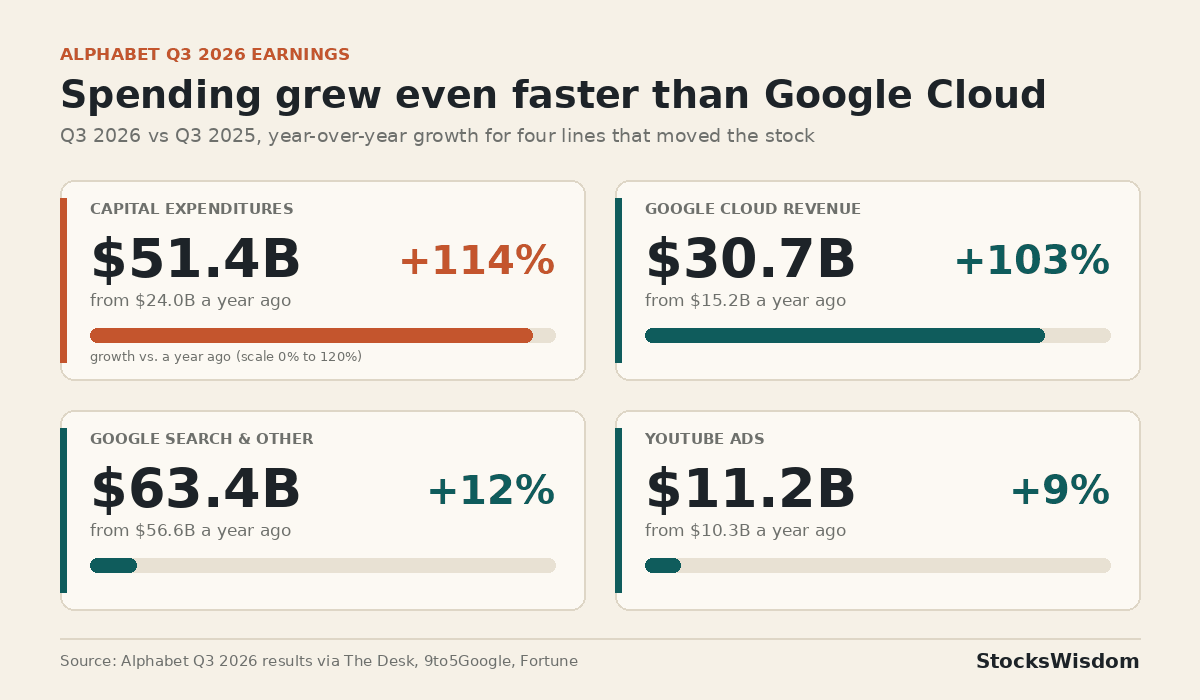
So why the selloff? Because capital spending grew even faster than Cloud.
Alphabet spent $51.4 billion on property and equipment in Q3, up 114% from $24.0 billion a year earlier, per The Desk. That’s servers, chips and data centers, mostly for AI. Free cash flow went negative by about $9.1 billion, deeper than the roughly $5.9 billion shortfall in Q2.
Think about what that means. One of the most profitable companies in history is now spending more cash than its operations bring in.
And the pace keeps climbing. Q2 capex was $44.9 billion, so Alphabet added another $6.5 billion of quarterly spending in just three months. Why do investors care so much about free cash flow? It’s the money left over to pay dividends, buy back shares or cushion a bad year. When it shrinks, a company leans harder on its balance sheet, and the market starts asking how long the bet can run before it pays off.
Management held its full-year 2026 capex plan steady at $195 billion to $205 billion, the range it raised to in July, per the Q2 call transcript. The kicker: executives again signaled a significant increase in 2027. Investors hoping for a spending plateau didn’t get one.
Search revenue rose 12% to $63.4 billion. Google said query growth was the fastest in five years, which is a strong rebuttal to the old fear that chatbots would eat search. Still, analysts wanted more from the ad side.
YouTube ads grew 9% to $11.2 billion. That’s slower than the rest of the company and slower than the 25% headline. Subscriptions, platforms and devices added 11%.
None of this is broken. It just isn’t growing fast enough to pay for a $200 billion construction budget without help from Cloud.
If you own an S&P 500 or Nasdaq index fund, you own Alphabet. It’s one of the biggest weights in both. A 9% drop in one giant stock can nudge your whole portfolio, especially on a day when Microsoft and Meta are reporting too.
For individual shareholders, the question is simple to state and hard to answer. Will today’s spending turn into tomorrow’s profits? Cloud’s 103% growth says demand is real. Negative free cash flow says the payback isn’t here yet.
A few practical thoughts:
Before you buy or trim, it can help to look past the headlines. StocksWisdom shows a stock’s sentiment, technical signals and a 30-day forecast, which gives you a quick read on whether a drop like this looks like panic or a trend.
As for savers and borrowers, the Fed’s hold means today’s rates stay put for now. High-yield savings accounts keep paying decently, and credit card and auto loan rates won’t drop soon.
No on profit, roughly yes on sales. Revenue of $127.6 billion was about in line, but EPS of $2.12 missed the $3.00 estimate, partly due to an $8.7 billion investment loss.
Spending. Capex more than doubled to $51.4 billion, free cash flow turned more negative, and management hinted at bigger spending in 2027.
Capital expenditures are money spent on long-lasting assets like buildings, servers and chips. It doesn’t hit profits all at once, but it does drain cash right away.
So here’s my question for you: is Alphabet building the next great profit engine, or spending its way into a problem? Tell me in the comments.
Not financial advice. Do your own research.