Physical Address
304 North Cardinal St.
Dorchester Center, MA 02124
Physical Address
304 North Cardinal St.
Dorchester Center, MA 02124

You get to put a little more of your paycheck to work next year. On November 12 the IRS said the 401(k) employee contribution limit rises to $25,500 for 2027, up $1,000 from $24,500 this year. Catch-up money for savers 50 and older goes up too, and so does the special bigger catch-up for people aged 60 to 63.
One number didn’t move. IRA savers are still capped at $7,500, per the IRS announcement, and the extra $1,100 catch-up for IRA savers 50 and up is also unchanged.
So what should you do with this? If you already max out, you’ll need to bump your deferral rate before your first January paycheck. If you don’t, the new limits matter less than a simpler question: are you getting your full employer match? Let’s walk through the numbers.
Here’s what changes on January 1, using figures from the IRS release and PlanSponsor’s breakdown.
| Limit | 2026 | 2027 |
|---|---|---|
| 401(k), 403(b), 457, TSP employee deferral | $24,500 | $25,500 |
| Catch-up, age 50 and older | $8,000 | $8,500 |
| Higher catch-up, age 60 to 63 | $11,250 | $11,750 |
| Max for ages 50 to 59 and 64+ | $32,500 | $34,000 |
| Max for ages 60 to 63 | $35,750 | $37,250 |
| Employee plus employer total | $72,000 | $75,000 |
| IRA contribution | $7,500 | $7,500 |
| SIMPLE IRA deferral | $17,000 | $17,500 |
That employee-plus-employer cap comes from Fidelity’s limits page. It mostly matters to people with generous matches, profit-sharing, or after-tax “mega backdoor Roth” options in their plan.
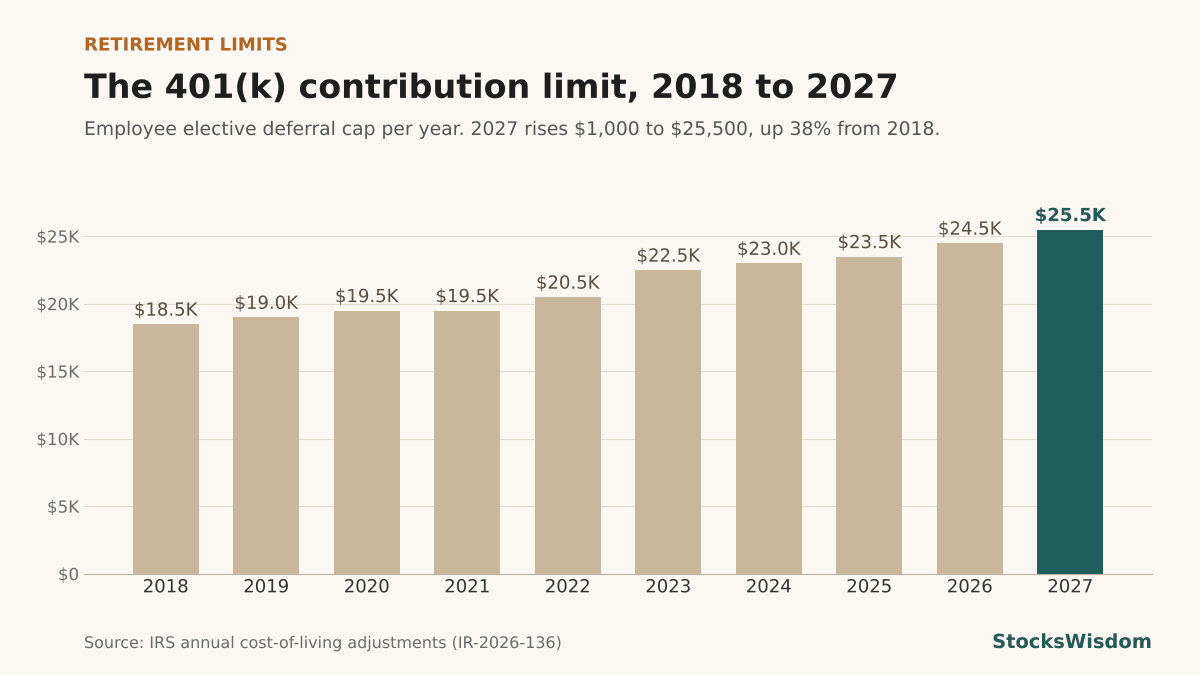
These caps are tied to inflation. When prices run hot, the IRS bumps the 401(k) cap in $500 steps once the formula clears the next threshold. That’s why the last few years have brought bigger jumps than the slow years of the late 2010s.
Back in 2018 the limit was $18,500. Next year it’s $25,500, a 38% increase. The chart below shows how the employee deferral cap has moved each year since 2018.
If you’re 50 or older at any point in 2027, you can add $8,500 on top of the regular $25,500, for $34,000 total.
People who turn 60, 61, 62 or 63 during the year get a bigger catch-up of $11,750 instead. That brings their max to $37,250. This “super catch-up” came from the SECURE 2.0 law, and it’s optional for employers. Check your plan documents or ask HR, because not every plan has turned it on.
There’s a quirk here. At 64 you drop back to the standard $8,500 catch-up. So the four-year window from 60 to 63 is the best time in your career to stuff money into a workplace plan, if you can afford to.
This one catches people off guard. If your FICA wages from your employer topped $155,000 in 2026, any catch-up dollars you put in during 2027 must go in as Roth (after-tax) contributions. The threshold applied to 2025 wages was $150,000, per WealthFluent’s summary of IRS guidance.
In plain terms, you lose the upfront tax deduction on the catch-up part. You still get tax-free growth and tax-free withdrawals later, which isn’t a bad deal. But if your plan has no Roth option at all, Fidelity notes that high earners in that plan can’t make catch-up contributions.
Final IRS rules generally apply to contributions starting in 2027, though many plans began following them this year. Your regular $25,500 can still go in pre-tax. Only the catch-up portion gets forced into Roth.
IRA savers get a $7,500 cap again, but the income lines that decide who can use a Roth IRA did move up:
The Saver’s Credit income cap for married couples filing jointly also rises, to $83,000 from $80,500. If you’re unsure which IRA fits you, our Roth IRA vs Traditional IRA guide breaks down the tradeoffs.
Most people don’t max out, and that’s fine. Still, it helps to see what maxing out takes.
To hit $25,500 you’d need about $981 per paycheck if you’re paid every two weeks (26 checks), or $1,062.50 if you’re paid twice a month (24 checks). Savers aged 60 to 63 going for the full $37,250 need roughly $1,433 per biweekly check.
What does the extra $1,000 buy you? If you’re in the 22% federal bracket and contribute pre-tax, that $1,000 cuts your federal tax bill by about $220 this year. And $1,000 a year invested for 25 years at a 7% average return grows to roughly $63,000. That’s a hypothetical return, not a promise, but it shows why small bumps add up.
One practical warning: if you set your contribution as a percentage of pay and you get a raise, you could hit the cap early in the fall. Some employers only match on each paycheck, so maxing out by October can cost you match dollars in November and December. Ask whether your plan has a “true-up” feature.
November has been rough, and plenty of people are wondering whether to slow their contributions until the volatility settles down. That’s usually backwards.
A 401(k) buys shares every payday no matter what the market does. When prices drop, each contribution buys more shares. That’s dollar-cost averaging built right into your paycheck, and it’s one reason steady savers tend to do fine through sell-offs. We compared it with investing all at once in our dollar-cost averaging vs lump sum post.
What you hold inside the plan matters more than the timing. A target-date fund or a broad index fund keeps it simple. If you also pick individual stocks in a brokerage account, a tool like StocksWisdom shows a stock’s sentiment, technical signals and 30-day forecast in one place, which helps you sanity-check a name before you buy.
Priority order for most people looks like this: grab the full employer match first, then pay down high-interest debt, then fund an IRA or HSA, then go back and push your 401(k) toward the limit.
With your first paycheck dated in 2027. Limits follow the calendar year your pay is issued, not when you earned it. Update your deferral rate in December so January’s check reflects it.
No. That $25,500 covers only your own contributions. Employer matches and profit-sharing count toward the separate $75,000 combined limit.
No. Your employee deferral limit is per person across all 401(k) and 403(b) plans. Split it however you like, but the total can’t go over $25,500 (plus any catch-up you qualify for).
Are you raising your 401(k) contribution for 2027, or holding steady while the market sorts itself out? Tell us in the comments.
Not financial advice. Do your own research.