Physical Address
304 North Cardinal St.
Dorchester Center, MA 02124
Physical Address
304 North Cardinal St.
Dorchester Center, MA 02124

Last Friday felt like the floor was giving way. Today, Wall Street got the floor back, and then some.
The S&P 500 jumped 4.73% on Monday to 7,237.17, snapping a seven-day losing streak. The Nasdaq Composite soared 6.51% to 24,089.56, and the Dow added 1,447.98 points (3.01%) to close at 49,595.31, according to Motley Fool’s market recap. For all three indexes, it was the best session since April 2025, per CNBC data cited by Oninvest.
The spark? Nvidia’s board put Jensen Huang back in the CEO chair, eleven days after he resigned. Nvidia stock rocketed 31.48% to $165.05, adding nearly $1 trillion in market value in a single afternoon.
Is the sell-off over? Nobody knows yet. But today’s stock market rebound is a perfect real-world lesson in why the market’s best days tend to show up right when it feels scariest to own stocks.
Here’s how the big indexes and Nvidia moved from Friday’s close to Monday’s close.
| Friday, Nov. 20 close | Monday, Nov. 23 close | Change | |
|---|---|---|---|
| S&P 500 | 6,910.39 | 7,237.17 | +4.73% |
| Nasdaq Composite | 22,617.73 | 24,089.56 | +6.51% |
| Dow Jones | 48,147.33 | 49,595.31 | +3.01% |
| Nvidia (NVDA) | about $125.53 | $165.05 | +31.48% |
Friday’s closing levels come from the Associated Press, which reported the S&P 500 sank 3.7% that day and the Nasdaq dropped 5.3%, wiping out its gain for the year.
AI names led the charge. CoreWeave rose 22.32%, Dell gained 20.46%, Nebius climbed 20.28% and Micron added 19.04%. Tesla jumped about 11.5%. AMD gained 6.85%.
Not everything rose. CrowdStrike fell 8.92% after agreeing to buy Zscaler in an all-stock deal worth $44 billion. Zscaler shares rose 17.67%.
On Nov. 12, Nvidia said Huang had resigned as president, CEO and board member, effective immediately. CFO Colette Kress stepped in as interim CEO. We covered the fallout in our post on Huang’s resignation.
On Monday, the board reversed course. In a press release filed with the SEC, Nvidia said the board voted unanimously to reinstate Huang as president, CEO and director. It said it had received input from senior levels of the U.S. government and was confident his return “poses no national security risk.”
Board chair Harvey Jones said, “The Board believes Jensen is the right person to lead NVIDIA.” Huang said he was “honored to return.”
One detail matters for investors. The independent committee’s investigation isn’t finished. The release says it “will proceed to conclusion,” and the board also created a new national security and export control committee. So the leadership question looks settled, but the probe isn’t.
Why did one CEO decision lift thousands of stocks? Because Nvidia is huge. It makes up roughly 6% of the S&P 500 by some estimates, so a 31% jump in one stock adds close to 2 percentage points to the index by itself.
For the S&P 500, yes. Barely.
The index set its record close of 7,818.93 on Oct. 6, per AP data. Friday’s close of 6,910.39 left it 11.6% below that peak, which put it in correction territory (a drop of 10% or more from a high). Monday’s close puts it 7.4% below the record. It would need to rise about 8% more to get back to the top.
The Nasdaq is a different story. Even after a 6.51% day, it’s still more than 10% under its October high. If the difference between a pullback, a correction and a bear market is fuzzy, our explainer on correction vs bear market lays it out.
Plenty of people sold last week. That’s a normal reaction to seven straight red days.
But look at the timing. Friday was the S&P 500’s worst week since April 2025. Monday was its best day since April 2025. If you’d sold Friday afternoon to “wait for things to calm down,” you’d have missed a 4.73% gain by Monday’s close.
This isn’t a one-off. According to a Motley Fool analysis of the SPDR S&P 500 ETF, seven of the fund’s 10 best days over the past 20 years came within two weeks of one of its 10 worst days. The single best day was Oct. 13, 2008, a 14.5% gain in the middle of the financial crisis.
The graphic below shows what $10,000 put into that S&P 500 fund on Oct. 12, 2006, grew to by Oct. 12, 2026, with dividends reinvested, depending on how many of the best days you missed.
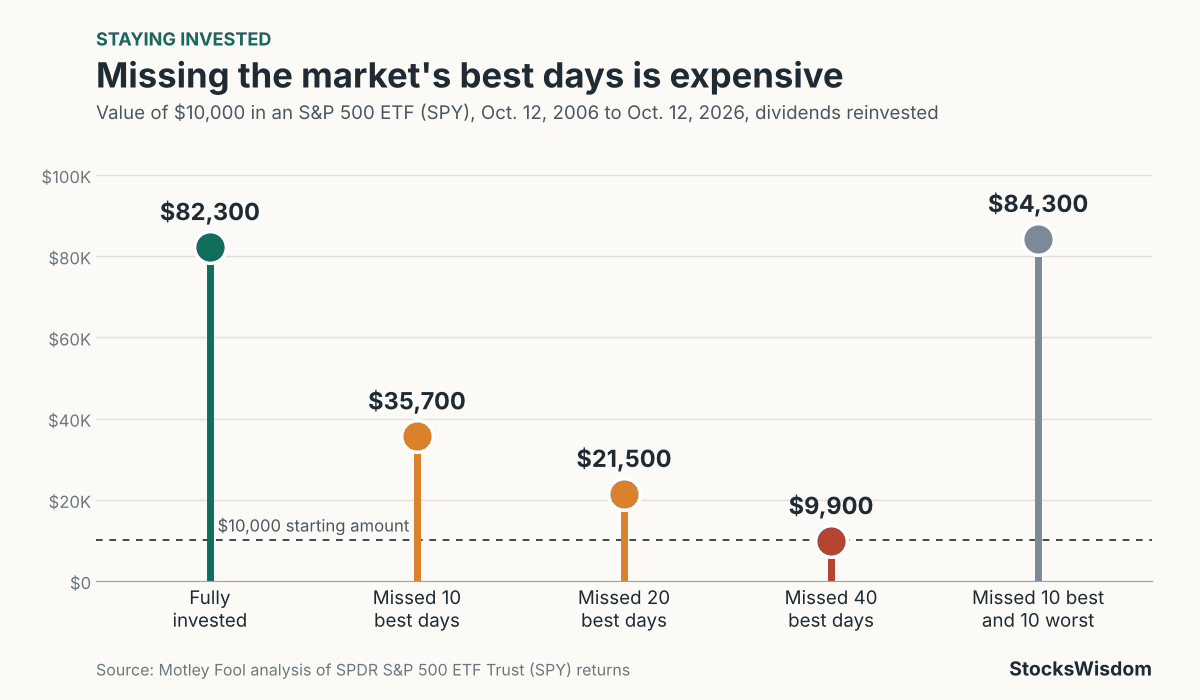
Stay fully invested and you ended up with about $82,300. Miss just the 10 best days, out of more than 5,000 trading days, and you’d have around $35,700. Miss the best 40 and you’d have slightly less than you started with.
Yes, skipping the 10 worst days too would have left you with about $84,300. But nobody can reliably dodge the worst days without also missing the best ones, because they arrive in clumps.
If you own an index fund in a 401(k) or IRA, Monday undid a chunk of last week’s damage, and you didn’t have to do anything to get it.
A few practical moves:
If you want a quick read on whether a stock you own is still being sold or starting to recover, StocksWisdom shows a stock’s sentiment, technical signals and a 30-day forecast on one screen.
One great day doesn’t confirm a bottom. Relief rallies are common inside corrections, and some of the sharpest one-day gains ever came during bear markets that kept going (see 2008).
Some risks haven’t moved. Rates are still high, with the Fed’s target at 3.75% to 4.00% and some officials openly talking about more hikes. The 10-year Treasury yield sat near 4.92% on Monday. Nvidia still faces the open board investigation, a reported SEC accounting probe and China export limits.
What changed is sentiment. The VIX, Wall Street’s fear gauge, dropped about 24% to around 27 late in the session. Calmer, but not calm.
Nvidia reinstated Jensen Huang as CEO, and its stock jumped 31.48%. Because Nvidia is one of the biggest companies in the S&P 500, and because so many AI stocks depend on its spending, the move set off a broad relief rally after seven straight down days.
No, not as of Monday’s close. It finished 7.4% below its Oct. 6 record of 7,818.93, back inside the 10% line. The Nasdaq is still in correction territory.
That depends on your timeline and your plan, not on one day’s move. Regular investing through ups and downs has historically beaten trying to pick the exact bottom, and a 4.7% bounce doesn’t mean prices can’t fall again.
Did you sell during last week’s slide, buy more, or just stop checking your account? Tell us in the comments.
Not financial advice. Do your own research.