Physical Address
304 North Cardinal St.
Dorchester Center, MA 02124
Physical Address
304 North Cardinal St.
Dorchester Center, MA 02124

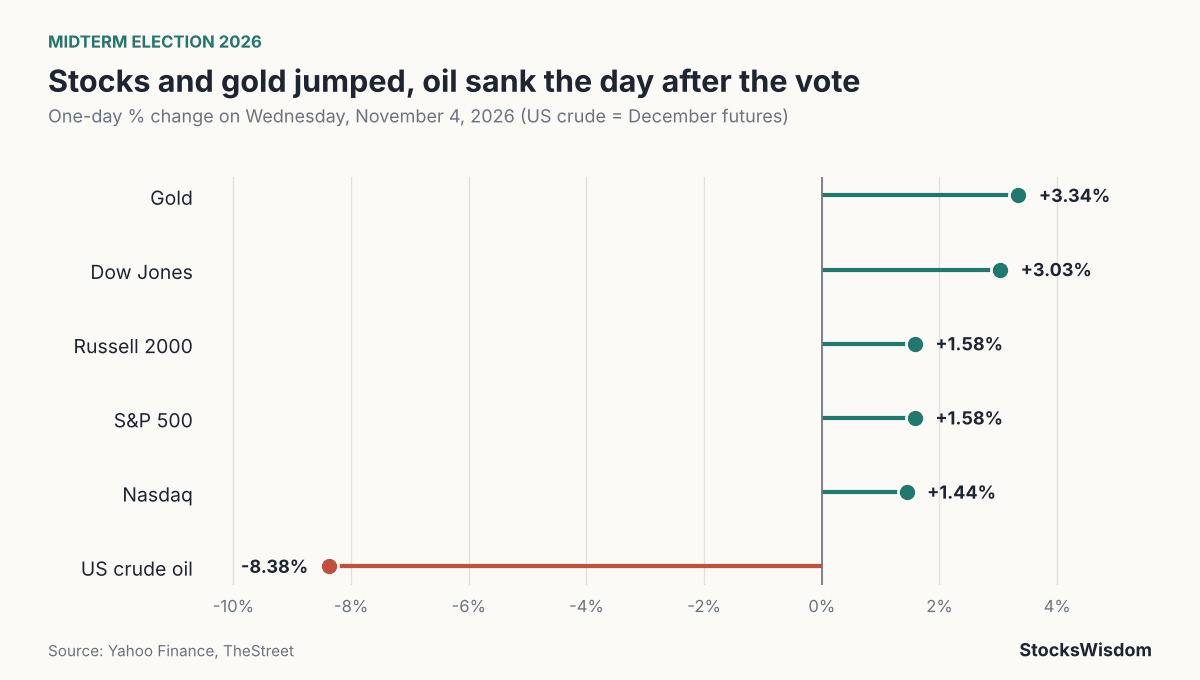
Wall Street got its election answer on Wednesday, and it liked what it heard. The Dow Jones Industrial Average jumped 1,569.40 points, or 3.03%, to close at 53,356.12, its best session since April 2025 and its best post-midterm day in 44 years, according to Yahoo Finance. The S&P 500 rose 1.58% to 7,688.62. The Nasdaq added 1.44%.
What set it off was a clear result. Democrats won control of both the House and the Senate, based on Associated Press projections. A few races are still being counted, but Republicans were on track to lose Senate seats in states President Trump carried comfortably in 2024.
Then there’s oil. US crude futures fell more than 8% to about $88 a barrel, and Brent dropped roughly $10 to trade under $100 for the first time in weeks, per TheStreet. For a market that’s been worried about inflation and a 10-year Treasury yield near 5%, cheaper oil may matter more than any single seat in Congress.
In short, it was a Democratic sweep. What made it unusual was where it happened.
According to vote tracker VoteHub, cited by TheStreet, Democrats were on track to flip seven Senate seats in states Trump won by 10 points or more. Since 1926, the party out of power had never flipped more than four Senate seats in a president’s stronghold states. If the remaining races break their way, Democrats could hold 56 Senate seats, their most since 2008.
In Texas, Democrat Gina Hinojosa won the governor’s race over Greg Abbott, with the official count still pending.
What does a Republican president facing a Democratic Congress mean in practice? Gridlock. Big new laws get much harder to pass. Spending fights get louder. Trump himself said, “I think they’re gonna want to work with me. Otherwise, I’d just veto everything.”
Markets usually don’t hate that.
Two strategists made the same point to CNBC on Wednesday, as relayed by StockTitan. Andrew Slimmon of Morgan Stanley Investment Management said the result means gridlock and that markets prefer it to one party holding too much power. Jay Woods of Freedom Capital Markets said gridlock has historically been good for stocks.
It’s boring logic, and that’s the appeal. If Washington can’t pass much, companies can plan around the rules they already have. Fewer surprises means less of a “policy risk” discount on stock prices.
A second reason was the war with Iran. Peter Boockvar, chief investment officer at One Point BFG Wealth Partners, said the result adds “even more pressure to end the war.” Traders read that as a shot at lower energy prices, which is why oil fell so hard.
Fear drained out fast, too. The VIX volatility index dropped about 20% to 16.61.
Not everything went up. Energy stocks were the worst sector of the day, which makes sense when crude loses 8% in a session. Trump Media fell more than 11% at the open and kept sliding.
AI infrastructure names had a rough day as well. Hut 8 was down nearly 22% by early afternoon, the iShares Semiconductor ETF slipped about 1%, and Nvidia lost about 1.6%.
Here’s who gained:
Gold jumped about 3.3% to roughly $4,072 an ounce, and the 10-year Treasury yield slipped to about 4.89%.
The chart below shows how the major indexes, gold and oil moved on November 4, 2026.
One day is noise. Twelve months tells you more, and here the record is friendly.
A Motley Fool analysis going back to 1874, republished by Stacker, found the S&P 500 gained in 32 of 38 midterm years. The average total return in the 12 months after a midterm was 14%, compared with 11% for a typical 12-month stretch.
| Period after a midterm | Average S&P 500 return | Share of times positive |
|---|---|---|
| 1 month | 0.5% | 55% |
| 3 months | 6% | 76% |
| 6 months | 10% | 87% |
| 12 months | 14% | 84% |
Bank of America’s numbers are even tidier. Since World War II, the index has risen in every six-month and 12-month period following a midterm election, with average gains of about 13% and 14%, according to investingLive.
Look at that one-month row, though. Gains right after the vote are close to a coin flip. Most of the historical payoff showed up over months, not days. We covered the longer pattern in our look at how political elections affect the stock market.
History is a base rate, not a promise. A few things make this year different.
Valuations are high. The S&P 500 sits near 7,700, and the Nasdaq only just bounced from a drop of nearly 8% that we wrote about in our correction vs bear market explainer. Stocks that start expensive have less room for the “relief rally” math to work.
Rates are another problem. A 10-year yield near 4.9% keeps mortgages and car loans pricey, and it makes bonds a real alternative to stocks.
And the war. If talks with Iran stall, oil can climb back just as fast as it fell. Iran’s Revolutionary Guard said four tankers caught fire after hitting mines in the Strait of Hormuz, a reminder that the risk hasn’t gone anywhere.
For most people, the right move after an election is to do very little. The rally already happened. Chasing Wednesday’s winners on Thursday morning means buying after the easy money is gone.
A few practical points:
If you want to see whether a specific stock’s momentum is holding after a day like this, StocksWisdom shows each stock’s sentiment, technical signals and a 30-day forecast in one place. It’s a quick way to separate a real trend from an election-day pop.
And if you have cash on the sidelines, history suggests time in the market beats guessing the perfect entry. Spreading purchases over a few months is a reasonable middle ground.
Usually, yes. The S&P 500 rose in 32 of 38 midterm years since 1874 and averaged a 14% gain over the following 12 months. Short-term results are much less reliable.
It often has been. Gridlock limits big policy surprises, which investors tend to like. It doesn’t protect stocks from recessions, rate spikes or wars.
Traders bet a Democratic Congress adds pressure to end the war with Iran, which would ease supply fears. US crude fell more than 8% and Brent slipped under $100.
So, are you adding to stocks after the midterm rally, or waiting for the dust to settle? Tell us in the comments.
Not financial advice. Do your own research.