Physical Address
304 North Cardinal St.
Dorchester Center, MA 02124
Physical Address
304 North Cardinal St.
Dorchester Center, MA 02124

The Dow dropped 1,101 points on Thursday, November 19, closing at 49,097.06. That’s a 2.2% slide in one session. The S&P 500 lost 2% to finish at 7,175.83, and the Nasdaq Composite fell 2.3% to 23,879.20.
What makes this one sting is the streak. It was the S&P 500’s sixth straight losing day, its longest run of losses in about two and a half years, according to AP. More than 90% of the stocks in the index fell. The S&P now sits 8.2% below the record close of 7,818.93 it set on October 6.
So here’s the question everyone is typing into a search bar tonight: is a stock market correction coming? We’re close. Let’s look at what happened, how close “close” is, and what it means for your money.
Thursday didn’t start ugly. Anthropic made its Nasdaq debut under the ticker ANT, and the excitement briefly lifted the whole market. The S&P 500 was up as much as 1.3% at one point.
Then the rally faded. Chip and AI names that opened green flipped hard. Nvidia went from up 4.7% to down 3.3%. Micron swung from a 7.8% gain to a 2.1% loss, and CoreWeave went from up 10.5% to down 6.1%. AMD was the worst of the big names, falling about 7.7% after a short seller raised questions about its ties to a blacklisted Chinese server maker, per Motley Fool.
Industrials were the weakest sector, down 2.6%. Only energy and consumer staples managed to finish slightly positive.
There were a few winners. Insmed jumped about 20.6% on reports Sanofi is weighing a takeover. Palo Alto Networks rose 6.4% after beating earnings forecasts and announcing a $4.5 billion all-stock deal for Applied Compute. Walmart narrowly beat profit and revenue estimates and still slipped 1%. When good news can’t hold a stock up, you know the mood is sour.
There isn’t one villain here. It’s a pile of worries that kept stacking up all month.
AI valuations. Investors are asking harder questions about whether the huge spending on AI chips and data centers will pay off. Dan Ives, an analyst at Yorkville Ives, called it “a very turbulent, white-knuckle period,” per AP.
Interest rates. The 10-year Treasury yield is hovering around 5%, ending Thursday near 5.04%. Rates that high make borrowing pricier for companies funding AI buildouts, and they give savers a decent return without taking stock market risk. After last week’s hot inflation readings (see our breakdown of October CPI), traders are bracing for another Fed hike. As of November 12, CME FedWatch put the odds of a quarter-point December hike at 89%, according to Zacks.
Nvidia’s leadership shock. Jensen Huang’s sudden resignation as CEO hit the market’s most important stock. Even a strong quarter, with revenue of $115.8 billion, couldn’t turn sentiment around.
Policy risk. Democratic midterm wins raised concerns about tighter AI regulation. Monday’s 1.9% drop came alongside a new U.S. rule restricting China’s access to AI chips, per Yahoo Finance.
Wall Street’s “fear gauge,” the VIX, jumped more than 13% on Thursday and ended the day in the high 20s.
A correction is a drop of 10% or more from a recent high. A bear market is 20% or more. We explain the difference in detail in our post on correction vs bear market.
The Nasdaq already crossed that line back on November 5, when it fell more than 10% below its October record, as The Signal reported. The S&P 500 hasn’t. Not yet.
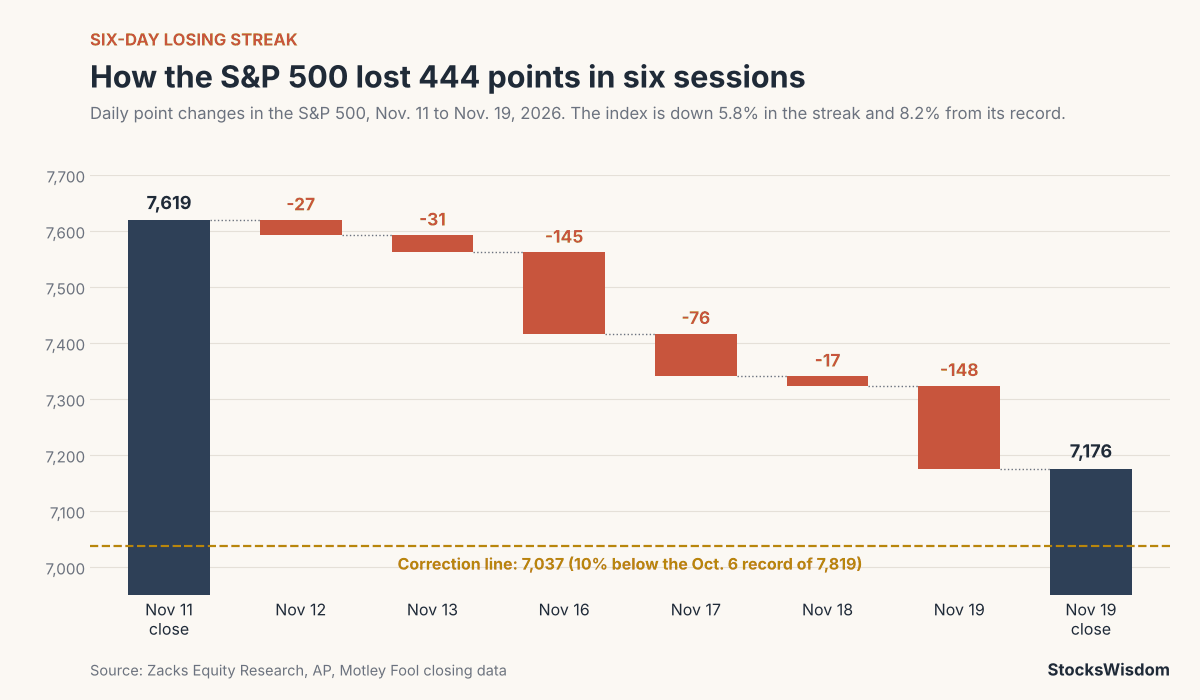
The chart below shows how the S&P 500 lost 444 points over six sessions, day by day, and where the correction line sits.
| Level | S&P 500 value | Distance from Thursday’s close |
|---|---|---|
| Record close (Oct. 6) | 7,818.93 | +9.0% |
| Start of streak (Nov. 11 close) | 7,619.38 | +6.2% |
| Thursday close (Nov. 19) | 7,175.83 | 0% |
| Correction (10% off record) | 7,037.04 | minus 1.9% |
| Bear market (20% off record) | 6,255.14 | minus 12.8% |
Put plainly, the S&P 500 needs to fall just 1.9% more to officially enter a correction. One more day like Thursday would do it.
Since November 11, the Dow has given up 6.5% from its 52,486.49 close that day.
Anthropic priced its shares at $83, above the $70 to $78 range we covered in our Anthropic IPO guide. The company raised a record $81.3 billion.
ANT opened at $111.50, a 34% pop, according to Yahoo Finance. It didn’t stay there. ANT closed at $97.17, still up 17.1% from the IPO price but nearly 13% below where it first traded.
There’s an interesting wrinkle. Vanda Research found that retail investors were selling other single stocks, led by AMD, to raise cash for Anthropic. So some of the selling elsewhere was money moving, not money leaving.
If you own an index fund, you’ve felt this. The S&P 500 is down about 5.8% in six trading days. On a $50,000 portfolio that tracks it, that’s roughly $2,900 on paper.
What matters more than that number:
If you’re sitting on losses in a taxable account, a sell-off like this can be useful. Our guide to tax-loss harvesting shows how to turn red numbers into a smaller tax bill.
Want to see whether a stock you own is just caught in the crowd or showing real weakness? StocksWisdom shows each stock’s sentiment, technical signals and a 30-day forecast, which helps separate noise from an actual trend change.
Losing streaks end, usually when the worry behind them gets a fresh data point.
Inflation and the Fed top the list. A cooler inflation reading could ease rate-hike fears fast. Softer economic data already pushed Treasury yields a bit lower on Thursday, as jobless claims ticked up and a mid-Atlantic factory survey showed slowing growth.
AI is the other lever. If Nvidia’s next CEO steadies investors, or if big tech spending keeps showing real revenue, the chip trade could find its footing.
A broad sell-off hit nearly every sector on November 19. Worries about AI valuations, interest rates near 5%, a likely December Fed hike and Nvidia’s CEO shakeup all weighed on stocks, even as Anthropic’s IPO briefly lifted the market.
The Nasdaq is. It fell more than 10% from its record in early November. The S&P 500 is 8.2% below its October 6 record, so it would need another 1.9% drop to hit correction territory.
That depends on your goals and timeline, not on one bad week. Long-term investors who sell during sharp drops often miss the rebound. If the swings are too much to handle, adjust your stock and bond mix with a plan rather than reacting to one day.
Are you buying this dip, holding tight, or trimming your stock exposure? Tell us in the comments.
Not financial advice. Do your own research.