Physical Address
304 North Cardinal St.
Dorchester Center, MA 02124
Physical Address
304 North Cardinal St.
Dorchester Center, MA 02124


Tesla sold almost exactly as much this summer as it did a year ago. Revenue for the third quarter came in at $28.05 billion, against $28.10 billion in Q3 2025. Flat. Yet operating income fell 56%, to $718 million.
That gap is the real story of Tesla’s Q3 2026 earnings. The car business got a bit healthier (gross margin climbed to 19.6%), but spending on AI, robots and robotaxis grew far faster than sales. Adjusted earnings of $0.48 a share beat the $0.44 Wall Street expected, and free cash flow swung back to a positive $1.5 billion.
Investors shrugged anyway. The stock closed Thursday at $374.58, down about 3%, on a rough day when the Nasdaq dropped 2.6% and Meta sank 7% over its own AI spending worries (Yahoo Finance). So what happened, and what should you take from it?
Here’s how the quarter compares with a year ago, using figures from Tesla’s own Q3 2026 release.
| Metric | Q3 2025 | Q3 2026 | Change |
|---|---|---|---|
| Revenue | $28.10B | $28.05B | Flat |
| Gross margin | 18.0% | 19.6% | Up 1.6 pts |
| R&D spending | $1.63B | $2.76B | Up 69% |
| Operating income | $1.62B | $0.72B | Down 56% |
| GAAP net income | $1.37B | $0.79B | Down 43% |
| Vehicle deliveries | 497,099 | 486,532 | Down 2% |
| Energy storage deployed | 12.5 GWh | 13.7 GWh | Up 10% |
Against expectations, it was a mixed card. Revenue landed a hair under the $28.13 billion consensus. Deliveries beat the roughly 463,000 analysts were looking for. Energy storage missed badly, though: consensus was near 15.9 GWh, according to Electrek, and energy revenue fell 16% to $2.88 billion.
Services was the quiet winner. That line (used cars, paid Supercharging, insurance and repairs) jumped 33% to $4.6 billion.
Start with gross profit, which is what’s left after paying to build the cars, batteries and services. It rose 9% to $5.49 billion. Good news.
Then the bills arrived. Research and development cost $2.76 billion, up 69%. Sales, general and administrative costs rose 29% to $2.02 billion. Subtract both and you get the $718 million of operating income. A year earlier, the same math left $1.62 billion. The chart below shows how each quarter’s gross profit got split between R&D, overhead and what Tesla kept as operating profit.
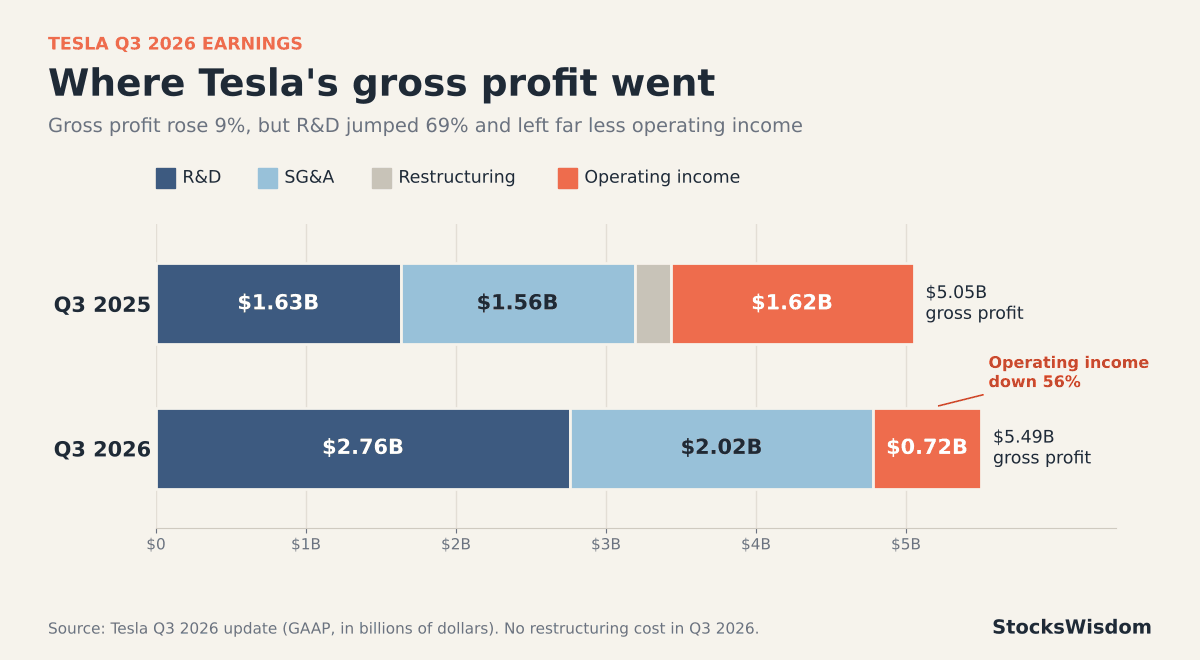
This is the part beginners often miss. A company can earn more on every car it sells and still make less money in total, because spending below the gross profit line can grow faster than the business. Tesla’s operating margin was just 2.6%, down from 5.8% a year ago. For every $100 of sales, Tesla kept $2.60 as operating profit.
To be fair, the trend inside 2026 is improving. Operating margin was only 1.4% in Q2, and free cash flow was negative $1.09 billion that quarter. Q3 was better on both counts.
Here’s the odd twist. Tesla cut its 2026 capital spending plan to about $20 billion, down from the “more than $25 billion” it guided to earlier (Yahoo Finance). Q3 capex was $4.73 billion, well below the roughly $7.96 billion analysts had penciled in.
Normally, spending less than planned is good news. More cash stays in the bank. That’s exactly why free cash flow crushed the estimate.
But Tesla isn’t valued like a normal carmaker. Its roughly $1.5 trillion market value rests on robotaxis, robots and AI chips, and those need heavy investment. A smaller budget made some investors wonder whether the AI buildout is slowing. CFO Vaibhav Taneja put it plainly on the call: “We are revising our CapEx guidance to be approximately $20 billion for the current year.”
Musk pushed back on the idea that Tesla is pulling back. He said spending would become more meaningful in 2027 and “noticeable in the tens of billions in 2028,” according to the earnings call transcript. Tesla also lined up the ability to borrow up to $30 billion, though it doesn’t plan to tap that this year.
One detail to keep in mind: Tesla spent $13.01 billion through September. Hitting $20 billion means about $7 billion in Q4 alone, more than any quarter so far this year.
Most of the bull case lives here, so it’s worth a quick tour.
Cybercab rides started September 3 in Austin, and unsupervised robotaxi miles grew eightfold from the prior quarter. Tesla says Dallas is next, with more cities before year-end and 24/7 service as a goal. Active FSD subscriptions hit 1.74 million, up 67% (Electrek points out that count includes people who bought FSD outright).
Optimus, the humanoid robot, is now in early production in Fremont. Musk didn’t hedge: “I remain convinced that Optimus will be the biggest product on Earth.” Customer deliveries outside Tesla aren’t expected until around the end of 2027, though.
There’s regulatory risk too. NHTSA sent Tesla a special order with 21 questions about how Cybercab was self-certified, and answers are due October 30.
Hanging over all of this is a possible merger with SpaceX, which reported its own first quarterly profit this week. Musk said both companies formed special committees of independent directors to study a tie-up, and that he can’t take part because he’s conflicted. On Tesla’s call, he called his position “tap dancing through a minefield” and took no questions on it.
Fortune ran the numbers: Tesla is worth about $1.52 trillion and SpaceX about $2.14 trillion. Add a typical 30% takeover premium and SpaceX would need to issue shares equal to roughly 92% of its existing stock. Nothing is agreed. But any deal headline could move TSLA sharply in either direction.
If you own an S&P 500 or Nasdaq 100 index fund, you already own Tesla, so this matters even if you’ve never bought a single share.
A few practical lessons from this report:
If you’re tracking how traders react after a report like this, StocksWisdom shows a stock’s sentiment, technical signals and a 30-day forecast side by side, which helps separate a one-day mood swing from a real shift.
On profit, yes. Adjusted EPS was $0.48 against a $0.44 estimate. Revenue of $28.05 billion came in slightly below the $28.13 billion consensus.
Falling operating profit, a capex cut that some read as a slower AI push, weak energy deployments and a broad tech selloff on Thursday all weighed on shares.
About $20 billion in capital expenditures, down from earlier guidance of more than $25 billion. Management says spending rises again in 2027 and 2028.
Do you see Tesla’s lower spending as discipline or as a warning sign for its AI plans? Tell us in the comments.
Not financial advice. Do your own research.