Physical Address
304 North Cardinal St.
Dorchester Center, MA 02124
Physical Address
304 North Cardinal St.
Dorchester Center, MA 02124

Amazon just pulled off something that would’ve sounded absurd a few years ago. Its cloud business grew 39%, it booked a record $28.1 billion in quarterly operating profit, and its stock still dropped more than 7% before Friday’s open.
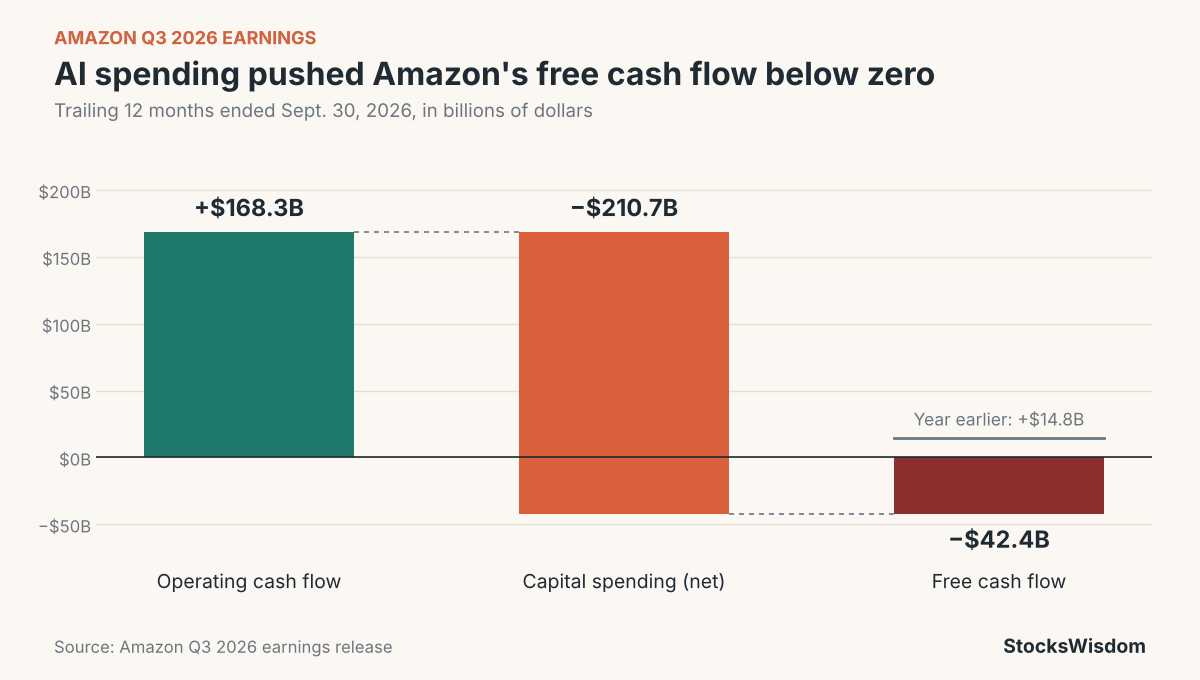
One number explains it: negative $42.4 billion. That’s Amazon’s free cash flow over the last 12 months, according to the company’s third quarter earnings release. A year earlier, that same figure was a positive $14.8 billion. AI data centers ate the difference.
And the selling didn’t stay inside one ticker. On Friday the Nasdaq closed down 2.86% at 25,437, finishing an October slide of roughly 5% that Yahoo Finance called its worst month since March 2025. So this isn’t only an Amazon story. It’s the clearest look yet at the bill Big Tech is running up on AI, and who’s paying it.
Sales came in at $201.9 billion, up 12% from $180.2 billion a year ago. That landed just under the $202.31 billion Wall Street wanted, per SiliconANGLE. Earnings of $1.89 a share missed the $1.96 forecast.
Here’s how the big pieces compare with last year:
| Metric | Q3 2026 | Q3 2025 | Change |
|---|---|---|---|
| Net sales | $201.9B | $180.2B | +12% |
| AWS sales | $46.0B | $33.0B | +39% |
| Operating income | $28.1B | $17.4B | +61% |
| AWS operating income | $17.8B | $11.4B | +55% |
| Net income | $20.7B | $21.2B | -2% |
| Diluted EPS | $1.89 | $1.95 | -3% |
| Capital spending | $77.3B | $35.1B | +120% |
Don’t read too much into the dip in net income. Last year’s quarter included a $9.5 billion pre-tax gain on Amazon’s stake in Anthropic, and nothing like that showed up this time. Operating income, which tracks the actual business, jumped 61%.
The soft spots were in shopping and ads. Online store sales grew only 2% to $68.47 billion, short of the $69.68 billion analysts expected. Advertising rose 11% to $19.64 billion, well below a $20.82 billion forecast. Amazon says moving Prime Day into the second quarter in most large countries knocked about 4 percentage points off Q3 sales growth, which explains part of it, though not all.
AWS brought in $46.0 billion, up 39%. That’s the sixth quarter in a row of faster growth, according to an analysis by Data Studios, and AWS now earns $17.8 billion a quarter in operating profit. That’s nearly two thirds of Amazon’s total, from a unit that brings in less than a quarter of its sales.
CEO Andy Jassy sounded thrilled. “Our AWS investment in functionality and infrastructure is working,” he said in the release, pointing to a $184 billion annual revenue run rate. Then he went bigger: “There has never been a trillion dollar revenue business, and we may have two of them in the next 5-10 years.”
Demand looks real. AWS reported a $578 billion backlog of contracted future revenue, and Amazon said its custom chip business is growing at triple-digit percentages. Jassy also projected AWS growth above 40% in both 2027 and 2028.
Free cash flow is simple. Take the cash a company brings in from running its business, subtract what it spends on buildings, servers and equipment, and what’s left is free cash flow. It’s the money a company could use for buybacks, dividends or paying down debt.
Amazon’s operating cash flow was fine. Great, even. It rose 29% to $168.3 billion over the trailing 12 months. Capital spending just grew a lot faster. Net of proceeds and incentives, Amazon spent $210.7 billion on property and equipment over that stretch, up from about $120 billion a year earlier.
Q3 alone took $77.3 billion, way above the $58.7 billion analysts had penciled in. Amazon kept its 2026 cash capex target at about $220 billion, and Jassy said the company plans to “spend more meaningfully in 2027.” The chart below shows how the last 12 months of cash added up.
Markets were fine with big AI budgets as long as the cash kept flowing. That patience is wearing thin.
Amazon gave investors three reasons to sell at once. Sales and profit came in a little light, spending blew past estimates, and fourth quarter guidance of $240 billion to $247 billion has a midpoint of $243.5 billion, below the $244.5 billion Street estimate. Shares fell more than 7% before the open, then pared that to about 2% by late morning, StockTitan reported.
It’s a pattern now. Alphabet had a rare miss and its worst day in over 20 years on Thursday (we broke down Alphabet’s Q3 numbers here). Intel sank about 28% Friday after a weak forecast, which we covered in our Intel Q3 2026 earnings post. Add a 10-year Treasury yield near 4.93% and two Fed officials talking about possible rate hikes, and tech had very little room for disappointment.
If you own an S&P 500 or Nasdaq index fund, you own Amazon, plus Alphabet, Microsoft and the rest of the AI spenders. A rough month for those names hits your 401(k) even if you’ve never bought a single tech stock directly. It’s worth checking how much of your portfolio really rides on five or six companies.
Negative free cash flow isn’t the same as losing money. Amazon is very profitable. It’s choosing to pour almost every dollar it earns (and then some) back into data centers. That’s a bet, and bets can work or fail. A $578 billion backlog says customers want what AWS is building. The risk is that spending keeps climbing faster than that demand shows up as cash.
For long-term holders, the question isn’t whether next week’s price bounces. It’s whether AWS can turn $220 billion a year of spending into profits big enough to justify it. If you’d like a fast read on where AMZN stands after the drop, StocksWisdom shows a stock’s sentiment, technical signals and 30-day forecast on one page.
Savers and borrowers should watch rates, too. September’s PCE inflation reading ran hot, and a 10-year yield near 4.93% keeps mortgage and auto loan rates high. High-yield savings accounts, on the other hand, stay attractive.
New to reading these reports? Our guide on how to read an earnings report walks through cash flow statements step by step.
It missed slightly. EPS was $1.89 against a $1.96 estimate, and revenue of $201.9 billion came in just below the $202.31 billion forecast. AWS beat, while ads and online stores fell short.
Capital spending outran cash from operations. Amazon generated $168.3 billion of operating cash flow over 12 months but spent $210.7 billion (net) on equipment, mostly for AI data centers, leaving an outflow of $42.4 billion.
Amazon expects about $220 billion in cash capital spending for 2026, most of it tied to AWS and AI infrastructure. Jassy said spending will rise more meaningfully in 2027.
So here’s my question for you: is Amazon’s $220 billion bet a smart long game, or is the market right to want cash now? Tell us in the comments.
Not financial advice. Do your own research.