Physical Address
304 North Cardinal St.
Dorchester Center, MA 02124
Physical Address
304 North Cardinal St.
Dorchester Center, MA 02124

Wall Street braced for a soft number this morning. It got the opposite. The October jobs report showed U.S. employers added 165,000 jobs last month, according to the Bureau of Labor Statistics, more than double the roughly 65,000 economists expected. Unemployment slipped to 4.1% from 4.2%.
On a normal day that’s simply good news. This isn’t a normal stretch. Inflation ran at 3.7% in September, the Fed already has two officials voting to raise rates, and traders now see a December hike as the most likely outcome. A hot jobs number pushes that bet even further.
So let’s walk through what the report said, why markets read “more jobs” as “higher rates,” and what it means for your paycheck, your loans and your portfolio.
Here’s the scorecard. Forecasts come from the Reuters poll cited by Yahoo Finance; everything else is straight from the BLS release.
| Measure | October 2026 | Forecast or prior |
|---|---|---|
| Nonfarm payrolls | +165,000 | ~65,000 expected |
| Unemployment rate | 4.1% | 4.2% in September |
| Average hourly earnings | $38.00 (+0.4% m/m) | +3.1% vs a year ago |
| September payrolls (revised) | +60,000 | first reported +29,000 |
| August payrolls (revised) | +186,000 | first reported +133,000 |
| Labor force participation | 61.9% | 61.8% in September |
Revisions matter almost as much as the headline. August and September together were bumped up by 84,000 jobs. Add those to October and the three-month average lands around 137,000 a month. Compare that with a 12-month average of just 48,000, which was dragged down by a 140,000 drop last October.
In plain English, hiring isn’t fading. It picked up speed this fall.
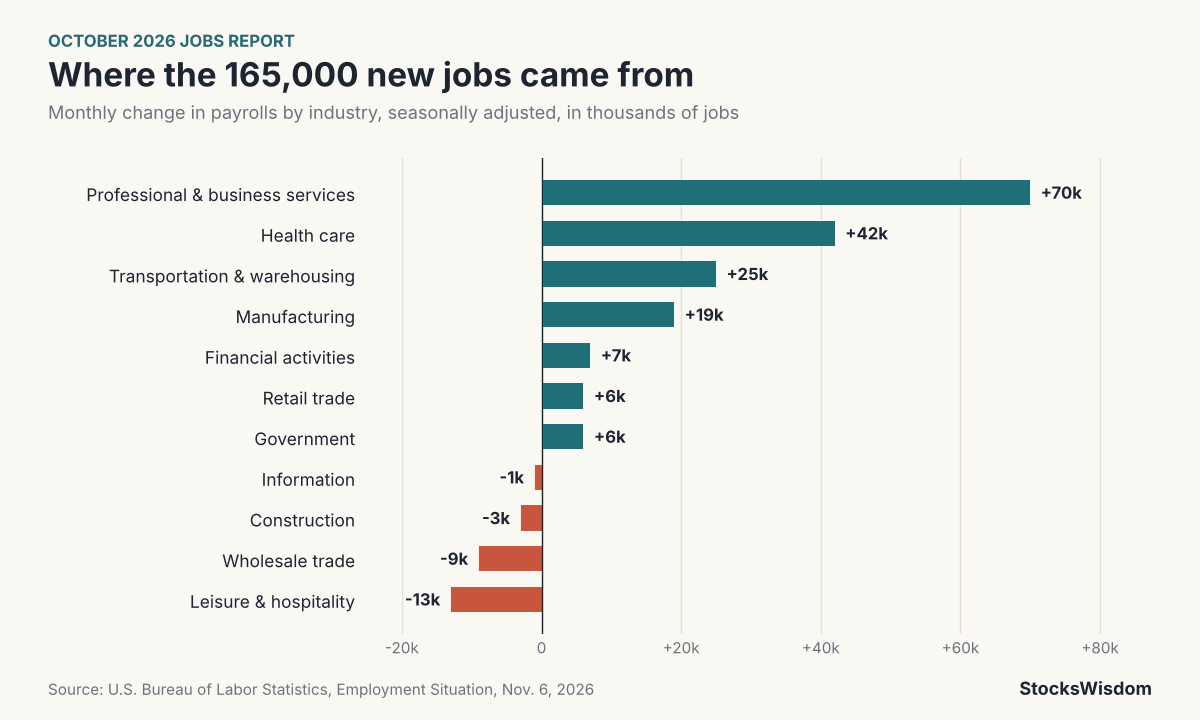
Professional and business services led with 70,000 new jobs. Health care added 42,000, keeping up the steady pace it’s had for years. Transportation and warehousing added 25,000 and manufacturing added 19,000, which is a decent month for a sector that’s struggled.
Not everything was green. Leisure and hospitality lost 13,000 jobs, wholesale trade shed about 9,000 and construction slipped by 3,000. Restaurants and hotels cutting staff fits the story from our recent look at consumer sentiment near a record low. People are still working. They’re just being careful about going out.
The chart below shows how October’s 165,000 jobs break down by industry.
You’d think a strong economy is great for stocks. Sometimes it is. Right now, though, the market cares more about interest rates than about growth, and a hot labor market gives the Fed cover to tighten.
Look at the math. At its October 28 meeting, the Fed held its benchmark rate at 3.75% to 4%, but the vote was 10 to 2. Lisa Cook and Beth Hammack both wanted a quarter-point hike. Its statement said plainly that inflation is still running high.
After this morning’s data, traders put the odds of a December hike at about 78%, up from 70% earlier in the day. Peter Cardillo of Spartan Capital told Reuters that “the Fed has no choice but to raise rates in December.” The 2-year Treasury yield, which tracks Fed expectations closely, jumped about 6 basis points to 4.52%.
Stocks ended mixed. The S&P 500 rose 0.31% to 7,376.86 and the Nasdaq gained 1.09%, mostly because chip stocks bounced after Thursday’s brutal sell-off (we covered why the SOX fell 12%). Meanwhile, the Dow fell 0.46%, per Yahoo Finance’s market wrap. It still capped the S&P 500’s worst week since June.
Here’s the uncomfortable part. Average hourly pay rose 3.1% over the past year. Prices rose 3.7% over the year through September, according to the latest CPI release.
That means the typical worker’s raise isn’t keeping up with the cost of living.
Most of that gap is gasoline. Gas prices jumped 9.1% in September alone and are up 34.2% from a year ago, and the BLS says gasoline accounted for more than half of September’s monthly price increase. Core inflation, which strips out food and energy, was a calmer 2.6%.
Why does this matter for the Fed? Wages growing at 3.1% aren’t the kind of thing that sparks a wage-price spiral. Some Fed officials may argue the inflation problem is mostly an energy shock that rate hikes can’t fix. Others will point at 165,000 jobs and say the economy can handle tighter policy. December’s vote could be close.
If you have a job or are looking for one: this is a decent market for workers. Unemployment at 4.1% is low by historical standards and companies are still hiring. You still have room to ask for a raise. One caveat: Savvy Wealth’s Anshul Sharma pointed out that the number of people working part time because they can’t find full-time work rose by 339,000, so not all of the new work is the kind people want.
If you borrow: brace for rates to stay high or go higher. Credit card rates and many adjustable loans move with the Fed’s benchmark, so a December hike would show up on your statement within a billing cycle or two. Mortgage rates follow the 10-year Treasury yield more than the Fed itself, and that yield is sitting near 4.86%. We explained that link when the 10-year hit its highest level since 2002.
If you save: you’re one of the few winners. High-yield savings accounts, CDs and money market funds keep paying well while the Fed is in tightening mode. A hike would push those yields up a bit more.
If you invest: expect bumpy weeks. Growth and tech stocks are the most sensitive to rate expectations because their value depends on profits far in the future. Before reacting to a headline, it helps to look at how a specific stock is actually behaving. StocksWisdom shows a stock’s sentiment, technical signals and 30-day forecast in one place, which beats guessing from a news alert.
Both, depending on the backdrop. When inflation is tame, strong hiring usually lifts stocks because it means more spending and better profits. When inflation is high, as it is now, strong hiring can hurt stocks because it raises the odds of rate hikes.
Today the market split the difference. Investors liked the sign that a recession isn’t close. They didn’t like what it means for borrowing costs.
U.S. employers added 165,000 nonfarm jobs in October 2026, well above the forecast of about 65,000. Unemployment fell to 4.1%.
Nobody knows for sure, but markets now price about a 78% chance of a quarter-point hike. Fed officials meet December 8 to 9, and the October inflation report on November 10 will weigh heavily on the decision.
Strong hiring makes a rate hike more likely, and bond yields move up when investors expect higher rates. Short-term yields like the 2-year react the most because they track the Fed most closely.
Are you changing anything in your portfolio or budget with a rate hike looking likely? Tell us in the comments.
Not financial advice. Do your own research.