Physical Address
304 North Cardinal St.
Dorchester Center, MA 02124
Physical Address
304 North Cardinal St.
Dorchester Center, MA 02124

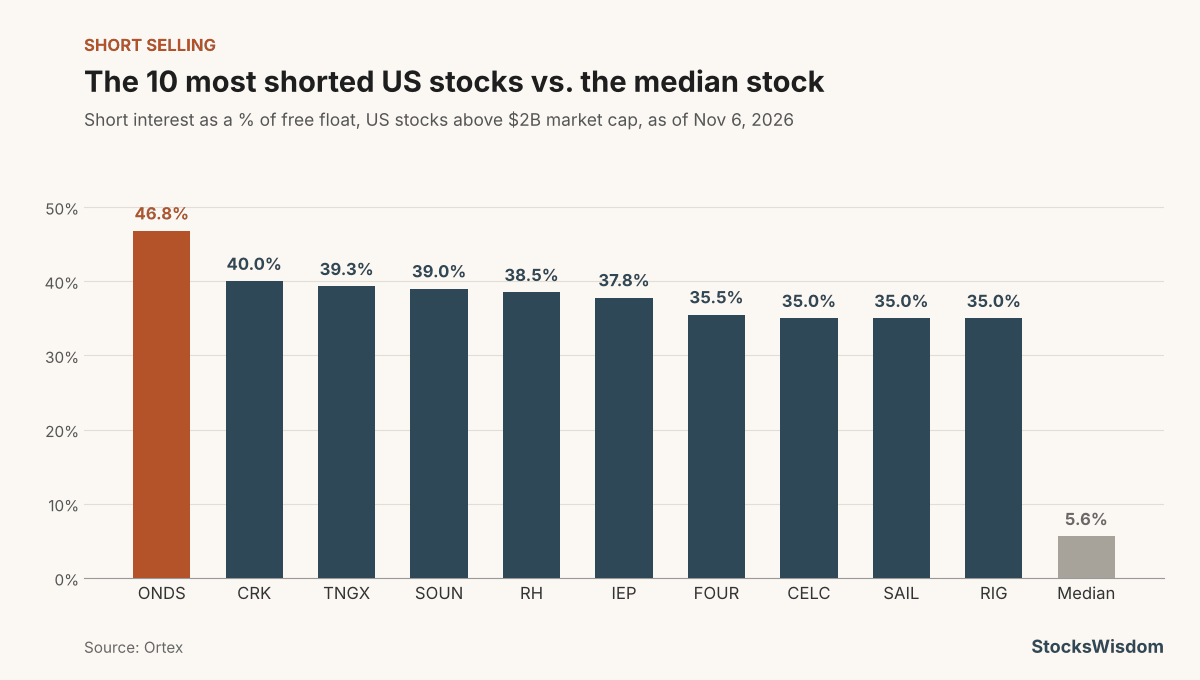
Almost half of Ondas Holdings’ tradable shares are currently sold short. According to Ortex, 46.8% of the drone maker’s free float was shorted as of November 6, making it the most shorted US stock worth more than $2 billion. Comstock Resources (40.0%), Tango Therapeutics (39.3%) and SoundHound AI (39.0%) came right behind it.
For comparison, the median US stock above $2 billion has just 5.6% of its float sold short.
So what are all those traders actually doing? They’re betting the price will fall. That’s short selling, and it’s one of the most misunderstood trades in the market. Here’s how it works, what it costs, and why a big short interest number can mean danger for the bears as much as for the stock.
When you buy a stock (go “long”), you profit if it rises. A short sale flips that order. You borrow shares, sell them right away at today’s price, and hope to buy them back later for less. Then you return the shares to the lender and keep the difference.
Here’s the SEC’s own plain definition from Investor.gov: a short sale “generally involves the sale of a stock you do not own (or that you will borrow for delivery).” Your broker usually lends you the shares, pulling them from its own inventory or from other clients’ margin accounts.
You need a margin account to do this, and your broker has to approve you. You also pay interest on the borrowed shares. If the company pays a dividend while you’re short, you owe that dividend to the lender, out of your own pocket.
Say a stock trades at $50 and you short 100 shares. You get $5,000 in your account, though you can’t walk away with it. That cash is collateral, and you still owe 100 shares.
| Scenario | Price when you buy back | Cost to close | Profit or loss |
|---|---|---|---|
| Stock falls | $40 | $4,000 | +$1,000 |
| Stock is flat | $50 | $5,000 | $0 (minus fees) |
| Stock rises | $75 | $7,500 | -$2,500 |
| Stock doubles | $100 | $10,000 | -$5,000 |
| Stock triples | $150 | $15,000 | -$10,000 |
The best you can ever do is +$5,000, and only if the company goes to zero. The losses have no ceiling.
That asymmetry is the whole story. The SEC warns that shorting “leaves an investor open to the possibility of unlimited losses,” while a regular buyer can lose at most what they put in.
Time works against short sellers. Every day the trade stays open, you pay a borrow fee, quoted as an annual rate. Easy-to-borrow stocks cost very little. Hard-to-borrow ones can get expensive fast.
Ortex lists Ondas’ cost to borrow at 3.62% a year. On a $5,000 short held for 30 days, that’s roughly $15. Not much. But on crowded meme names, borrow rates have been known to jump far higher, and at those levels the fee alone can eat a decent gain.
Then there’s margin. If the stock rises, your broker may ask you to add cash. Don’t, and it can buy back the shares for you at the worst possible moment.
Two numbers tell you how crowded a short trade is.
Short interest as a % of float is the share of tradable stock currently sold short. Above 10% is generally considered high. Above 20% is extreme. Ortex counted 422 US names above $2 billion with more than 10% short, and 82 above 20%.
Days to cover divides the shares sold short by average daily trading volume. It estimates how many days it would take every short seller to buy back if they all rushed for the exit at once.
| Stock | Ticker | Short % of float | Days to cover | Borrow cost |
|---|---|---|---|---|
| Ondas | ONDS | 46.8% | 5.2 | 3.62% |
| Comstock Resources | CRK | 40.0% | 9.4 | 0.48% |
| Tango Therapeutics | TNGX | 39.3% | 10.6 | 0.54% |
| SoundHound AI | SOUN | 39.0% | 10.5 | 1.60% |
| RH | RH | 38.5% | 6.2 | 0.52% |
| Icahn Enterprises | IEP | 37.8% | 10.6 | 1.16% |
Data as of November 6, 2026, via Ortex.
Official short interest comes from FINRA, which requires brokers to report positions twice a month: once around the 15th and once at month end. The data gets published seven business days later, so it’s always a little stale.
The ten most shorted large US stocks all sit at roughly six to eight times the median, which is hard to see in a table. The chart below shows how far above a typical stock each one sits.
A short squeeze happens when a heavily shorted stock rises and short sellers rush to buy shares back to limit losses. Their buying pushes the price higher, which forces more shorts to buy, and so on.
GameStop in January 2021 is the textbook case. An SEC staff report found that GME short interest reached 122.97% of float that month. That’s possible because borrowed shares can be lent again. The stock closed at $19.95 on January 12, hit $347.51 at the close on January 27, and touched an intraday high of $483 the next day.
But here’s a twist most people miss. The SEC staff concluded that buying by short sellers “was a small fraction of overall buy volume,” and that “it was the positive sentiment, not the buying-to-cover, that sustained the weeks-long price appreciation.” In other words, the squeeze lit the match. Ordinary buyers kept the fire going.
So high short interest is not a buy signal by itself. Lots of heavily shorted stocks are shorted for good reasons and keep falling.
Shorting is legal, and it helps markets by adding liquidity and pushing back against overhyped stocks. Some short sellers dig up real fraud. Still, it’s regulated.
Regulation SHO, in force since 2005, requires brokers to locate shares before shorting and targets “naked” short sales that fail to deliver. Using short sales to manipulate a price is illegal.
There’s also a circuit breaker. Under SEC Rule 201, once a stock drops 10% or more from the prior day’s close, short sales can’t execute at or below the current best bid for the rest of that day and the next. It’s designed to keep shorts from piling onto a stock that’s already in free fall.
Most people never need to short anything. Odds are against short sellers over long stretches because stocks tend to rise over time, and you’re paying fees while you wait. If you want to bet against a stock with a capped loss, buying a put option limits your risk to the premium you paid (our guide to implied moves in options covers how options price big swings).
Short data is still useful even if you never short. A huge short interest in a stock you own is a flag. It means a lot of professional money thinks something is wrong. If you want a quick read on whether the crowd is leaning bearish on a name, StocksWisdom shows a stock’s sentiment, technical signals and a 30-day forecast in one place.
And if you’re sitting on losers after this fall’s sell-off, the smarter move is often tax-loss harvesting, not trying to profit from the next leg down.
Yes. Since a stock’s price can keep rising, your losses on a short have no upper limit. A $5,000 short in a stock that triples costs you $10,000.
Yes, for retail and professional investors alike, with a margin account and broker approval. Manipulative shorting and abusive naked shorting are not.
No. It means the trade is crowded, which raises the odds of sharp rallies on good news. Many highly shorted stocks simply keep falling.
Have you ever shorted a stock, or do you just watch short interest as a warning sign? Tell us in the comments.
Not financial advice. Do your own research.