Physical Address
304 North Cardinal St.
Dorchester Center, MA 02124
Physical Address
304 North Cardinal St.
Dorchester Center, MA 02124

Anthropic picked a rough week to go public. The Nasdaq fell 2.5% on Monday to 24,509.76, and Nvidia slid another 4.1% the day before its first earnings report without Jensen Huang, according to The Motley Fool’s market wrap. Into that mess walks the biggest stock sale in history.
Anthropic, the company behind the Claude AI models, plans to price its IPO on Wednesday, November 18, with shares set to start trading Thursday on the Nasdaq under the ticker ANT. The range is $70 to $78 a share for 825 million Class A shares, per the company’s own roadshow announcement. At the top of that range, the public deal raises about $64.4 billion.
Add a separate $26 billion private sale to seven chip and cloud partners, and the total hits $90.4 billion. That beats the $75 billion SpaceX raised in June, as Investopedia reported via Yahoo Finance. So here’s what’s on the table, what it’s worth, and whether a regular investor can actually get shares.
Of the 825 million shares, 801.35 million are new stock sold by Anthropic. Another 23.65 million come from existing holders, and Anthropic gets none of that money. Underwriters also get a 30-day option to buy up to 123.75 million extra shares, which is standard for big deals. Goldman Sachs and Morgan Stanley are leading the offering.
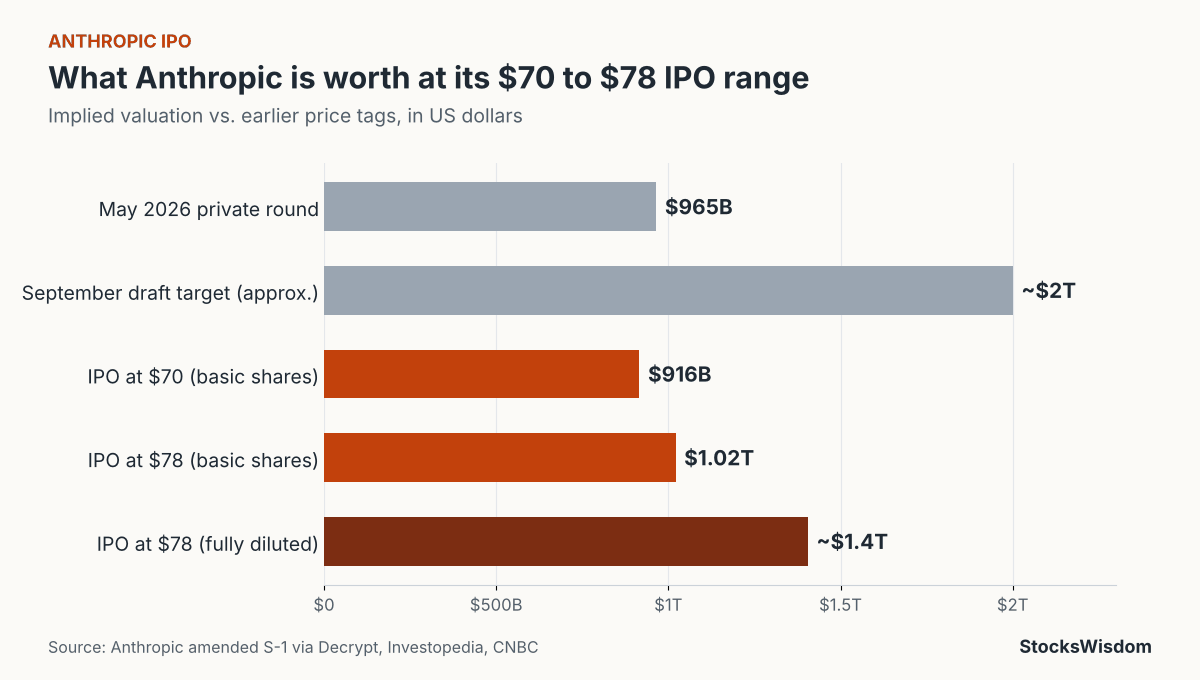
Here’s how the numbers shift across the range. Market value uses roughly 13.09 billion shares outstanding after the deal, the figure cited in Decrypt’s breakdown of the amended filing.
| IPO price | Public deal size | Market value (basic shares) |
|---|---|---|
| $70 (low end) | $57.8 billion | $916 billion |
| $74 (midpoint) | $61.1 billion | $969 billion |
| $78 (high end) | $64.4 billion | $1.02 trillion |
Count every diluted share, and the fully diluted value at $78 runs up to about $1.4 trillion. That’s the headline number you’ll see most often this week.
This part is unusual. Seven companies agreed to buy $26 billion of Class N stock at whatever the final IPO price turns out to be: AMD, Broadcom, Google, Micron, Microsoft, Nvidia and TSMC, per RTTNews.
At the midpoint, Google and Nvidia each take about $10 billion. AMD takes about $2.5 billion, Broadcom, Micron and Microsoft about $1 billion apiece, and TSMC about $500 million.
Two details matter. Class N shares carry no votes, and they aren’t covered by the usual post-IPO lockup. These are also the same companies Anthropic pays for chips and cloud capacity, so part of this money is suppliers investing in a giant customer. That’s not a scandal. It’s just worth knowing when you hear that demand is “strong.”
Revenue is the bull case in one line. Anthropic booked $17 billion in the third quarter alone and $33.2 billion in the first nine months of 2026, up from about $2.5 billion in the same stretch a year earlier.
Losses are a different story. Net loss for those nine months came to $104 billion. Before you panic, $94.3 billion of that is a non-cash charge tied to convertible notes and similar instruments rising in value as the company got pricier. Strip that out and the operating loss was about $1.26 billion, which is small next to the revenue.
Spending commitments are the number that should make you pause. Anthropic has signed up for roughly $900.9 billion in compute and infrastructure spending, with about $451.6 billion expected before the end of 2030. It held $95.6 billion in cash plus $36.3 billion in short-term investments at the end of September. The IPO cash helps, but this is a company that has to keep growing fast to pay for what it’s already ordered.
For more on the original filing, our earlier look at what Anthropic’s S-1 revealed walks through the first-half numbers.
Rough math: $17 billion a quarter annualizes to about $68 billion. At $1.02 trillion, ANT would trade near 15 times that run rate. Pricey, but not crazy for a company whose sales grew more than tenfold in a year.
Price tags have been sliding, though. Anthropic raised money at a $965 billion valuation in May. An earlier draft filing pointed to something closer to $2 trillion as of September. Then the AI sell-off hit, and some large investors told The Wall Street Journal that a $1.5 trillion price would likely have to come down. It did.
The chart below shows how this week’s IPO range stacks up against those earlier price tags.
Yes, more than usual. Up to 20% of the shares are earmarked for individual investors, well above the typical IPO. Requests can go through Charles Schwab, E*TRADE, Fidelity, Robinhood and SoFi.
Getting shares isn’t guaranteed, and you’ll likely get fewer than you ask for. Demand was reportedly about seven times the shares on offer, per a Bloomberg report cited by Investopedia. Each broker sets its own rules. SoFi’s IPO page, for example, says it has no minimum balance and weighs your account size, membership tier and past IPO behavior when it hands out shares.
Watch the fine print on flipping. SoFi restricts future IPO access for six months if you sell within 30 days of the first trade, 12 months for a second time, and permanently after a third. Other brokers have similar rules.
If you get an allocation, you pay the final IPO price set Wednesday night, not the opening trade Thursday. That can be a nice edge if the stock pops. It can also hurt. According to a Financial Times analysis, the 10 biggest US IPOs of 2026 have fallen about 20% on average from their offer prices.
If you miss the allocation, think hard before buying at the open. First-day prices on hot deals often run well above the offer, and you’d be paying that premium during a week when the Nasdaq is down about 5% over the past month and the 10-year Treasury yield sits at 5.15%.
You may also already own some Anthropic without trying. Google, Nvidia, Microsoft and AMD all hold stakes, and ANT could join major indexes down the road. If you own an S&P 500 or Nasdaq-100 fund, your exposure to AI is already big. Check that before adding more.
One more thing: voting control. A single Class F share, held by an entity owned by the seven co-founders, carries 50.1% of the vote on most matters, and a Long-Term Benefit Trust elects a board majority. As a Class A buyer, you’re along for the ride.
If you want a quick read on the AI stocks that trade alongside ANT, StocksWisdom shows each stock’s sentiment, technical signals and a 30-day forecast in one place. It helps to see whether the whole group is still under pressure before you jump in.
Pricing is expected Wednesday evening, November 18, with trading on the Nasdaq under ANT expected Thursday, November 19. Dates can slip if markets turn ugly.
The expected range is $70 to $78. The final price can land outside that range, and the first trade on Thursday could be far from either number.
No. It posted a $104 billion net loss for the first nine months of 2026, though most of that was a non-cash charge. The operating loss was about $1.26 billion on $33.2 billion of revenue.
Are you putting in a request for ANT shares, or waiting to see how it trades first?
Not financial advice. Do your own research.