Physical Address
304 North Cardinal St.
Dorchester Center, MA 02124
Physical Address
304 North Cardinal St.
Dorchester Center, MA 02124

The Fed’s favorite inflation gauge just moved the wrong way again. Prices measured by the PCE index rose 0.3% in October and 3.8% from a year earlier, the Bureau of Economic Analysis said Wednesday morning. Core PCE, which strips out food and energy, also climbed 0.3% for the month and hit 3.3% year over year, according to the BEA release.
Headline inflation landed right where economists expected. Core didn’t. Forecasters surveyed by Dow Jones were looking for 3.2%, and September’s first reading was 3.1%, per InvestmentNews. That extra tenth matters because core is the number Fed officials watch most closely.
Wall Street had a wild day with it. At its low, the Dow was down more than 1,100 points, then clawed all the way back to close up 0.33% at 50,182.95. The S&P 500 slipped 0.25% and the Nasdaq lost 0.62%, with Nvidia sliding 3.91%, according to The Motley Fool. So what does a 3.8% PCE print mean for your savings, your loans and your portfolio? Let’s walk through it.
Here are the headline numbers from the BEA, compared with what the agency first reported for September.
| Measure | October 2026 | September 2026 (first estimate) |
|---|---|---|
| PCE prices, month over month | 0.3% | 0.5% |
| PCE prices, year over year | 3.8% | 3.6% |
| Core PCE, month over month | 0.3% | 0.3% |
| Core PCE, year over year | 3.3% | 3.1% |
| Personal income | +0.7% | +0.3% |
| Consumer spending (dollars) | +0.3% | +0.6% |
| Real spending (after inflation) | 0.0% | +0.1% |
A 0.3% monthly gain doesn’t sound like much. But if prices kept rising at that pace for a full year, you’d get roughly 3.7% inflation, almost double the Fed’s 2% goal. Core has now printed 0.3% for three straight months.
You’ve probably heard more about the Consumer Price Index. CPI tracks what households pay out of pocket for a fixed basket of goods and services. PCE is broader. It also counts spending made on your behalf, like the share of health insurance your employer covers, and its weights shift when people swap one product for a cheaper one.
That’s why the Fed officially defines its 2% inflation target using PCE, not CPI.
This month PCE carries even more weight than usual. Natalia Lojevsky of CIFC Asset Management told InvestmentNews that “PCE carries extra weight this month,” because the October CPI report couldn’t publish an annual inflation rate. For many investors, Wednesday’s release was the first clean year-over-year read on October prices. If you want the backstory on the other October data, our breakdown of October PPI and wholesale inflation covers the pipeline pressure that showed up earlier this month.
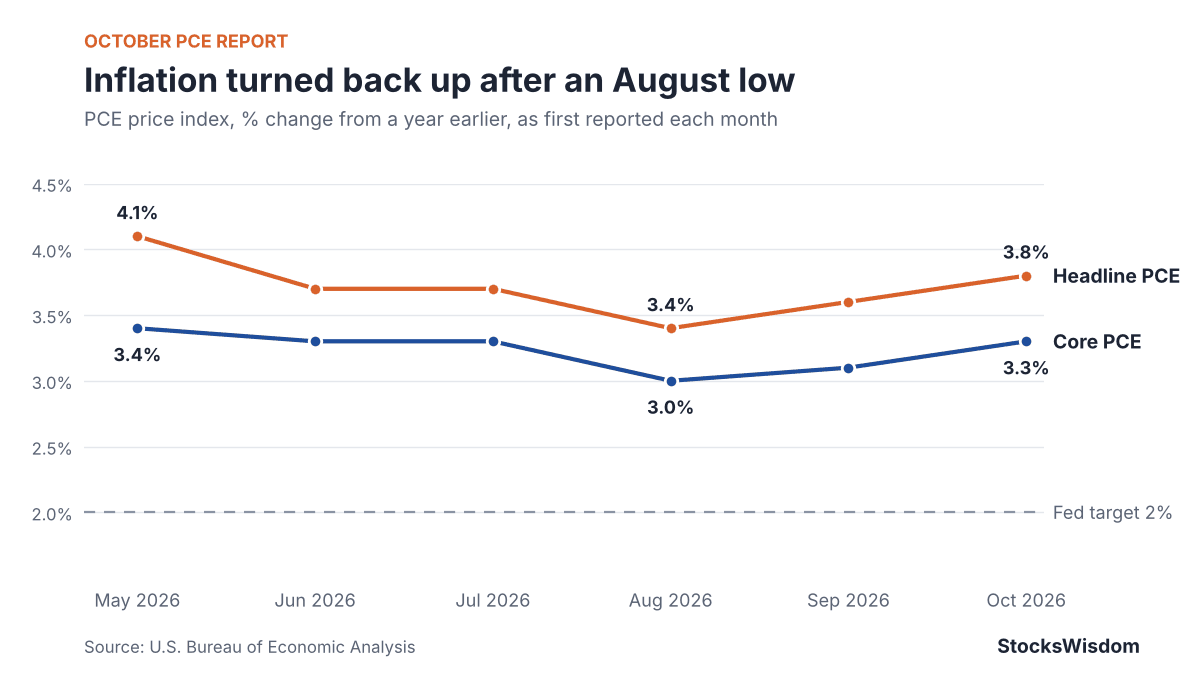
Here’s the frustrating part for anyone hoping prices were cooling. Headline PCE dipped to 3.4% in August, then reversed. It’s risen two months in a row since. Core followed the same path, bottoming at 3.0% before turning back up to 3.3%, which matches where it stood in June and July.
Bradford Smith, a portfolio manager at Janus Henderson Investors, put it plainly to InvestmentNews: “The problem is that core inflation remains on the uptrend.” The chart below shows how headline and core PCE inflation have moved since May, as first reported by the BEA each month, against the Fed’s 2% target.
On the income side, the report looked strong. Personal income rose $201.8 billion, or 0.7%, in October. Disposable income, what’s left after taxes, climbed 0.8%.
Spending told a different story. Consumers spent $63.8 billion more in October, a 0.3% gain, with services making up most of it. Once you adjust for inflation, though, real spending fell by $5.8 billion, basically flat. People paid more and got about the same amount of stuff.
Where did the extra income go? Into savings. Households pushed the personal saving rate to 4.1% of disposable income, up from the 3.8% first reported for September. That’s a sign some households are getting more cautious, even with paychecks growing.
Policymakers raised their benchmark rate by a quarter point in September, the first hike since July 2023, and then held at 3.75% to 4% in October. That October vote was 10 to 2, and both dissenters, Lisa Cook and Beth Hammack, wanted another hike right away. In its October statement, the committee said it wanted more data to “ensure a timely return of inflation to the Committee’s 2 percent goal.”
After this report, traders barely see any doubt. CME FedWatch put the odds of a December hike near 98%, InvestmentNews reported. The central bank’s last meeting of 2026 wraps up December 9.
Chris Zaccarelli, chief investment officer at Northlight Asset Management, told InvestmentNews that “Inflation data is still too high and is unlikely to convince the Fed to remain on hold.” Our preview of the October Fed meeting explains how a hike flows through to everyday rates.
A December hike would push the federal funds range to 4% to 4.25%. Here’s how that tends to ripple out.
Savers. Good news, mostly. High-yield savings accounts, money market funds and new CDs usually track the Fed’s moves within weeks. If your bank still pays under 1%, you’re leaving real money on the table while inflation runs near 4%.
Borrowers. Credit card APRs are tied to the prime rate, so they rise almost automatically after a hike. Variable-rate debt like HELOCs follows too. If you carry a card balance, paying it down beats almost any investment return right now.
Homebuyers. Mortgage rates track the 10-year Treasury yield more than the Fed’s rate. Wednesday’s move helped a bit: the 10-year eased to 4.91%, so a December hike that’s already expected may not lift mortgage rates much on its own.
Stock investors. Higher rates hit growth stocks hardest, because their value rests on profits far in the future. That’s partly why the Nasdaq and AI names like Nvidia lagged while the Dow recovered. If you own rate-sensitive tech, it helps to check how each holding is behaving before reacting to one scary morning. StocksWisdom shows a stock’s sentiment, technical signals and 30-day forecast in one place, which makes that check quicker.
Tariffs add another wrinkle. Washington proposed new tariffs on 14 trading partners early Wednesday, per InvestmentNews, and import taxes tend to show up in consumer prices with a lag.
It’s a measure of the prices Americans pay for goods and services, published monthly by the Bureau of Economic Analysis. Fed officials use it to define its 2% inflation target.
Core PCE leaves out food and energy, which swing a lot from month to month. Economists see core as a better guide to where inflation is heading.
Not automatically, but it raises the odds. With core at 3.3% and rising, markets now expect a quarter-point hike in December.
Is inflation changing how you save or invest heading into 2027? Tell us in the comments.
Not financial advice. Do your own research.