Physical Address
304 North Cardinal St.
Dorchester Center, MA 02124
Physical Address
304 North Cardinal St.
Dorchester Center, MA 02124

Nvidia just reported the biggest quarter in its history, and the stock fell anyway.
For the quarter ended October 25 (fiscal Q3 2027), revenue came in at $115.8 billion. That’s up 20% from the prior quarter and up 103% from a year ago, according to the company’s earnings release filed with the SEC. Adjusted earnings per share hit $2.68, and the company guided to $130 billion for the current quarter. Wall Street had expected about $108.7 billion in sales and $2.47 a share, per Kiplinger’s earnings coverage.
Shares jumped more than 4% after hours on Tuesday. By Wednesday’s close they were down 2.9% at $150.96, near the bottom of a $150.40 to $159.70 trading range. So what happened? And what should a regular investor make of a company that doubles its sales and still can’t catch a bid?
Start with the scoreboard. Every major line beat or matched what analysts wanted.
| Metric | Q3 FY2027 | Q3 FY2026 (year ago) | Change |
|---|---|---|---|
| Revenue | $115.8B | $57.0B | +103% |
| Data Center revenue | $107.6B | $51.2B | +110% |
| Edge Computing revenue | $8.2B | n/a | +42% |
| Adjusted EPS | $2.68 | $1.30 | +106% |
| Adjusted gross margin | 74.9% | 73.6% | +1.3 pts |
| Next-quarter revenue guide | $130B (±3%) | $65B (±2%) | +100% |
Data Center is the whole story here. It’s now 93% of sales, as the new Vera Rubin platform ramps. Edge Computing, the smaller segment Nvidia reports alongside it, grew 42% but is still a rounding error by comparison.
Nvidia also returned $28.1 billion to shareholders during the quarter through buybacks and dividends. After a $150 billion boost to its repurchase plan in September, it had about $227.3 billion left on the authorization at quarter end.
This was the first earnings call since Jensen Huang stepped down as CEO last week (we covered that shock in our post on Huang’s resignation). Colette Kress, the longtime CFO who is now also interim CEO, kept the message simple.
“Vera Rubin is off to an explosive start, our roadmap is on track and our ambition has never been greater.”
She also raised Nvidia’s growth target for next fiscal year to 75% from 70%. “We feel confident in the demand in front of us, as well as the supply, that we can do 75%,” Kress said on the call, per Kiplinger. That’s a big number off a much bigger base. Next fiscal year lines up closely with calendar 2027.
The growth curve still hasn’t flattened. Sequential growth has stayed near 20% for three straight quarters, which is unusual for a company that already booked $81.6 billion in its April quarter. The chart below shows Nvidia’s quarterly revenue over the past five quarters, plus the $130 billion guide for the quarter ending in January.
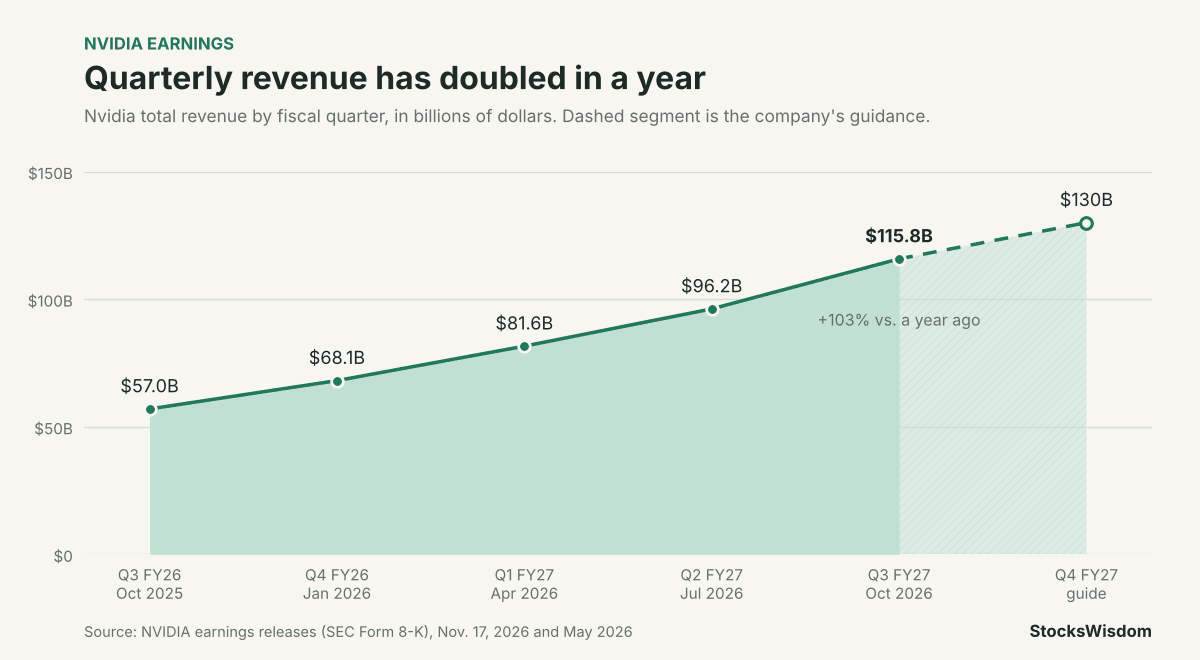
One footnote on that guide: the January quarter includes an extra week, so a slice of the jump is calendar math rather than pure demand. Even so, $130 billion would be a 91% gain over the $68.1 billion Nvidia booked in the same quarter last year.
Three reasons, and none of them show up in the income statement.
Leadership questions. Some investors want Huang back. On the call, Nvidia’s chairman and Kress rejected that idea, according to The Motley Fool’s market recap. Huang and Kress are also scheduled to sit for congressional interviews, and nobody knows how those go. Markets hate an open question at the top.
China. The outlook assumes zero data center compute revenue from China, and the stock is also dealing with new export restrictions and regulatory scrutiny. Guidance that excludes China is conservative, which is fine. It also means a growth driver has gone quiet.
Rates. Minutes from the Fed’s last meeting, released Wednesday afternoon, pointed to more rate hikes ahead. With the 10-year Treasury yield sitting near 5.1%, investors are less willing to pay up for future growth. If you missed the setup, our October CPI breakdown explains why a December hike is on the table.
There’s also positioning. Options traders had priced in a move of roughly 8% either way, the kind of setup we explained in our guide to the implied move. A beat this size was partly baked in.
Here’s the odd part. Nvidia’s stock is about 35% below its intraday high from October 6. Its 52-week range now runs from $148.80 to about $243, so Wednesday’s close sits a couple of dollars above the low.
Last week, before these results, the shares traded at about 12 times expected earnings for the next 12 months. That was the lowest multiple since November 2012, per LSEG data cited by Reuters via Wealth Professional. For context, the S&P 500 as a whole usually trades well above that.
Cheap stocks can get cheaper, of course. A low multiple is the market saying it doesn’t trust the earnings to last. Still, it’s a very different setup from the “priced for perfection” story of a year ago.
If you own an S&P 500 or Nasdaq 100 index fund, you own a lot of Nvidia. It’s the heaviest single weight in the S&P 500, so its swings move your 401(k) whether you picked the stock or not. On Wednesday the S&P 500 slipped 0.23% to 7,324, while the Nasdaq Composite gained 0.42% as AMD (up 5.3%) and Broadcom (up 3.7%) picked up the slack.
A few practical thoughts:
Before you act, it helps to look at more than the headline. StocksWisdom shows a stock’s sentiment, technical signals and 30-day forecast, which is useful when the news says one thing and the price says another.
Back in August, Nvidia posted $96.2 billion in revenue, which we broke down in our Q2 earnings explainer. Since then, quarterly sales are up almost $20 billion. Gross margin held near 75%, but the guide calls for 71% to 72% next quarter. That dip matters. A lower margin on a ramping product is normal, yet investors will want to see it bounce back by spring.
Yes. Revenue of $115.8 billion topped the roughly $108.7 billion consensus, and adjusted EPS of $2.68 beat the $2.47 estimate. The $130 billion guide was roughly in line with what analysts at UBS expected.
The results were strong, but investors focused on the CEO transition, China export limits and rising interest rates. Expectations were also high going in.
Nvidia will pay $0.25 per share on December 23, 2026, to shareholders of record on December 2, 2026.
Would you buy Nvidia at 12 times earnings with an interim CEO, or wait for the leadership question to settle? Tell us in the comments.
Not financial advice. Do your own research.